Cross Deputization for Pokagon Band of Potawatomi and County Officers

Link to South Bend Tribune article here.

Excerpt:

In the meantime, the deal will allow tribal police officers to enforce Indiana laws in St. Joseph County, including on the 1700 acres of Pokagon land near North Liberty and the 166 acres between Prairie Avenue, Locust Road and the St. Joseph Valley Parkway.

“With the Pokagon Band restoring the tribal village here in South Bend, we thought it was our duty to work with St. Joseph County to enhance public safety in this area,” said tribal Chairman John Warren.

Goshen, IN Schools Drop R-Name Nickname

Here are several news stories, some detailing the involvement of the Pokagon Band of Potawatomi Indians:

Redskins mascot no more in Goshen: School board votes 5-2 to drop name

THE END OF GOSHEN ‘REDSKINS’: So, where do we go from here?”

“Goshen Redskins mascot to be retired Jan. 1, 2016”

NAICJA Final Panel, Incorporating Peacemaking Into State Courts

Peacemaking Panel

Judge Michael Petoskey, Judge Tim Connors, Judge Lorintha Umtuch

Sharing information on the formation of and experiences with the Washtenaw County Peacemaking Court.

Indiana Alternative Medicaid Expansion Plan Rejected for Failure to Consult with Tribe

Here.


A federal agency has asked the Pence administration to resubmit its proposal for an alternative Medicaid expansion because Indiana’s initial application didn’t include input from a band of Potawatomi Indians.


The Centers for Medicare and Medicaid Services returned the state’s proposal last month, two weeks after the state submitted the plan. Federal officials wrote that they could not begin their formal review until Indiana consulted the tribe.

“Specifically, at time of submission, the state did not meet the requirements for tribal consultation with the Pokagon Band of Potawatomi Indians,” wrote Angela Garner, the acting director of the federal agency’s division of state demonstrations and waivers.

News Profile of Tribal Marriage Equality Initiatives

Here is “These Native-American Tribes Are Pioneering Marriage Equality:The Puyallup Tribe is the latest to join a growing list of Native-American tribes legalizing same-sex marriage, many in states that have banned it.”

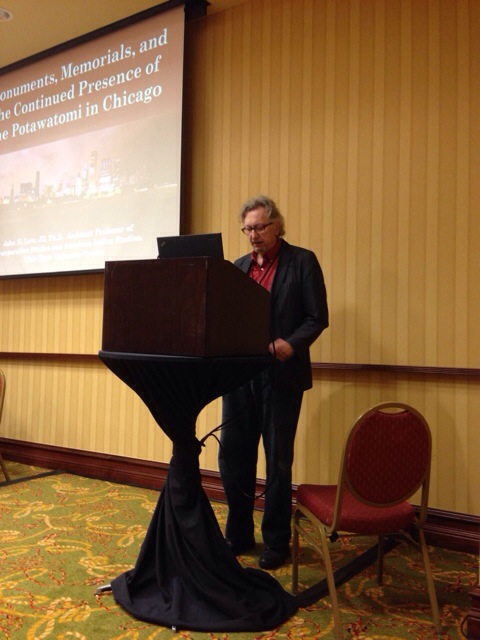
NAISA Panel on Simon Pokagon

John Low, a Pokagon Band member, opened it up

20140529-174950-64190419.jpg

MSU Press is here displaying Simon’s novel

20140529-175055-64255988.jpg

Congrats to 2014 Udall Interns

Here:

NAME TRIBE SCHOOL
Anthony C. Locklear II Lumbee Tribe of North Carolina University of North Carolina-Chapel Hill
Cade M. Cross Three Affiliated Tribes of the Fort Berthold Reservation Dartmouth College
Chelee A. John Navajo Nation Arizona State University
Chelsea Barnes Lumbee Tribe of North Carolina University of North Carolina-Chapel Hill
Dinee Dorame Navajo Nation Yale University
Glennas’ba B. Augborne Navajo Nation Arizona State University
Heidi J. Todacheene Navajo Nation University of New Mexico
Jacqueline A. Bisille Navajo Nation Arizona State University
Kristie L. Johnson Navajo Nation Saint Louis University
Sarah M. Ballew Pokagon Band of Potawatomi Indians University of Michigan-Ann Arbor
Twila R. Begay Navajo Nation University of Washington
Whitney B. Gravelle Bay Mills Indian Community Michigan State University

Pokagon Band Honors Notre Dame Law Dean Newton

Pokagons Honor Co-Editor of Cohen’s Handbook

DOWAGIAC, Mich. — March 10, 2014 — The Pokagon Band of Potawatomi honored Dean Nell Jessup Newton of the Notre Dame Law School at a dinner Thursday, March 6 for her work in editing Cohen’s Handbook of Federal Indian Law, a preeminent resource used throughout Indian Country. The dinner was held at the Morris Inn on the campus of Notre Dame.

In the photos:

Pokagon artist Dean Newton dinner

Jason S. Wesaw, a Pokagon artist, describes his work for Dean Newton. His pottery piece shown was commissioned to be gifted to the Dean for her important legal work with Native Americans. Wesaw also began the evening with an honor song for Dean Newton.

Pokagon group shot Dean Newton dinner

The group gathered after the dinner below a photo of the Notre Dame Golden Dome: left to right: Ed Williams (Pokagon Potawatomi), general counsel of the Pokagon Band, Stephen Rambeaux, court administrator of the Pokagon Tribal Court, Matt Martin (Pokagon Potawatomi), VP of security at Four Winds Casino Resort , Judy Winchester (Pokagon Potawatomi),Chairman John Warren of the Pokagon Band, Acting Treasurer Tom Topash of the Pokagon Band, Dean Newton, Michaelina Magnuson-Martin (Pokagon Potawatomi), Andrea Topash-Rios (Pokagon Potawatomi) associate professional specialist at Notre Dame, Paul Shagen (Bay Mills), associate general counsel of the Pokagon Band and adjunct law instructor at Notre Dame, Tim Sexton, associate VP of Public Affairs at Notre Dame, Jason S. Wesaw (Pokagon Potawatomi).

About The Pokagon Band of Potawatomi Indians

The Pokagon Band of Potawatomi Indians’ sovereignty was reaffirmed under legislation signed into law by President Clinton in September of 1994.  The Pokagon Band is dedicated to providing community development initiatives such as housing, education, family services, medical care and cultural preservation for its approximately 4,800 citizens.  The Pokagon Band’s ten county service area includes four counties in Southwestern Michigan and six in Northern Indiana.  Its main administrative offices are located in Dowagiac, Mich., with a satellite office in South Bend, Ind. More information is available at www.pokagonband-nsn.gov.

Media Contacts: Paige Risser, (269)462-4283, Paige.Risser@pokagonband-nsn.gov  # # #
News Coverage of DOJ Taskforce Hearing #2

Here. An excerpt:

Daniel Cauffman, 21, can speak candidly about the physical abuse he suffered at the hands of his stepmother when he was a child.

He knows his story of closed-fist punches coupled with other acts of physical violence speaks for hundreds – if not thousands – of children on Native American lands across the country.

“I hope it does help,” said Cauffman, a member of the Pokagon Band of Potawatomi, Mich.

He was one of several young people to give testimony Tuesday alongside regional experts at a public hearing for the advisory committee to the Attorney General’s Task Force on American Indian and Alaska Native Children Exposed to Violence.

“I’m glad they do stuff like this ’cause it does raise awareness,” Cauffman said. “As far as hopes goes, hopefully we can pull kids out of the situation.”

More detailed coverage here.

Fletcher Paper on “Tribal Justice Systems”

I drafted a paper titled “Tribal Justice Systems” for the Allegheny College Undergraduate Conference “Democracy Realized? The Legacies of the Civil Rights Movement” and posted it on SSRN. You can download here.

Here is the abstract:

This short paper is produced for the Allegheny College conference Democracy Realized? The Legacies of the Civil Rights Movement (March 28-29, 2014).

United States Supreme Court Justice Hugo Black, a former member of the Ku Klux Klan, authored the Court’s opinion in Williams v. Lee, a decision hailed as the opening salvo in the modern era of federal Indian law. The Williams decision was the work of the liberal wing of the Court, with important input by Chief Justice Warren and Justices Brennan and Douglas. Williams, a ringing endorsement of inherent tribal governance authority, more specifically endorsed tribal justices systems as embodied in tribal courts. Without Williams and similar cases, it is unlikely that tribal governments and Congress would act to develop tribal justice systems. Williams, and the tribal courts that arose as a result, was a powerful civil rights decision that commentators rightfully have linked to Brown v. Board of Education.

This paper will survey several tribal justice systems in an effort to identify commonalities and complexities. There are hundreds of tribal justice systems in the United States; each of them unique in the details, but many of them similar to other tribal, state, and federal courts.

The paper is divided into three sections. The first two parts include a section on adversarial tribal justice systems and a section on non-adversarial tribal justice systems, often called restorative justice systems. The third part involves greater discussion of the complexities of incorporating tribal customary and traditional law into tribal common law.

In case one wonders, “Representing Justice” by Judith Resnik and Dennis Curtis influenced the paper.