Whether Eleventh Amendment sovereign immunity and tribal sovereign immunity deprived the lower courts of subject-matter jurisdiction over the Snoqualmie Indian Tribe’s claim, requiring dismissal on that ground under United States Supreme Court precedent including Steel Co. v. Citizens for a Better Environment, 523 U.S. 83 (1996).
Whether, under United States Supreme Court precedent including Ruhrgas AG v. Marathon Oil Co., 526 U.S. 574 (1999) and Sinochem Int’l Co. v. Malaysia Intern. Shipping Corp., 549 U.S. 422 (2007), an issue preclusion dismissal is a merits dismissal and excluded from the threshold grounds among which a federal court may choose to dismiss a case before establishing its subject-matter jurisdiction.
Whether, under United States Supreme Court precedent including Sinochem Int’l Co. v. Malaysia Intern. Shipping Corp., 549 U.S. 422 (2007), jurisdictional issues in this case were not “arduous” or “difficult to determine” because the lower courts could readily determine that they lacked jurisdiction, such that those courts committed reversible error in bypassing determination of their subject-matter jurisdiction and proceeding to dismiss the case instead with prejudice on issue preclusion grounds.
Whether the Trial Court and the Court of Appeals committed prejudicial error in barring/blocking a Native American tribe from pursuing in rem / quiet title remedies on lands promised and granted to them by the USA from that tribe, but stolen by another tribe based on lack of subject matter jurisdiction due to the non-justiciable political question doctrine.
Whether or not, the Court committed prejudicial error by blocking a native American tribe from pursuing an in rem/quiet title/stolen tribal lands case, on the basis of USA sovereign immunity tribal sovereign immunity.
Whether the waiver by the United States of America of its sovereign immunity over quiet title claims impermissibly discriminates in violation of the Equal Protection Clause of the 14th Amendment against Native American tribes having quiet title claims that are barred by the Native American lands express exceptions set forth in 28 USC section 2409a.
Whether the Trial Court and the Court of Appeals committed prejudicial air in barring/blocking the Indian tribes pursuit of Land title claims constitutes an impermissible denial of the right to access to courts as guaranteed by the First Amendment right to petition the court government for redress of grievances.
As I noted earlier in our announcement of his imminent retirement, Justice Breyer was no tribal sovereignty warrior ala Sotomayor, but he was no Indian fighter, either. He was part of the Rehnquist Court Nine that stayed together more than a decade. And, as such, he was also a part of a Rehnquist Court that showed nothing but contempt for tribal interests in the 1990s and 2000s. Justice Breyer’s voting patters are striking for one reason only — he rarely dissented from the Court’s majority in the Indian law docket. He seems to have gone with the flow.
Let’s start with the overall period of time starting with Oklahoma Tax Commission v. Chickasaw Nation in 1995 up ’til now. Justice Breyer voted with tribal interests in 19 out of 48 cases I counted (I excluded a few, like South Florida v. Miccosukee, because it wasn’t an Indian law case; Amoco v. Southern Ute, because Breyer recused; Yellen v. Chehalis, because both sides had tribal interests), or 39.6 percent. Tribes won 19 out of those 48 cases (see what I mean about going with the flow?). Breyer was in the majority in 43 out 48 cases, an 89.6 percent clip. Justice Breyer authored five majority (or plurality) opinions, four of them supporting tribal interests. He wrote a pair of short concurrences in cases tribes lost.
Since 2014, when the Court decided Bay Mills Indian Community v. Michigan, Breyer’s voting pattern changed dramatically to favor tribal interests, again, in tune with the direction of the overall Court. Starting with Bay Mills, Breyer voted for tribal interests 9 out of 11 times. The Court, during that same period, was exactly the same for cases with votes (tribes won two cases 4-4 and we don’t know those votes, but it would be fair to say Breyer was very likely to have favored tribes in those cases, and, again, Yellen, which we don’t count).
In Breyer’s early years, he rarely wrote for the Court. His first Indian law majority opinion (or any opinion, for that matter) was Chickasaw v. US, a loss for tribes, and which came 7 years after he joined the Court (which pushes back on the notion that junior justices get assigned the “chickenshit” Indian law cases).
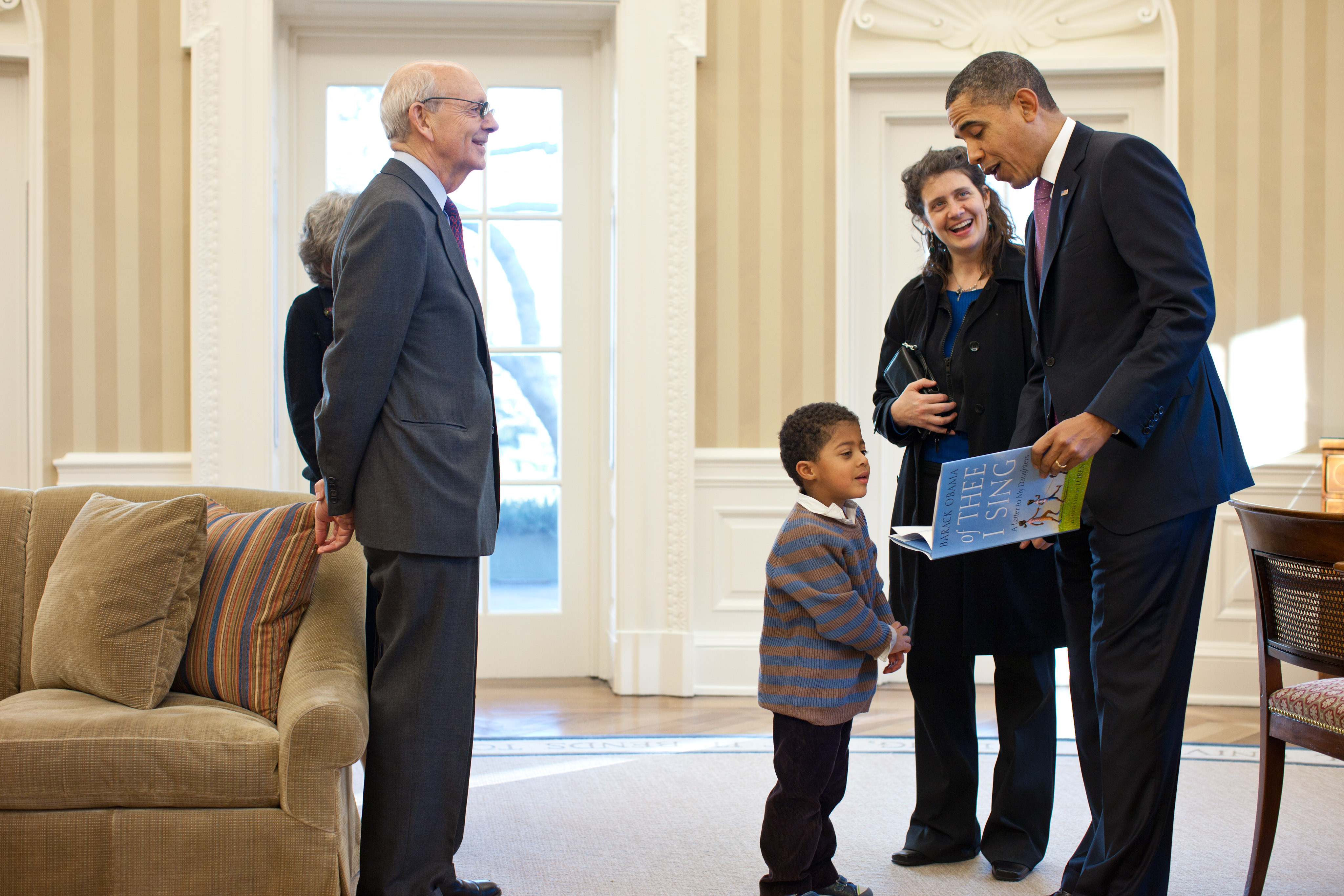
President Barack Obama reads from his book, “Of Thee I Sing: A Letter to My Daughters,” during a visit by Supreme Court Justice Stephen Breyer and his family to the Oval Office, March 2, 2011. Joining them, from left, are Justice Breyer’s wife Joanna Breyer, grandson Eli Essiam Breyer and daughter Nell Breyer. (Official White House Photo by Pete Souza)
In the good stuff, Breyer wrote the majority opinion in United States v. Lara, certainly a critically important case supporting the notion that Congress can exercise its plenary Indian affairs power to reaffirm tribal inherent sovereignty as in VAWA 2013. Breyer also wrote majority opinions in Cherokee v. Leavitt, the first ISDEAA contract support costs case, and United States v. Cooley, the first SCOTUS decision affirming tribal inherent powers over nonmembers under the Montana rubric. Breyer also wrote for a three-justice plurality in Washington v. Cougar Den.
Justice Breyer also wrote a critically important concurring opinion in Carcieri v. Salazarthat articulated the bones of a conceptual framework later fleshed out by Interior allowing Indian tribes not federally acknowledged in 1934 to show that they might still have been under federal jurisdiction then, and therefore eligible to benefit from the fee-to-trust process. He cited the example of the Grand Traverse Band, which has paid dividends to the tribe.
In the bad stuff — and I do mean BAD — Breyer voted with the 5-4 majority in Adoptive Couple v. Baby Girl, swapping places with Justice Scalia, who dissented in favor of a Cherokee birth father. Breyer’s concurrence tries at least to limit the scope of the majority’s incredibly vicious attack on the Cherokee father, but offers absolutely no reason for the vote. Brackeen and all the attacks on ICWA are happening right now because of that vote. Period.
There are a bunch more denials of Oklahoma’s brilliant papering strategy (we’ll post materials later, cuz we have lives and Tribal Law won’t teach itself . . . or will it?):
Oh and because we can’t have nice things, the Court granted the Harvard affirmative action case, too.



 Turtle Talk
You must be logged in to post a comment.