Job Posting at VA Office of Tribal Relations

Here.

This position is located in the Central Office of the  Department of Veterans Affairs in Washington, DC.  The incumbent is the primary staff support resource for the Office of Tribal Government Relations.

Duties included:

-Performs as an advisor within the Office of Tribal Government Relations (OTGR) and is responsible for prioritizing and coordinating issues relating to the Department’s daily relationship with tribal government leaders and representatives.

-Serves as the subject matter expert and secondary liaison with other federal Department and Agency support staff in tribal consultation.

-Researches and keeps abreast of issues and initiatives that may relate to OTGR activities.

-Plan and evaluate topics requiring higher level programmatic attention, developing background information on tribal veteran issues, drafting of office position papers, executive summaries, Congressional correspondence and associated communication documents for higher level review.

-Actively participates in staff and/or management level meetings and discussions pertaining to the activities encompassed in the management functions of OTGR.

-Follows ups on newly implemented or adapted policies and procedures as directed.

-Serves as the action officer for short and long-range efforts and program functions within OTGR.

-Advises management on tribal consultation strategies, sources, and special programs that emphasize affirmative action in conveying program initiatives.

-Assist with a variety of one time and recurring projects, reports, and studies relating to the evaluation of a wide variety of personnel management subjects.
Unpublished California ICWA Opinion Reversing for Non-Compliance

A long and sad opinion here, but a few things of note:

-as usual, Jay Treaty arguments are brushed aside.

-the State’s assumption that a claim of tribal membership is vague doesn’t mean ICWA might apply. And families might involve many tribes, from geographically diverse areas.

-there is or was a dedicated ICWA court or docket in Los Angeles County.

-the foster parents were not interested in helping with reunification in the slightest.

ACLU Blog Post on Oglala Sioux Tribe v. Van Hunnik

Here.

Previous coverage here.

Training Annoucement from NICWA

Join us for our upcoming training institutes. These interactive and energetic courses are taught by dynamic trainers who are experts in the field of Indian child welfare. Led by those with an extensive experience working with tribal communities, participants will also enjoy the opportunity to network with other attendees from tribal, state, and national agencies located throughout the country. For more information visit www.nicwa.org/training/institutes/. Contact Lauren Shapiro at lauren@nicwa.org with any questions. Choose from one of the following trainings:

Virtual Classroom: Enhancing Basic Skills for Tribal Child Welfare Workers
Tuesdays, July 15–August 12, 2014, 9:00 a.m.–10:30 a.m. PDT
Wednesdays, October 1–29, 2014, 9:00 a.m.–10:30 a.m. PDT

September 8–10, 2014: Portland, Oregon
Positive Indian Parenting
ICWA Basics and Advanced ICWA

December 1–3, 2014: San Diego, California
Positive Indian Parenting
ICWA Basics and Advanced ICWA

April 23–24, 2015: Portland, Oregon
Positive Indian Parenting
ICWA Basics

Positive Indian Parenting
Positive Indian Parenting prepares tribal and non-tribal child welfare personnel to train American Indian and Alaska Native parents using a culturally specific approach. This two- or three-day train-the-trainer class will draw on the strengths of historic Indian child-rearing patterns and blend traditional values with modern skills.

ICWA Basics & Advanced
ICWA Basics is a two-day training that provides participants with information about the basic legal requirements of the Indian Child Welfare Act of 1978 (ICWA) and the practice issues involved with its implementation. Stay for Advanced ICWA which will provide participants with advanced strategies for implementing ICWA.

Enhancing Basic Skills for Tribal Child Welfare Workers
NICWA is bringing our training institutes to the virtual classroom! New to tribal child welfare? Want to brush up on your tribal child welfare skills? This five-part webinar series is geared toward tribal child welfare workers who want to improve their basic skills.

Two Motions for Partial Summary Judgment in Oglala Sioux Tribe v. Van Hunnik

Brief in Support of First Motion (July 2014)

Statement of Undisputed Facts (First Motion)

As a result of the fact that (a) Defendants allowed no testimony at 48-hour hearings, (b) Defendants allowed no cross-examination at 48-hour hearings, (c) often the only questions asked of the parents in a 48-hour hearing were for purposes of identification and to see if they understood their rights, and (d) Defendants never conducted the inquiries required by 25 U.S.C. § 1922, Defendants’ 48-hour hearings were completed rather quickly. Judging from the length of the transcripts that were produced, the average length of time it took to complete a 48-hour hearing, Plaintiffs estimate, was under four minutes. A number of these hearings appear to have been completed in about sixty seconds.

The brief goes on to describe the many, many individual hearings where children were kept in DSS care for 45 or 60 days with absolutely to no evidence or testimony as to why.

Due Process Motion (Second PSJ)

Due Process Undisputed Facts

Canadian Supreme Court Rules Against Grassy Narrows First Nation

Decision here.

The central question on this appeal is whether Ontario has the power to take up lands in the Keewatin area under Treaty 3 so as to limit the harvesting rights under the treaty, or whether this is subject to Canada’s approval.

                    Ontario and only Ontario has the power to take up lands under Treaty 3. This is confirmed by constitutional provisions, the interpretation of the treaty, and legislation dealing with Treaty 3 lands.

                    First, although Treaty 3 was negotiated by the federal government, it is an agreement between the Ojibway and the Crown. Both levels of government are responsible for fulfilling the treaty promises when acting within the division of powers under the Constitution. Sections 109 , 92(5)  and 92A  of the Constitution Act, 1867  establish conclusively that Ontario holds the beneficial interest in the Keewatin lands and has exclusive power to manage and sell those lands as well as to make laws in relation to the resources on or under those lands. Together, these provisions give Ontario the power to take up lands in the Keewatin area under Treaty 3 for provincially regulated purposes such as forestry. Further; s. 91(24) of that same Act does not give Canada the authority to take up provincial land for exclusively provincial purposes.

                    Second, nothing in the text or history of the negotiation of Treaty 3 suggests that a two‑step process requiring federal supervision or approval was intended. The text of the taking‑up clause supports the view that the right to take up land rests with the level of government that has jurisdiction under the Constitution. The reference in the treaty to Canada merely reflects the fact that the lands at the time were in Canada, not Ontario.

                    Lastly, legislation subsequent to the signature of the treaty and which dealt with Treaty 3 lands confirmed Ontario’s right to take up that land by virtue of its control and beneficial ownership of the territory. It did not amend the terms of Treaty 3.

Short Video on the Recent Tar Sands Healing Walk

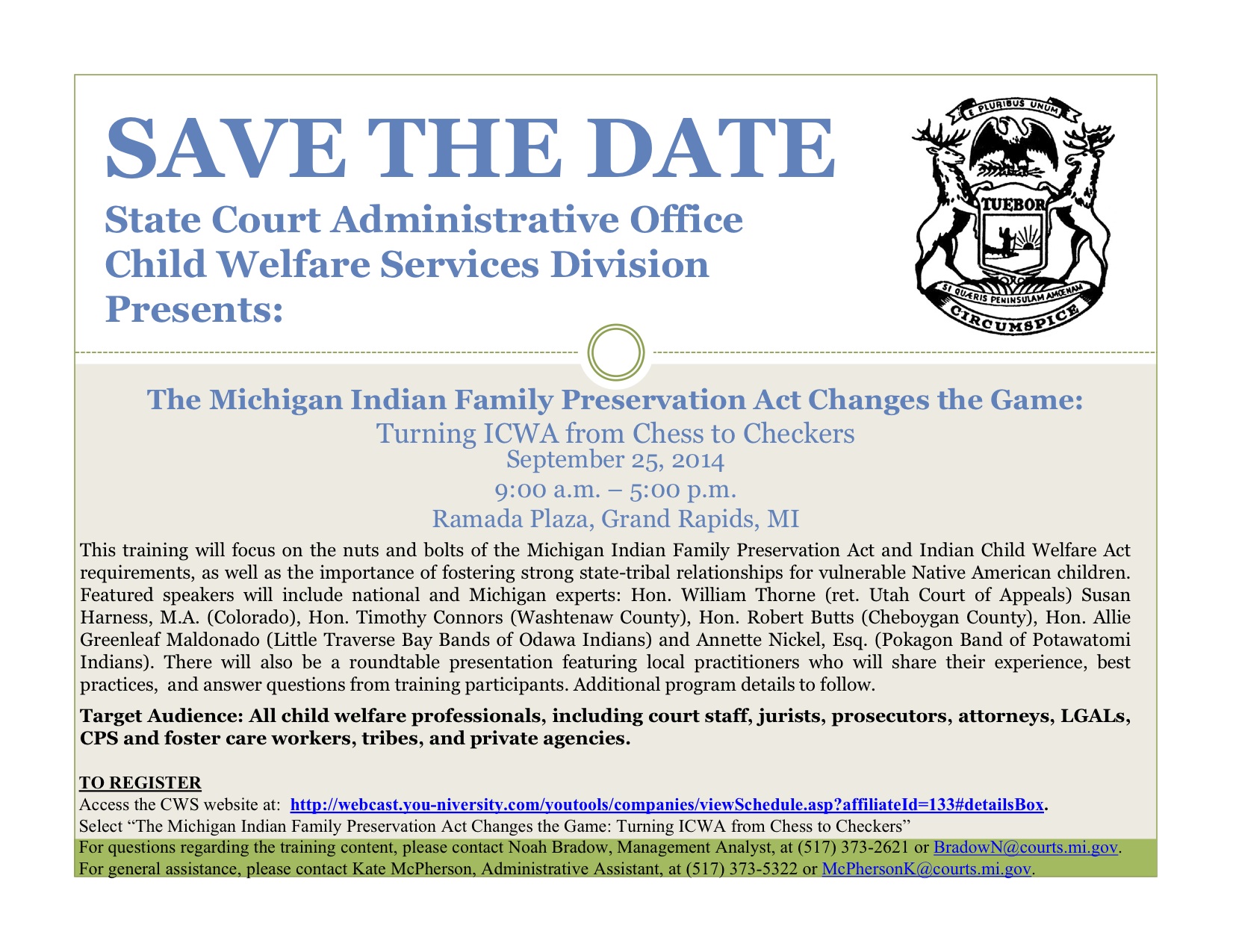
State Court Training on the Michigan Indian Family Preservation Act

092514_Save_the_Date_Final

Canadian Supreme Court Issues Decision in Tsilhqot’in First Nation Land Claim

Decision here

Held: The appeal should be allowed and a declaration of Aboriginal title over the area requested should be granted. A declaration that British Columbia breached its duty to consult owed to the Tsilhqot’in Nation should also be granted.

***

In finding that Aboriginal title had been established in this case, the trial judge identified the correct legal test and applied it appropriately to the evidence. While the population was small, he found evidence that the parts of the land to which he found title were regularly used by the Tsilhqot’in, which supports the conclusion of sufficient occupation. The geographic proximity between sites for which evidence of recent occupation was tendered and those for which direct evidence of historic occupation existed also supports an inference of continuous occupation. And from the evidence that prior to the assertion of sovereignty the Tsilhqot’in repelled other people from their land and demanded permission from outsiders who wished to pass over it, he concluded that the Tsilhqot’in treated the land as exclusively theirs. The Province’s criticisms of the trial judge’s findings on the facts are primarily rooted in the erroneous thesis that only specific, intensively occupied areas can support Aboriginal title. Moreover, it was the trial judge’s task to sort out conflicting evidence and make findings of fact. The presence of conflicting evidence does not demonstrate palpable and overriding error. The Province has not established that the conclusions of the trial judge are unsupported by the evidence or otherwise in error. Nor has it established his conclusions were arbitrary or insufficiently precise. Absent demonstrated error, his findings should not be disturbed.

APTN story here.

CBC here.

Michigan Supreme Court Issues Order to Create Tribal-State Forum

Order here.

The Michigan Tribal State Federal Judicial Forum is established. The membership of the forum shall consist of: the chief tribal judge of each of Michigan’s 12 federally recognized tribes, or their designated alternate judges, with membership to be expanded to accommodate any new federally recognized tribes; and 12 state court judges (or the same number as there are tribal judges), who will be appointed by the Michigan Supreme Court from among a pool of currently serving or retired Michigan judges or justices. In making appointments, the Court will consider geographic proximity to the tribes, Indian Child Welfare Act and MIFPA case load dockets, and current involvement with tribal court relations. The forum shall then pursue participation from federal judges and officials.

State bar post here.