New Book by Rebecca Webster: “In Defense of Sovereignty”

You can buy it here.

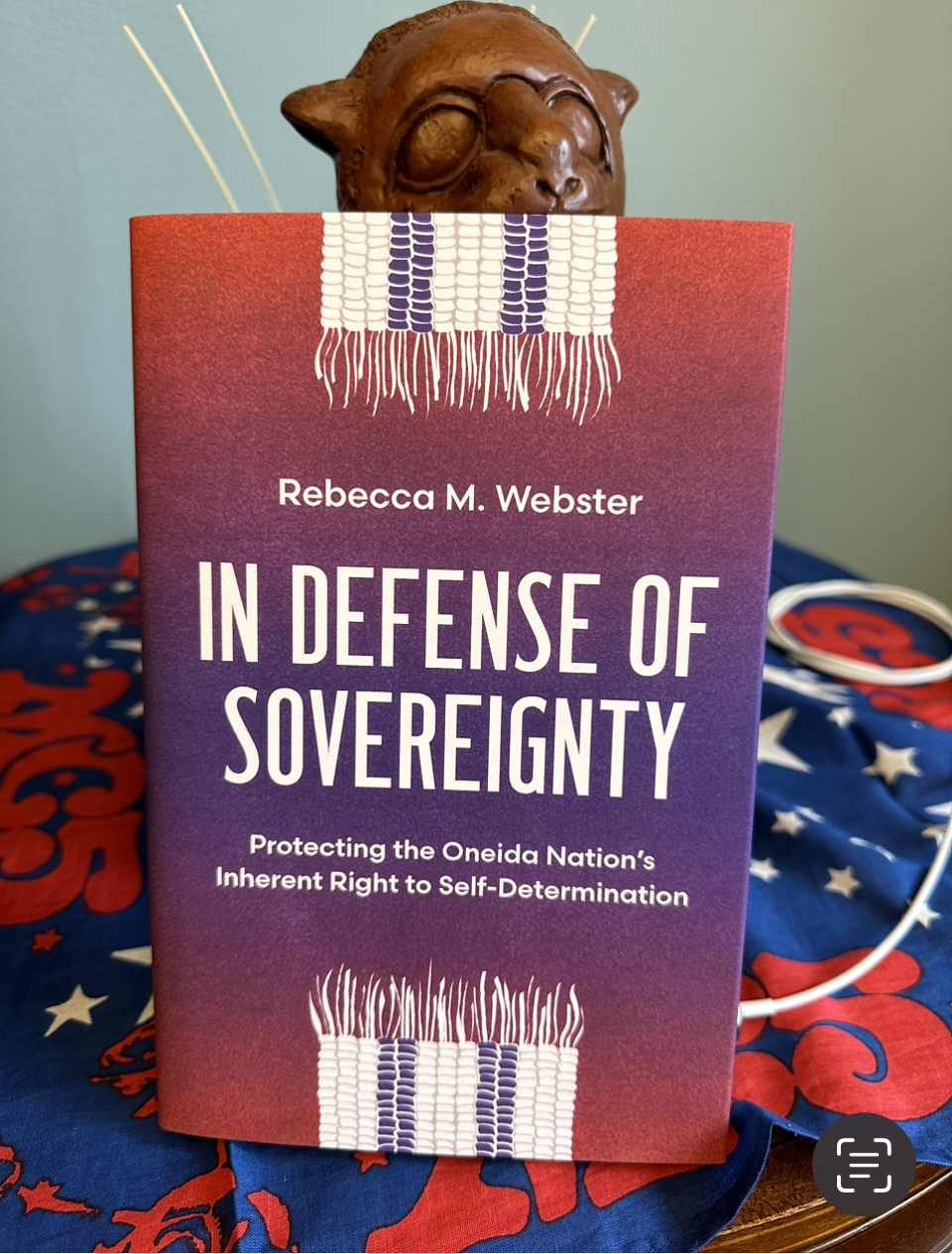
In Defense of Sovereignty
Protecting the Oneida Nation’s Inherent Right to Self-Determination
Rebecca M. Webster
Foreword by Richard Monette
With contributions by James R. Bittorf, William Gollnick, Frederick E. Hoxie, Arlinda F. Locklear, and James W. Oberly
“This valuable book lays out the features of a legal and political strategy to defend a reservation boundaries case. This material is thrilling where tribal citizens detail their ongoing, real-world struggles with the Village of Hobart. Successful and compelling.”
—Matthew L. M. Fletcher, author of Ghost Road: Anishinaabe Responses to Indian-Hating

A nuanced history by an Oneida Nation citizen directly involved in the litigation

The Oneida Nation has been engaged in legal conflicts to retain its sovereignty and its lands since forced removals in the 1820s from New York to what would become the state of Wisconsin. Legal scholar Rebecca M. Webster examines this history, including the nation’s treaties with the US and focusing especially on its relationship with the village of Hobart, Wisconsin. Since 2003, six disputes have led to litigation—the result of attempts by the local government to regulate the nation, repudiate its sovereignty, and relegate its government to the position of a common landowner, subject to municipal authority.

In Defense of Sovereignty shares the perspective of a nation citizen directly involved in the litigation, augmented by contributions from historians, attorneys, and a retired nation employee. It is an intimate and unflinching account of the impact of these jurisdictional battles and what is at stake for the future. Its lucid analysis is an invaluable contribution to public debates about the inherent right of Indigenous nations to continue to exist and exercise self-governance within their territories without being challenged at every turn.

 Rebecca Webster. Photo credit, Stephanie Stevens.Rebecca M. Webster, an assistant professor in the American Indian studies department at the University of Minnesota, Duluth, is a former senior staff attorney for the Oneida Nation.

New Student Scholarship on Tribal Courts and Environmental Tort Litigation

Helia Bidad has published “The Power of Tribal Courts in Ongoing Environmental-Tort Litigation” in the Yale Law Journal. Here is the abstract:

Cities, counties, and states across the country are bringing environmental and climate tort suits to hold environmental tortfeasors accountable. These cases are commonly brought in state and federal court, but the possibility of bringing these suits in tribal courts has largely been left out of the discussion. In the wake of attacks on tribal sovereignty in the form of tribal jurisdiction stripping, this Essay uses an original empirical analysis of 308 cases to understand the circumstances in which tribal-court jurisdiction currently exists for tribal members to sue nonmembers for environmental torts in tribal court. This Essay makes recommendations for how to strategically bring these suits and highlights important considerations for tribal sovereignty.

Florida State Bar Authorizes Practices of Lawyer Admitted in St. Croix Tribal Court

Nicholas Stamates, a recent UMich law grad, suggested I post the letter he filed with the Florida State Bar. The letter led to the bar authorizing him to practice as “house counsel” in Florida on the basis of his admission to practice in the St. Croix Chippewa courts. Interesting development. Here is the letter:

Tenth Circuit Briefs in United States v. Murphy [yes, that Murphy]

Here:

Mr. Murphy prevailed against Oklahoma in the Supreme Court following the McGirt decision, but was immediately prosecuted and convicted by the United States. He is now challenging the federal government’s delay.

Nevada Tribes Sue Interior over Lithium Mine Approvals

Here is the complaint in Reno-Sparks Indian Colony v. Haaland (N. Nev.):

2023 Maine Law School Indian Law Conference

KEYNOTE: MICHAEL-COREY HINTON, LEADER OF THE TRIBAL NATIONS PRACTICE GROUP AT DRUMMOND WOODSUM AND CITIZEN OF THE PASSAMAQUODDY TRIBE (SIPAYIK).

This is a significant moment in history for the Wabanaki People, the United States, and the State of Maine.  The Maine State Legislature recently revisited the Implementing Act to the Maine Indian Claims Settlement of 1980—the state law which purported to resolve land disputes between the Tribes and the State dating back to Maine’s pre-history.  There is growing public interest in—and momentum to recognize—tribal sovereignty.

Attorneys, students, and tribal leaders will gather in Portland on March 3, 2023, to highlight these current events in light of the fact that the history of tribal law in Maine has been one of isolation and restraint. The Symposium is presented by the Maine Law Review in partnership with Norman, Hanson & DeTroy, LLC, and the Maine State Bar Association.

Symposium participants will welcome five expert authors to discuss the importance of Federal Indian Law as it applies to the four federally recognized tribes located in Maine. A keynote address will be presented by Michael-Corey Hinton, Leader of the Tribal Nations Practice Group at Drummond Woodsum and citizen of the Passamaquoddy Tribe (Sipayik).

We invite you to share this registration form with those in your network who may be interested in attending the Symposium.

The Symposium will feature the following speakers:

Professor Nicole Friederichs, Practitioner in Residence at Suffolk University Law School

Professor Matthew Fletcher, Harry Burns Hutchins Collegiate Professor of Law at the University of Michigan Law School and Chief Justice of the Pokagon Band of Potawatomi Indians and the Poarch Band of Creek Indians

Hon. Donna Loring, elder and former council member of the Penobscot Indian Nation

Hon. Eric M. Mehnert, Chief Justice of the Penobscot Tribal Court and partner for Hawkes & Mehnert, LLP.

Joseph E. Gousse, Esq., attorney at Berman & Simmons

Friday, March 3, 2023

9:00 AM to 1:30 PM

300 Fore Street

REGISTER NOW

Massachusetts Appellate Court Holds Mashpee Wampanoag Tribe Immune from Suit

Here are the materials in Haney v. Mashpee Wampanoag Tribal Council (Mass. Ct. App.):

Tamera Begay: A Day in the Life of a Tribal Prosecutor [Federal Lawyer]

Tamera Begay has published “A Day in the Life of a Tribal Prosecutor” in the January/February issue of the Federal Lawyer [starts on page 14].

HIGHLY RECOMMENDED.

Gabe Galanda on Indigenous Kinship Renewal and Relational Sovereignty

Gabriel Galanda has posted “In the Spirit of Vine Deloria, Jr.: Indigenous Kinship Renewal and Relational Sovereignty” on SSRN. Here is the abstract:

This essay heeds Vine Deloria, Jr.’s inspiring call for the renewal of Indigenous kinship tradition and counsels for the development of relational sovereignty. The first part deconstructs the U.S. Supreme Court’s 1978 landmark decision in Santa Clara Pueblo v. Martinez to expose its distinctly economic underpinnings. That case exemplifies a steady erosion of Indigenous reciprocity, and concurrent rise of tribal per-capitalism and neocolonialism. The second part suggests five actions that Native nations could take to restore inclusionary, duty-based kinship systems and rules. First, Native nations should replace blood quantum with alternative citizenship criteria rooted in traditional kinship principles. Second, Native nations should renew kinship terminology to eliminate neocolonial identifiers. Third, Native nations should outlaw disenrollment and bring their relatives home. Fourth, Native nations should lift enrollment moratoria and welcome their lost generations. Lastly, Native nations should—after pausing to understand the colonial legacy of federally sanctioned monetary distributions to tribal individuals—cease per capita payments and reinvest in community revitalization. By drawing on Indigenous traditions of reciprocity and shared destiny, Native nations should reconcile their peoples’ modern individual rights with their customary obligations and duties to one another. Through these strategies, Native nations can engage in a new paradigm of relational sovereignty, whereby Indigenous human existence is exalted and protected over individual power and profit.