

Author: Matthew L.M. Fletcher
Frank Pommersheim Guest Post: “The Red Bird Trilogy”
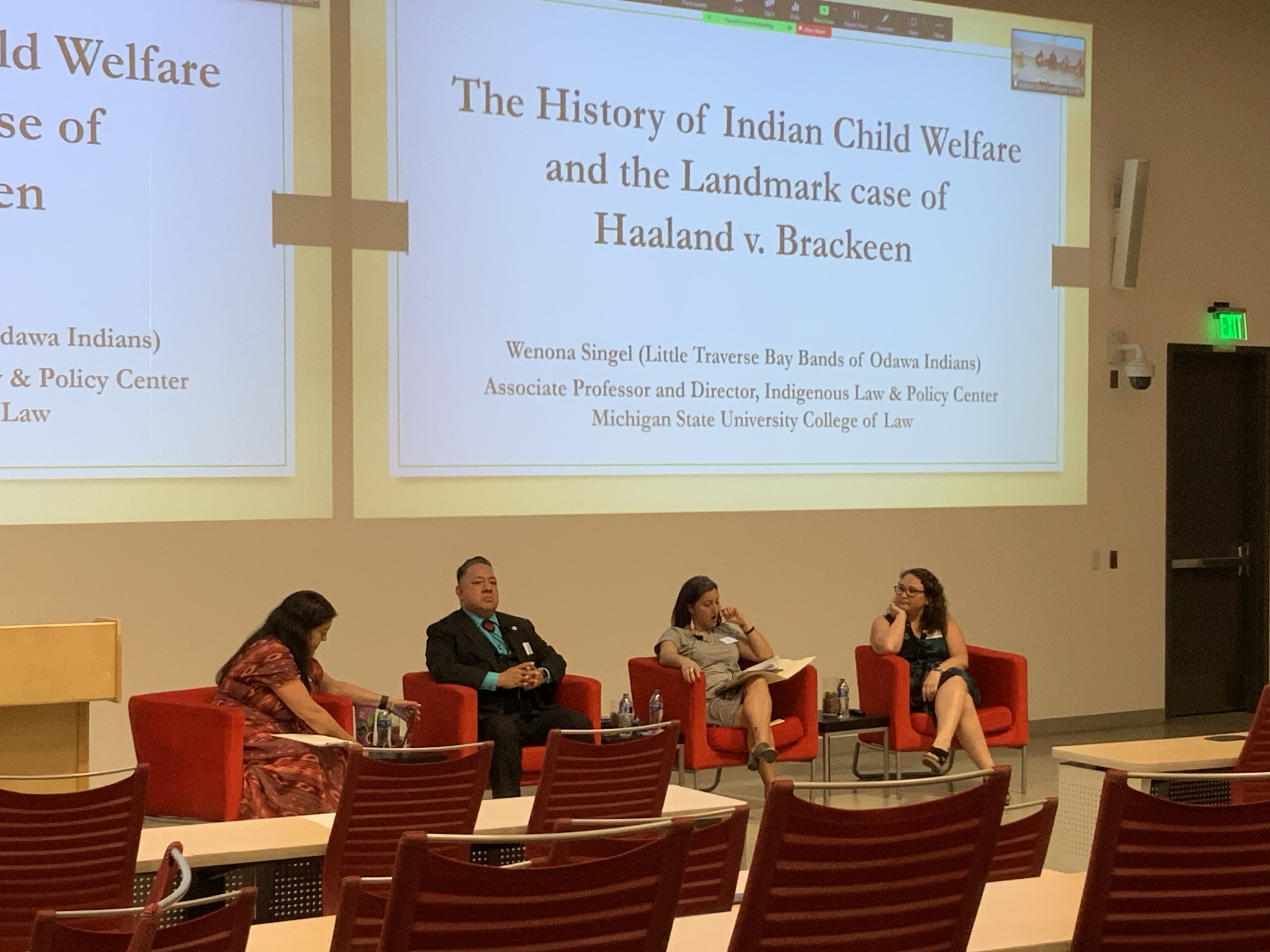
The Red Bird Trilogy: Comments Delivered at the 11th Annual University of South Dakota Native Alumni Dinner[1]
Frank Pommersheim
I. Opening Welcome
A special thanks to John Little,[2] Megan Red Shirt Shaw,[3] Damon Leader Charge,[4] the Tiyospaye Council, and many others for all their hard work on this event to recognize and highlight the contribution of Native alums to this University and to their Tribes and the State of South Dakota in their professional lives.
I also want to give special thanks to John and Megan for the decision to highlight the contributions and accomplishments of Native law school grads both during their time at the Law School and in their subsequent professional lives. This is an important first in the history of the Law School.
Although I am not sure that this is public knowledge yet (I remain a relative stranger in the world of social media!), I want to commend Dean Neil Fulton of the Law School for selecting J.R. LaPlante, class of 2009 and member of the Cheyenne River Sioux Tribe, as the 2023 keynote speaker at the special hooding graduation ceremony held by the Law School on May 5. This will be another first. J.R. will be the first Native alum to give the keynote at this prestigious event. Cheers!

Continue reading
Kirsten Carlson on the Democratic Difficulties of Castro-Huerta
Kirsten Matoy Carlson has published “The Democratic Difficulties of Oklahoma v. Castro-Huerta” in New Political Science. Here is the abstract:
The Supreme Court, some commentators argue, is at its most undemocratic since the Lochner Era in the 1930s. They point to the Supreme Court’s majority opinion in Dobbs v. Jackson Women’s Health Organization, which departs from public opinion on abortion and longstanding constitutional precedence. Dobbs, however, is not an outlier. The Supreme Court made a similar move in Oklahoma v. Castro-Huerta. The majority opinion questioned almost 200 years of constitutional interpretation and several decades of congressional policy to enable state governments to exercise criminal authority over non-Indians in Indian Country. This article compares the majority opinion in Castro-Huerta to congressional policy to explore the democratic and constitutional difficulties that can arise when the Supreme Court refuses to defer to Congress—the democratically elected and constitutionally appointed institution for making federal Indian policy. It reveals how the Court’s undemocratic turn extends beyond cases involving individual rights.

Oklahoma Federal Court Dismisses Pro Se Civil Rights Suit Brought by Cherokee Prisoners
Here are the materials in Hogshooter v. Cherokee Nation (E.D. Okla.):

Oklahoma Court of Criminal Appeals Finds Ottawa and Miami Reservations Remain Extant
Here are the materials in State of Oklahoma v. Brester:

North Dakota Federal Court Allows Challenge to Tribal TERO Suit to Proceed against TERO Officer
Here are the materials in Dakota Metal Fabrication v. Parisien (D.N.D.):

American Indian Law Journal, Vol. 11, No. 2
Here:

Current Issue: Volume 11, Issue 2 (2023)
Articles
Toward a Tribal Role in Groundwater Management
Alexandra Fay
Change by Drips and Drabs or No Change at All: The Coming UNDRIP Battles in Canadian Courts
Kevin Gray
Case Law on American Indians
Thomas P. Schlosser
Dual Taxation – Unbalanced and Arbitrary
Benjamin M. Simon
Oil, Indifference, and Displacement: An Indigenous Community Submerged and Tribal Relocation in the 21st Century
Jared Munster
Wenona Singel Selected to Michigan State University Presidential Search Committee
Leeds, Miller, Washburn, and Beetso on Castro-Huerta
Stacy Leeds, Robert J. Miller, Kevin K. Washburn, and Derrick Beetso have posted “Oklahoma v. Castro-Huerta — Rebalancing Federal-State-Tribal Power,” previously published in the Journal of Appellate Process and Practice, on SSRN. Here is the abstract:
The Supreme Court’s unexpected decision in Oklahoma v. Castro-Huerta in 2022 overturned established precedent and scrambled long-settled expectations about the division of criminal jurisdiction in Indian country. In this panel discussion shortly after the decision was issued, the authors provided a “hot take” on the Castro-Huerta decision and discussed its impact on criminal justice in Indian country and on federal Indian law more broadly.

We previously posted this symposium issue here.
Greg Ablavsky on Castro-Huerta
Gregory Ablavsky has posted “Too Much History: Castro Huerta and the Problem of Change in Indian Law,” forthcoming in the Supreme Court Review, on SSRN. Here is the abstract:
The Supreme Court’s decision last Term in Castro-Huerta v. Oklahoma dramatically rewrote the rules of criminal jurisdiction in federal Indian law. For the first time since 1882, the Court judicially expanded the scope of state criminal jurisdiction in Indian country, finding that states hold jurisdiction over Indian-on-non-Indian crime concurrently with the federal government. In reaching this conclusion, the Court exemplified the subjectivism that scholars have criticized in the Court’s Indian law jurisprudence for decades. The opinion distinguished or cast aside at least six prior decisions where the Court had seemingly reached the opposite conclusion, as well as concluding that the Court had already substantially limited the Court’s foundational holding in Worcester v. Georgia (1833) that Indian country ordinarily lies outside state authority.
Building on these earlier critiques, this Article uses Castro-Huerta to examine a less explored flaw in the Court’s Indian law rulings—what I call the problem of “too much history.” In Indian law, judges and litigants must make sense of over two centuries of jurisdictional debates, recorded largely not in statutes or constitutional provisions but in dozens of shifting Supreme Court decisions. The key question in Castro-Huerta, and the core of the dispute between majority and dissent, was change–how the law on state jurisdiction in Indian country had shifted over time. But the sheer mass of history makes it hard for the Justices to identify legitimate legal change in Indian law.

This conundrum leads to two broad types of judicial use of history in Indian law. “Good” history decisions, epitomized by this Term’s decision in Ysleta del Sur Pueblo v. Texas, employ specific context to examine narrowly defined legal questions. By contrast, “bad” history opinions, exemplified by Castro-Huerta, turn to the past as an independent source of law, ask broad, unanswerable questions of it, and provide no clear way to assess the inevitable heap of conflicting evidence.
Having laid out this challenge, the Article reexamines the question of the specific historical change at the core at Castro-Huerta. Rather than the majority’s narrative of abandonment and the dissent’s narrative of continuity, I think a more accurate account of what the Court has done with respect to state jurisdiction in Indian country is translation—trying to make sense of older legal principles within a new jurisprudential frame. But this approach makes the Court’s decisions in this area especially prone to misreading and selective citation, as Castro-Huerta underscored.

You must be logged in to post a comment.