Here:
FINAL Indian Law Scholars Amici Chickasaw v NLRB
UMUT et al amici brief Chickasaw v NLRB
Opening Brief here.
The MIT v. Caltech game would have been fun to watch.
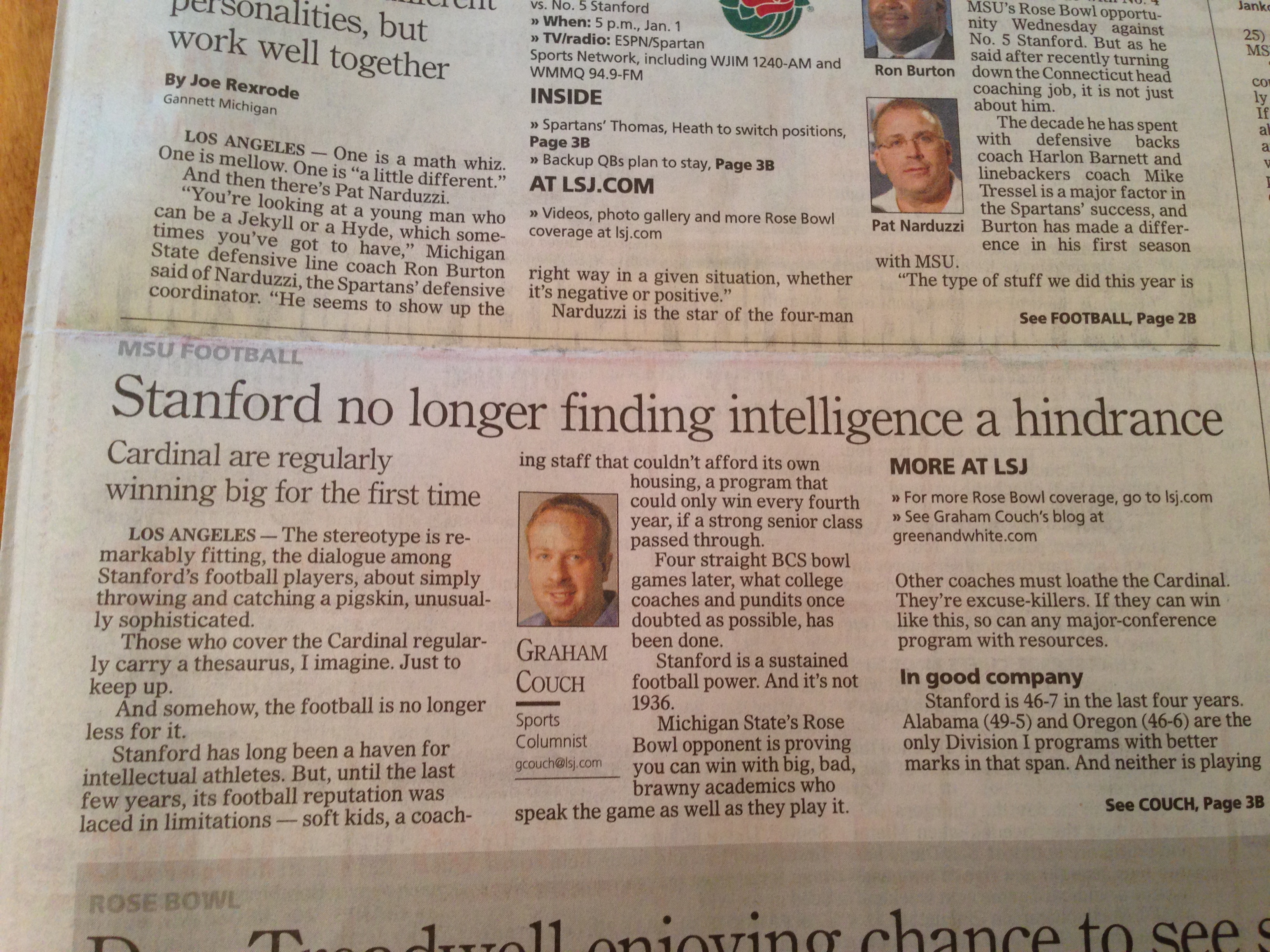
Sparty’s playing Stanford today in the Rose Bowl. I don’t care who wins (GO BLUE!), especially since Stanford’s NALSA has invited Wenona and I to campus a couple times. I know it’ll be a good game, a throwback game, with lots of defense and running up the middle and all that good stuff. At least one of the Michigan teams beat friggin’ Ohio.
Still, I thought the commentary below was worth posting, if only for shaming the local newspaper for a ridiculous headline — “Stanford no longer finding intelligence a hindrance”. Wow. Nice work Lansing State Journal.
Good stuff. Here:
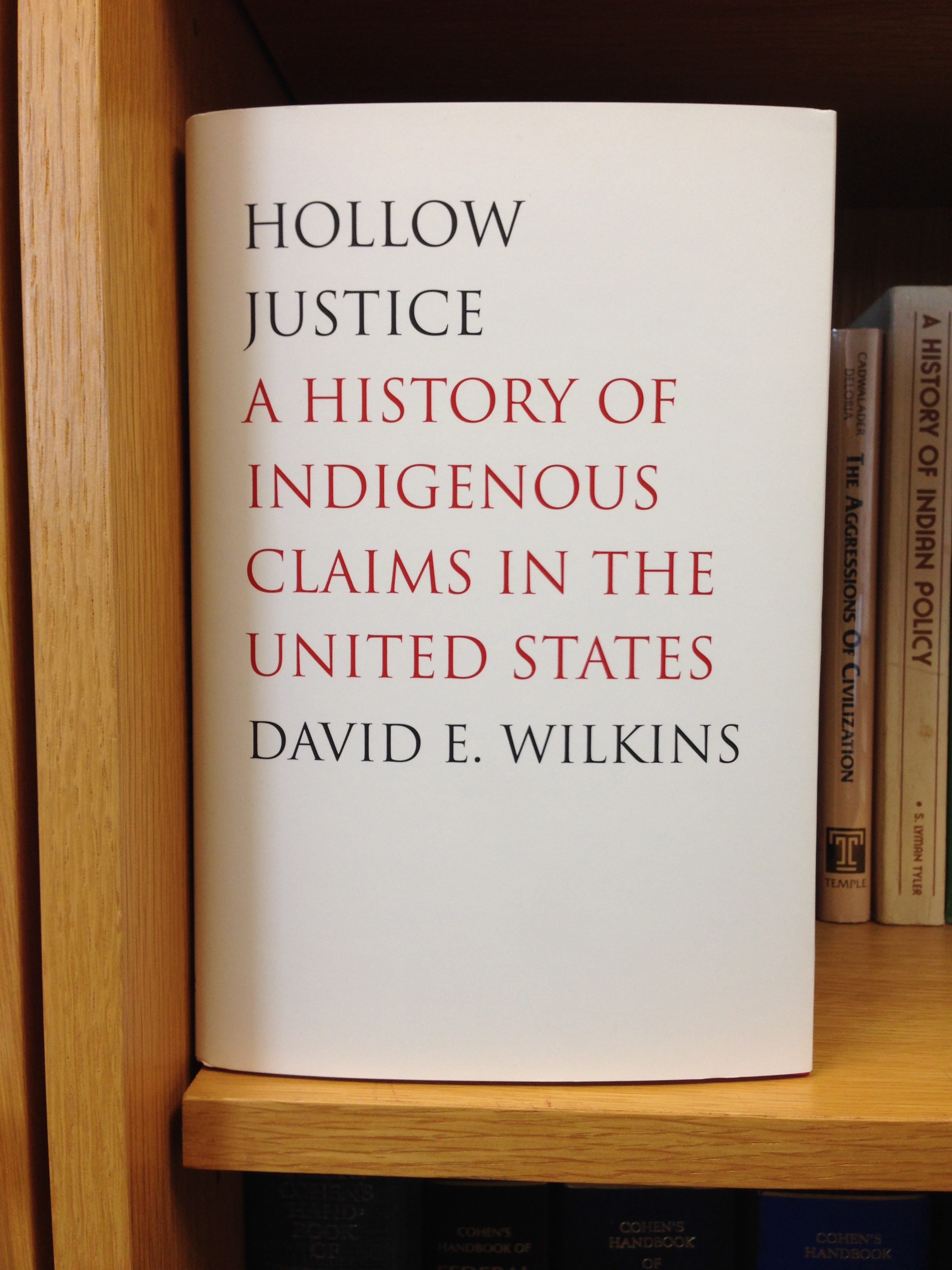
Here.
An excerpt:
The 306 people fighting to stay on the Nooksack Indian Tribe’s membership rolls won a rare legal victory recently when Tribal Court Chief Judge Raquel Montoya-Lewis ruled that tribal leaders had violated their rights by denying them $250-per-person Christmas checks that were mailed to everyone else in the 2,000-member tribe.
But the ruling didn’t put any extra presents under anyone’s tree. While Montoya-Lewis ruled that it was illegal to deny the 306 the same treatment as other tribe members before their legal status is determined, she also decided that she had no legal authority to order Chairman Bob Kelly and his supporters on the tribal council to issue checks to anyone.
The episode was one more example of the difficulties that the 306 have faced during the past year, as they try to get courts to block the move to strip them of tribal membership under a process known as disenrollment.
Here are the materials in Kickapoo Tribe of Indians of the Kickapoo Reservation in Kansas v. Black (D. Kan.):
248 Watershed District Motion for Summary J
291 Kickapoo Motion for Summary J
An excerpt:
As is evidenced by the briefing, this case has a long and complex factual background. However, the facts material to the pending motions are few and uncontroverted. The Kickapoo Indian Reservation (“Reservation”) lies almost entirely within the District’s boundaries. The Tribe and the District entered into the Watershed Plan and Environmental Impact Statement for the Upper Delaware and Tributaries Watershed (“Agreement”) in 1994 to serve as co-sponsors of a project aimed to carry out works of improvement for soil conservation and for other purposes, including flood prevention. The parties agreed to co-sponsor the project after failed attempts by each party to sponsor the project on its own. The parties reached the Agreement following a procedure established by the United States Department of Agriculture’s Soil Conservation Service (“SCS”), now known as the National Resource Conservation Service, under what is referred to as P.L. 83–566 (the Watershed Protection and Flood Prevention Act, 16 U.S.C. § 1001 et seq.). Many years of planning and negotiation by both parties and numerous other contractors, government officials, and agencies preceded the Agreement. In addition to twenty floodwater retarding dams and other various improvements, the Agreement included plans for a multipurpose dam with recreational facilities, otherwise known as the “Plum Creek Project.”
On multiple occasions, the Tribe asked the District to exercise its power of eminent domain to condemn non-Indian-owned land for the Plum Creek Project that the Tribe had been unable to acquire on its own. The District declined the Tribe’s request each time. The Tribe filed this water rights action on June 14, 2006, seeking declaratory relief, injunctive relief, compensatory damages, and specific performance. In essence, the Tribe claims that the Agreement is a binding contract that obligates the District to condemn 1,200 acres of land on the Tribe’s behalf to build the Plum Creek Project.The parties agree that the issue before the court in both summary judgment motions boils down to this: Does the Agreement unambiguously require the District to exercise its eminent domain powers on the Tribe’s behalf to acquire non-Indian land necessary to build the Plum Creek Project? The Tribe contends the answer is yes, and the District argues that the answer is no.
Tonya L. Brito, Raymond Kirk Anderson, and Monica Ashley Wedgewood have posted “Chronicle of a Debt Foretold: Zablocki v. Red Hail, 434 U.S. 374 (1978),” on SSRN. Here is the abstract:
Zablocki v. Red Hail is a canonical case in family law jurisprudence. One of the few Supreme Court decisions addressing the fundamental right to marry, the case involves a successful challenge to Wisconsin’s “permission to marry” statute. However, the conventional understanding of the case addresses only part of the story. The narrative threads uncovered as part of this oral history research study reveal a more multifaceted and complicated story than has been previously appreciated. The story behind Zablocki v. Red Hail spans the 1970s in Milwaukee, a period of great inequality and dynamic social change. It also engages the American Indian experience in the United States, particularly the experience of urban Indians who have been uprooted from their native lands and disconnected from their heritage and history. Finally, although Zablocki v. Red Hail was a significant constitutional victory, the ruling did not secure justice for Roger Red Hail because the pursuit of a rights-based claim left standing an economically unjust (and apparently unending) child support order.
Highly recommended!
Here are the materials in United States v. Williams:
From the opinion:
Zachary Carl Williams appeals his conviction for conspiracy to misbrand prescription drugs in violation of 21 U.S.C. §§ 331(a), 331(k), 333(a), and 18 U.S.C. § 371. Williams raises five issues on appeal. In his first two issues he alleges the indictment was constructively amended in violation of his constitutional rights. In his third and fourth issues he alleges the jury was improperly instructed. Finally, Williams argues that he is entitled to tribal sovereign immunity because his pharmacy operation was authorized by a license issued by the Ponca Tribe, a federally recognized tribe. Finding no error, we affirm Williams’ conviction.
Here.
An excerpt:
“We need to complete the ceremony of 1860 for the ones who were lost,” said Ted Hernandez, chairman of the 645-member tribe.
The ceremony will act as a marker on a long and unlikely journey of survival. It is not easy to recover from a massacre, and that year the endured one of the worst ethnic slaughters in U.S. history as they danced and sang at a world renewal ceremony on Indian Island.
A posse of white settlers sneaked through the darkness one night in 1860 and murdered more than 50 Native American women and children, mostly with axes and hatchets.
“Amidst the wailing of mutilated infants,” The San Francisco Bulletin wrote at the time, “the savage blows are given, cutting through bone and brain.”
Nearby settlers carried out two more massacres that night, killing an additional 90 Indians, most of them Wiyot, and for more than a century it seemed the Wiyot were a destroyed people.


You must be logged in to post a comment.