Department of Justice Announces Program to Enhance Tribal Access to National Crime Information Databases

DEPARTMENT OF JUSTICE ANNOUNCES PROGRAM TO ENHANCE TRIBAL ACCESS TO NATIONAL CRIME INFORMATION DATABASES

 Department of Justice Tribal Access Program (TAP) Will Improve the Exchange of Critical Data 

Department of the Interior Companion Program to Provide Name-Based Emergency Background Checks for Child Placement

WASHINGTON – The Department of Justice is launching an initial phase of the Tribal Access Program for National Crime Information (TAP) to provide federally-recognized tribes access to national crime information databases for both civil and criminal purposes.  TAP will allow tribes to more effectively serve and protect their communities by ensuring the exchange of critical data.

This initial phase of TAP was announced today in a meeting with tribes held during the 2015 Department of Justice/FBI Criminal Justice Information Services (CJIS) Division Tribal Conference in Tulsa, Oklahoma.

“Federal criminal databases hold critical information that can solve crimes, and keep police officers and communities safe,” said Deputy Attorney General Sally Quillian Yates.  “The Tribal Access Program is a step forward to providing tribes the access they need to protect their communities, keep guns from falling into the wrong hands, assist victims and prevent domestic and sexual violence.  Empowering tribal law enforcement with information strengthens public safety and is a key element in our ongoing strategy to build safe and healthy communities in Indian country. ”

“The FBI is pleased to participate in this initiative,” said Executive Assistant Director Amy Hess of the FBI’s Science and Technology Branch.  “This will be a positive step for the tribal agencies to receive valuable criminal information and also for those same tribal agencies to submit criminal information at the national level.  Through this partnership, information becomes richer and communities can become safer.”

TAP will support tribes in analyzing their needs for national crime information and help provide appropriate solutions, including a-state-of-the-art biometric/biographic computer workstation with capabilities to process finger and palm prints, take mugshots and submit records to national databases, as well as the ability to access CJIS systems for criminal and civil purposes through the Department of Justice.  TAP will also provide specialized training and assistance for participating tribes.

While in the Tribal Law and Order Act of 2010 Congress required the Attorney General to ensure that tribal officials that meet applicable requirements be permitted access to national crime information databases, the ability of tribes to fully participate in national criminal justice information sharing via state networks has been dependent upon various regulations, statutes and policies of the states in which a tribe’s land is located.  Therefore, improving access for tribal law enforcement to federal criminal information databases has been a departmental focus for several years.  In 2010, the department instituted two pilot projects, one biometric and one biographic, to improve informational access for tribes.  The biographic pilot continues to serve more than 20 tribal law enforcement agencies.

Departments of Justice and Interior Working Group

In 2014, the Departments of Justice and the Interior (DOI) formed a working group to assess the impact of the pilots and identify long-term sustainable solutions that address both criminal and civil needs of tribes.  The outcome of this collaboration was the TAP, as well as an additional program announced today by the DOI’s Bureau of Indian Affairs (BIA) that provides tribes with national crime information prior to making child placement decisions in emergency circumstances.  Under the BIA program, social service agencies of federally recognized tribes will be able to view criminal history information  accessed through BIA’s Office of Justice Services who will conduct name-based checks in situations where parents are unable to care for their children.

“Giving tribal government programs access to national crime databases through DOJ’s Tribal Access Program for National Crime Information is a tremendous step forward towards increasing public safety in Indian Country,” said Assistant Secretary Kevin K. Washburn for Indian Affairs at the Department of the Interior.  “The Bureau of Indian Affairs Office of Justice Services’ Purpose Code X program provides a much-needed tool for tribal social service agencies when they must find safe homes to place children during temporary emergency situations.”

In the initial phase of the TAP program, the biometric/biographic workstations will be deployed to up to 10 federally-recognized tribes who will provide user feedback.  This phase will focus on assisting tribes that have law enforcement agencies, while in the future the department will seek to address needs of the remaining tribes and find a long-term solution.  The department will continue to work with Congress for additional funding to more broadly deploy the program.

The Department of Justice’s Chief Information Officer manages TAP.

“It is our hope that TAP can minimize the national crime information gap and drive a deeper and more meaningful collaboration between the federal, state, local and tribal criminal justice communities,” said Chief Information Officer Joseph F. Klimavicz for the department.

For more information on TAP, visit www.justice.gov/tribal/tribal-access-program-tap.

For more information about the Justice Department’s work on tribal justice and public safety issues, visit: www.justice.gov/tribal.

For more information about the Department of the Interior Bureau of Indian Affairs, visit www.indianaffairs.gov/
Job Announcement: Center for Indian Country Development Coordinator, Federal Reserve Bank of Minneapolis

Position must be applied for through: https://www.minneapolisfed.org/about/careers/search-jobs?

Center for Indian Country Development Coordinator242260

Federal Reserve Bank of Minneapolis

Primary Location: MN-Minneapolis

Full-time

Employee Status: Regular

Overtime Status: Exempt

Travel: Yes, 5 % of the Time

Shift: Day Job

Job Sensitivity Tier II – No Credit Check

General Description
The Federal Reserve Bank of Minneapolis (the Bank) is looking for a coordinator to assist the Co-Directors of its Indian Country Center. This position has primary day-to-day administrative responsibilities for supporting the CICD by coordinating and performing a range of administrative, project management, and communication tasks, and assisting in designing programs and initiatives related to Indian Country community and economic development in the district and nationally.

The successful candidate will have a minimum of 3 years of demonstrated administrative and communications experience and knowledge and experience with American Indian communities. The candidate also will have a proven ability to think strategically while interacting with diverse groups. They must have the ability to meet critical deadlines, manage multiple assignments, and engage professionally with CICD partners and cohorts. The ability to conduct oneself, at all times, with integrity, honesty, and respect for every employee is paramount.

Supports the CICD and its Co-Directors by coordinating and performing a range of administrative, project management, and communication tasks, including:

Manages project communications and coordinates work activities.

Plans and schedules meetings and events for the CICD and the Bank, including meetings and communications with the CICD’s Leadership Council and Internal Partners’ Committee.

Assists in preparing cost estimates, budget projections, resource requirements, project plans, and other documentation in support of the activities of the Co-Directors and CICD.

Maintains the CICD’s internal and external website, internal Sharepoint sites, calendars, and contacts database, making edits and updates routinely and as needed. Plans and coordinates production of publications and online updates in a timely manner. Arranges for use of the preferred technologies to manage the flow of publications to print, web and digital media formats.

Assists with writing, rewriting, editing and copy editing various types of articles and papers.  Assists in managing current social platforms and develops new channels to grow social media presence and raise the Center’s awareness.  Writes short articles or blog posts and notices for inclusion in print of online publications and coordinates, assists in, or conducts the creation of art work, photographs, layout and other elements of publications.

Participates in projects and performs intermediate analytical tasks in support of CICD, Bank, or FRS initiatives.

Participates in Department, Bank, FRS and/or federal agency project teams, task forces, and work groups. Conducts or assists in special assignments, studies, and analyses; assumes leadership roles as assigned.

Analyzes and assists in the review of business functions and operational process improvements and/or enhancements. Tests, trains, and completes implementations, which may include coordinating activities such as developing plans, completing risk assessments, assigning tasks, monitoring and reporting progress, and preparing necessary communications.

Provides intermediate analytic support to assist CICD, Bank, or FRS management and staff resolve moderately complex operational and business issues. Escalates difficult and complex questions or problems to other analysts or management.

Assists in preparing and/or revising communications, including proposals, reports, and presentations for all levels of management. Develops and revises procedures, defines processes, and delivers training to users and staff.

Produces quarterly management reports. Assists in the development of annual CICD reports. Monitors and verifies compliance with applicable new and existing policies, procedures, and standards.

Monitors and verifies compliance with applicable new and existing policies, procedures, and standards. Serves as CICD’s Security Liaison, Business Continuity Plan manager, Records Retention Liaison, and Safety Coordinator. Completes security access reviews and initiates access requests, as needed. Maintains the CICD’s Business Continuity Plan and organizes updates and tests as needed. Updates the CICD’s files as needed to comply with Records Retention schedules.

Orders and maintains CICD supplies and equipment.

Performs other duties as assigned.

Provides training to less experienced analytical staff.

 Qualifications:
Bachelor’s degree or equivalent combination of higher education and/or experience.

Minimum 3 years direct work-related experience or equivalent combination of related higher education and experience for level II.  5 years for level III.

Minimum of 3 years of demonstrated administrative and communications experience and knowledge and experience with American Indian communities preferred.

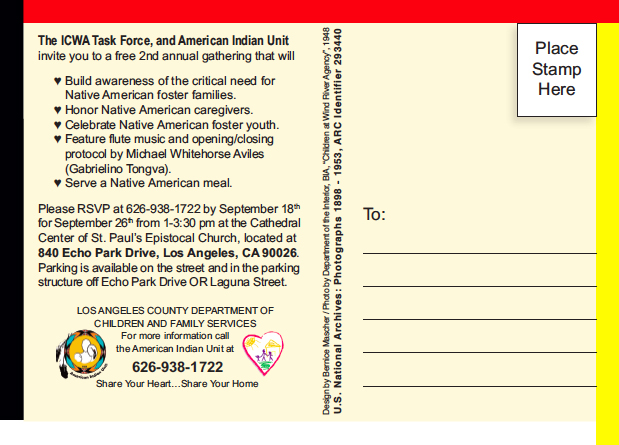
Los Angeles “Tiospaye” Native Foster Family Recruitment Event

The Los Angeles County Department of Children and Family Services American Indian Unit is sponsoring its 2nd Annual Native foster family/parent recruitment event. This event is an attempt to be proactive in searching to find native homes in an urban environment for those native children in foster/adoptive care.

***SAVE THE DATE: September 26,2015***
“TIOSPAYE”: Los Angeles Foster Family Recruitment Event
Sponsored by: The Los Angeles County Department of Children and Family Services American Indian Unit
RSVP by September 18, 2015 at 626-938-1722
Place: Cathedral Center of St. Paul’s Episcopal Church (ECHO PARK)
Address: 840 Echo Park Ave, Los Angeles, CA 90026

Sept_26_2015 LA foster recruitment Back Program

Sept_26_2015 LA foster recruitment Front

Job Announcement: Ft. Peck Public Defender

Public Defender:

            The Fort Peck Tribes are seeking an attorney for the full-time position of Public Defender in the Fort Peck Tribal Court. The position is in Poplar, MT. Candidates must be admitted to practice in any jurisdiction. Salary DOE. The job description is available at the HR office at fortpecktribes.org or contact Rita Weeks, rweeks@fptc.org.

The Judges’ Page Devotes Issue to the Topic of Tribal Issues in Dependency Court

The Judges’ Page, a newsletter published by the National CASA Association and the National Council of Juvenile and Family Court Judges, has just released the summer 2015 issue.  The entire issue is devoted to the theme Tribal Issues in Dependency Court.

The newsletter is available here.

From Judge Dean Lewis (ret):

The National Council of Juvenile and Family Court Judges (NCJFCJ) and the National CASA Association are partners in publishing The Judges’ Page. Both organizations are deeply committed to effective court advocacy for American Indian and Alaska Native children and families involved in dependency court proceedings. This issue of The Judges’ Page addresses the importance of compliance with the Indian Child Welfare Act of 1978 (ICWA) from the legal as well as the cultural perspective. The issue provides effective educational tools for ICWA implementation and offers examples of collaborations between state and tribal courts.

Readers should be aware that the Bureau of Indian Affairs (BIA) issued updated Guidelines for State Courts and Agencies in Indian Child Custody Proceeding effective February 25, 2015. The updated Guidelines are intended to promote compliance with ICWA’s stated goals and to provide best practices for ICWA compliance by state courts and child welfare agencies. In addition, on March 20, 2015, the Bureau of Indian Affairs proposed Regulations for State Courts and Agencies in Indian Child Custody Proceedings. Recently, Congress passed two bills to help protect Native American Children: The Native American Children’s Safety Act and the Alyce Spotted Bear and Walter Soboleff Commission on Native Children Act. The Executive branch and the Congress are to be commended for their efforts to clarify the original intent of the ICWA, and to promote the health, safety, and well-being of Native Children.

The NCJFCJ Tribal Caucus identified key topics of concern to be addressed in this issue of The Judges’ Page. Our thanks to Victoria Sweet, Program Attorney at NCJFCJ, for seeking input from the Caucus and securing numerous articles for this issue. Donna Goldsmith was tasked with developing a primer for judges and advocates on key issues for implementation of the ICWA, and we appreciate her undertaking that project. Our thanks also to Judge Len Edwards and Jennifer Walter of the Center for Families, Children & the Courts of the Judicial Council of California for securing and writing articles that exhibit the remarkable best practices instituted throughout that state. And, to all of the authors who volunteered their time to contribute to this issue, thank you.

Articles in This Issue

Judge William A. Thorne, Jr. (ret), describes the background that led to the adoption of the Indian Child Welfare Act and its relevance to treatment of all children impacted by the child welfare process.

Donna Goldsmith, JD, informs readers of the ICWA legal requirements and provides a primer of how to proceed in ICWA cases utilizing the provisions of the BIA updated Guidelines for State Courts and Agencies in Indian Child Custody.

Victoria Sweet, JD, gives an overview of the updated BIA Guidelines for State Courts and Agencies in Indian Child Custody Proceedings and proposed Regulations for State Courts and Agencies in Indian Child Custody Proceedings.

Mary Beth Jager, MSW, Rachel Rose Starks, MA, Adrian T. Smith, JD, MSW, and Miriam Jorgensen, PhD, collaborated to share the history of tribal child welfare systems and lawmaking which have been recognized by the ICWA as the governance
mechanism by which a tribe establishes and implements jurisdiction for the wellbeing of Indian children.

Judge Leonard Edwards (ret.) discusses the ICWA active efforts requirement and distinguishes active efforts from reasonable efforts.

Victoria Sweet, JD, describes the commitment of NCJFCJ to implementation of the ICWA. She introduces readers to NCJFCJ publications and includes the recommendation of NCJFCJ that state court judges apply the recently revised Bureau of Indian Affairs ICWA Guidelines.

Paige Beard, Director of Program Development at the National CASA Association, provides background on the National CASA Association’s commitment to training and supporting CASA volunteers who serve Indian
children through Tribal Courts and Dual State Court/Tribal Court Programs.

Judge Korey Wahwassuck reports on how the joint tribal-state jurisdiction in Itasca County, MN, has proven effective in promoting lifetime healing while protecting public safety, and how this model can be used as a tool for reducing the number of children in out-of-home placement, as well as speeding reunification.

The California Judicial Council established a Tribal/State Projects Unit in 2009 as part of the Center for Families, Children & the Courts. This unit staffs the California Tribal Court-State Court Forum (forum), which was formed in 2010. Judges and staff share their perspectives on their collaborative work locally and statewide through the forum.

Judge Leonard Edwards (ret.) discusses the ICWA active efforts requirement and distinguishes active efforts from reasonable efforts.

Justice Jill Elizabeth Tompkins reviews the provisions of the ICWA and the updated Guidelines for State Courts and Agencies in Indian Child Custody Proceedings provisions regarding transfer of an Indian child’s case from a state court to a tribal court from the perspective of the tribal court.

Jack Trope, JD, and Sarah L. Kastelic, PhD, set out the ICWA placement preferences. They explain the limitation on the “good cause” exception as established in the updated Guidelines for State Courts and Agencies in Indian Child Custody Proceedings.

Claire Chiamulera of the ABA Center on Children and the Law shares her recommendations in “Best Practice for Native American and All Families” reprinted from Child Law Practice.

Kathryn E. Fort, JD, offers insight and best practices on ICWA cases involving military families.

Jessica Jorgensen, JD, offers her perspective on the issue of “good cause” to deviate from ICWA placement preferences.
Web Resources is an article that provides readers with the websites of organizations that produce educational materials on the ICWA as well as resources and assistance in implementation of the ICWA.

Alaska Attorney General Publishes Opinion Regarding State Enforcement of Tribal Protection Orders

Link to full press release here  .

Attorney General Craig Richards published a formal Attorney General Opinion today regarding whether state and local law enforcement can enforce a tribal protection order that has not been registered with the court system. The opinion had been requested by Commissioner Folger, Department of Public Safety in order to provide clarity to the State Troopers in carrying out their duties.

This Opinion concludes that a tribal protection order does not need to be registered with the court system before a State trooper or other officer can enforce it. The protection order will be immediately enforceable if it meets the criteria outlined in the federal Violence Against Women Act (VAWA).

“This Opinion provides clear direction to officers on the ground as well as the victims they seek to protect,” said Attorney General Richards. “There should now be no doubt that these protection orders must be enforced.

Opinion available here Opinion Alaska Tribal Protection Orders

News coverage here .

Conference on ICWA, Competent Jurisdiction, and Peacemaking, July 29-31 in Albuquerque

A conference will be held July 29-31, 2015 at the Indian Pueblo Cultural Center in Albuquerque, NM.

Day one will be devoted to discussing ICWA, its original intent, and current court cases around the country that have impacted ICWA compliance.

Day two is focused on the term “competent jurisdiction” and how it has been interpreted. Participants will discuss ways that tribes can help educate parties in the legal system to understand cultural and sovereign rights.

Day three will explore the potential for implementing peacemaking in tribal legal systems, particularly in the context of children in need of care.

Full agenda here: Agenda For July 2015 ABQ.

NCJFCJ Releases Updated Disproportionality Rates for Children of Color in Foster Care Technical Assistance Bulletin

Since 2011, the NCJFCJ has published Disproportionality Rates for Children of Color in Foster Care Technical Assistance Bulletins, which identify national and state level disproportionality rates. The reports have gained national attention and have been used in a number of ways by a broad spectrum of stakeholders and interested parties.

Due to the ongoing need for dialogue surrounding the most currently available statistics on disproportionality, the NCJFCJ has published an updated Disproportionality Rates for Children of Color in Foster Care (Fiscal Year 2013) Technical Assistance Bulletin. This Bulletin, released June 2015, utilizes the most current (2013) Adoption and Foster Care Analysis and Reporting System (AFCARS) data and 2013 census population estimates data to calculate current disproportionality indexes for the nation, every state, and Washington, D.C.. The Bulletin makes comparisons between 2000 and 2013 disproportionality rates to illustrate changes that have occurred in the last decade regarding overrepresentation of children of color in the foster care system. African American and Native American disproportionality rates are illustrated in color coded maps demonstrate trends over time.

New this year, the Bulletin identifies some of the limitations of the data to help users be more informed consumers of the information and better understand what the data mean and do not mean.

2013 Dispro TAB Final

Videos Available from Indigenous Peacemaking Training

The NARF Indigenous Peacemaking Initiative held a training in Catoosa, Oklahoma on October 6-7, 2014. NARF partnered with NAICJA and Columbia Law School for this training and is working on organizing future Peacemaking events.

Videos of the training are now available here.

Anishinaabe nibi inaakonigewin (water law) gathering

Announcement from Professor Aimée Craft:

I hope that you will consider joining us for the Anishinaabe nibi (water) gathering taking place in the Whiteshell this June. After a few years of gathering with Elders on a project relating to Anishinaabe nibi inaakonigewin (water law), we are inviting people to come and learn about water teachings in an outdoor teaching lodge format.  We want to focus on youth participation and attendance.

Please share with your networks and people you think would be interested in attending.  All are welcome. 

To RSVP and for questions: watergathering2015@gmail.com

*Also, please consider bringing a young person to accompany you or assist us with travel funding for youth.*

 Agenda – Nibi Gathering – June 2015

Map – Nibi Gathering

Poster Nibi Gathering