Here.
Presidential Budget for Indian Affairs 2014
Here.
Here.
File this under very bored travel posts.
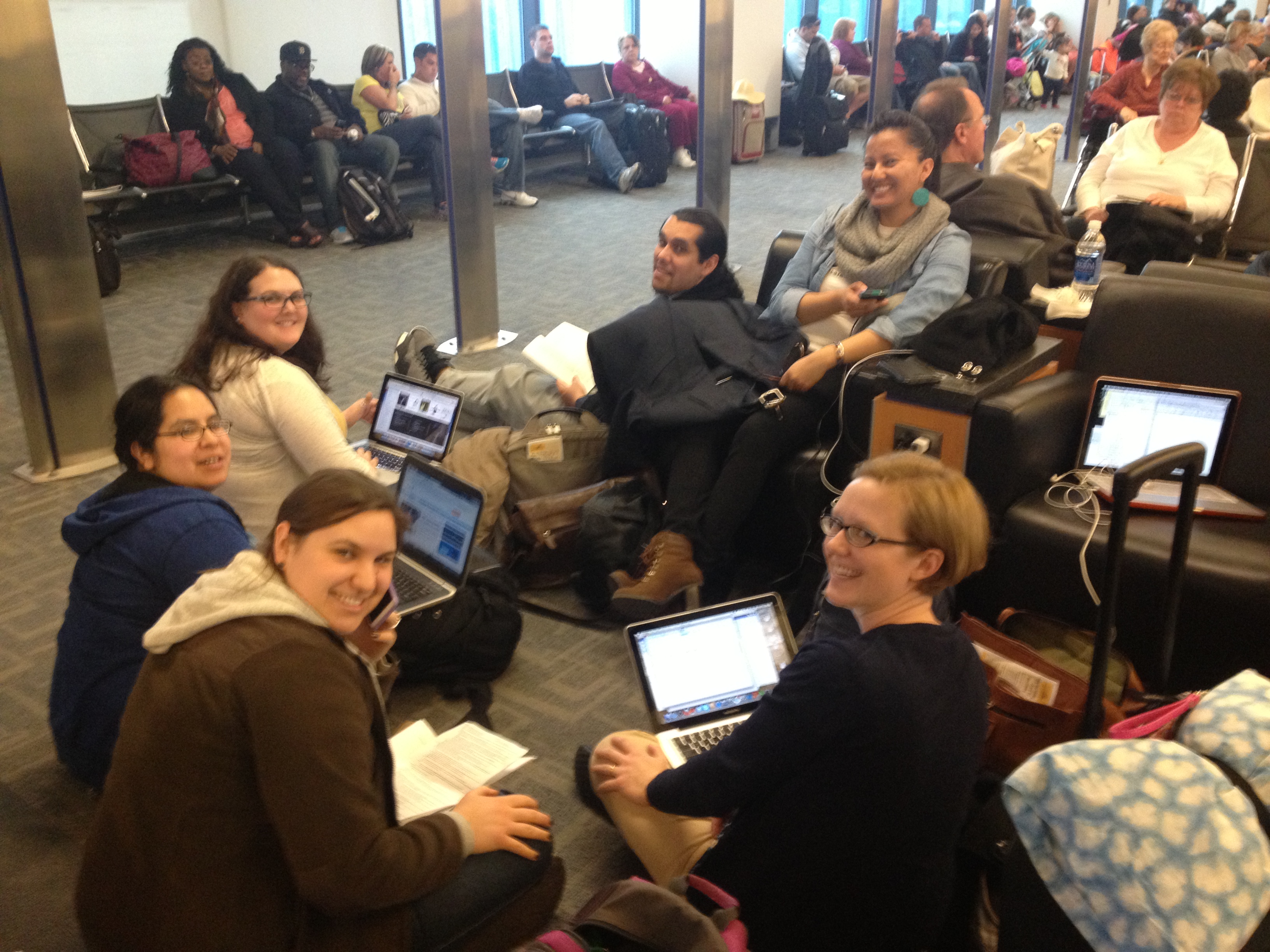
MSU Law students Emily, Angie, Sarah, John, Tamera and Nellie (taking the photo), and Kate Fort waiting. And waiting. And waiting.
 k
k
Article here.
Shoni, a junior, had a game-high 24 points Tuesday and was named the regional’s most outstanding player. Jude, a sophomore, had 15 points.
Maybe there will be a movie about them someday. There has already been a documentary, “Off the Rez,” which details how Shoni and her siblings moved with their mother, Ceci Moses, off the Umatilla Indian Reservation in Oregon to Portland, where Moses took a job as a high school girls basketball coach.
The Schimmel sisters have become heroes especially to Native Americans nationwide, and this Final Four spotlight on them and Louisville will be a huge emotional point of pride for their many supporters.
I am periodically posting about teaching, writing, ICWA, and the Baby Veronica case over at The Faculty Lounge. I put up my second post today.
We’re hosting three ILPC alums to talk about their experiences after law school. Please join us at 1pm in the Castle Board Room at the MSU College of Law. Snacks and drinks provided. 
The Michigan Court of Appeals heard the ICWA notice case that the Michigan Supreme Court originally remanded back to Wayne County for notice. That case, In re Morris, details what is required of Michigan courts when notifying tribes of a potential ICWA case.
The decision is here. There is finally extensive detail on what DHS did or did not put in the notice to the three Cherokee tribes, something the Supreme Court demanded in Michigan ICWA cases.
Since respondent could not obtain any additional information regarding his relatives, it would be unreasonable to expect petitioner to find it. Imposing this burden on petitioner would also encourage parents, who can best research their own ancestry, to delay the proceedings by providing limited information. Because it would often take a long time to uncover ancestry details, a requirement that ICWA tribal notices include every detail of a child’s ancestry would undermine ICWA ’ s 10-day provision, which prevents unreasonable delays. It would also jeopardize concepts of permanency and finality. The trial court did not err by finding that there was compliance with the ICWA’s notification requirements.
Here, from the Topeka Capital Journal, via Jamelle Bouie
The Legislature’s annual attempt to repeal a statute allowing in-state tuition for Kansas students without legal residency drew an emotional crowd to a House committee Wednesday.
***
But nothing drew a bigger reaction than when Rep. Ponka-We Victors, D-Wichita, wrapped up a series of questions to the bill’s chief proponent, Secretary of State Kris Kobach.
“I think it’s funny Mr. Kobach, because when you mention illegal immigrant, I think of all of you,” said Victors, the Legislature’s lone American Indian member.
The heavily pro-immigrant gallery burst into cheers and applause — a rare reaction in normally staid hearings.
 Turtle Talk
You must be logged in to post a comment.