Repost: Morning Edition Profile of Charlie Hill

Here.

Listen here.

Perhaps not surprisingly, Hill has mixed feelings about the concept of the American dream. He believes he’s attained his — but that it’s been out of reach for most Native Americans.

Take the fact that Native Americans have been the source of endless mockery, he says. “They make fun of the way we dance, we sing, our drum, our names, our religion, our rituals — you name it.”

So one of Hill’s dreams was to turn that humor around. “My whole thing is to get people to laugh with us, not at us,” he says.

Hollywood stereotypes have offered Hill a deep well from which to draw jokes. He re-creates the dialogue from old Westerns, but always gives the Indians the last laugh.

LA Times on Navajo Nation and the Coalition for Navajo Equality

Here.

New Mexico has seen celebrations across the state since its highest court 10 days ago unanimously ruled it was unconstitutional to deny a marriage license to same-sex couples. Not so for the sovereign Navajo Nation, whose borders spill over into the northeast part of the state and where tribal law is clear: Such unions are banned.

Some Navajo hope to change that, buoyed by the cultural climate shift underscored when the U.S. Supreme Court in June struck down part of the federal Defense of Marriage Act. Gay marriage is permitted in the District of Columbia and 18 states, the most recent being Utah, although officials there plan to appeal a federal court decision that overturned the state’s ban on same-sex marriage.

http://www.latimes.com/nation/la-na-navajo-gay-marriage-ban-20131230,0,5735043.story#ixzz2ozClvTgO

Oklahoma ICWA Interpretation Case: In re T.S.

We posted recently about the Supreme Court’s contempt for Congress. In this case that looks like an active efforts case, but turns into a long opinion interpreting many provisions of ICWA (active efforts, foster care placement, emergency removal) out of Oklahoma, it appears this contempt isn’t limited to the Supreme Court. This could be particularly harmful in ICWA cases. Opinion here.

From the trial court regarding active efforts in foster care placement:

The juvenile court announced his conclusion of ′′a lack of congressional intent in seeking foster care placement that active efforts have been proven unsuccessful. I think that was meant just for termination of parental rights proceeding.′′ Commenting ′′other courts have attempted to make rather constrained ways of finding active efforts have been met,′′ the court found ′′there has been offering of parenting classes to Father, even the placement of these children with their mothers is certainly an attempt to prevent the breakup of the Indian family, although they are not in [Father’s] care and he can’t have them returned to him on his demand.′′ After he acknowledged the opinion testimony of the qualified expert witness, Ms. Watashe, that ′′[active efforts] don’t apply but they have been met,′′ the court found ′′those things allow the Court to go forward with a finding that active efforts have been met here. I don’t find that they’ve been proven unsuccessful, but I don’t know how they could be at this stage. Again poor wording by Congress. Take that up.′

Footnote 10

And a troubling use of Baby Girl from the Oklahoma Appellate Court (this is a case where the children were with father, and removed on an abuse charge. NOT the fact pattern of Baby Girl):

Our decision to affirm is supported by the U.S. Supreme Court’s recent interpretation of ¶ 1912(d) in an adoption proceeding opposed by the Indian child’s biological father, a member of the Cherokee Nation who was never married to the child’s mother. See Adoptive Couple v. Baby Girl, 133 S.Ct. 2552, 2562- 2563 (June 25, 2013). In pertinent part, a majority of
the U.S. Supreme Court interpreted ¶ 1912(d) to apply ′′only in cases where an Indian family’s ′′breakup′′ would be precipitated by the termination of the parent’s rights,′′ and found such interpretation was confirmed by ¶ 1912(d)’s ′′placement next to ¶ 1912(e) and ¶ 1912(f), both of which condition the outcome of proceed- ings on the merits of an Indian child’s ’continued cus- tody’ with his parent.′′ (Emphasis added.) Id. Construing these adjacent provisions together, the Court further found:
None of the provisions create parental rights for unwed fathers where no such rights would otherwise exist. Instead, Indian parents who are already part of an ′′Indian family′′ are provided with access to ′′remedial services and rehabilitative programs′′ under ¶ 1912(d) so that their ′′custody′′ might be ′′continued′′ in a way that avoids foster-care placement under ¶ 1912(e) or termination of parental rights under ¶ [**59] 1912(f). In other words, the provision of ′′remedial services and rehabilitative programs′′ under ¶ 1912(d) supports the ′′continued custody′′ that is protected by ¶ 1912(e) and ¶ 1912(f). (Emphasis added; citation and footnote omitted.)
In this contested deprived child proceeding subject to ICWA, even if State had provided Father access to the specific services and programs after the show cause hearing and he had successfully commenced those programs, foster care placement could not have been avoided in light of the clear and convincing evidence supporting the juvenile court’s ¶ 1912(e)’s finding, i.e. at this stage of the proceeding Father’s continued custody was likely to result in serious emotional or physical damage to the children.

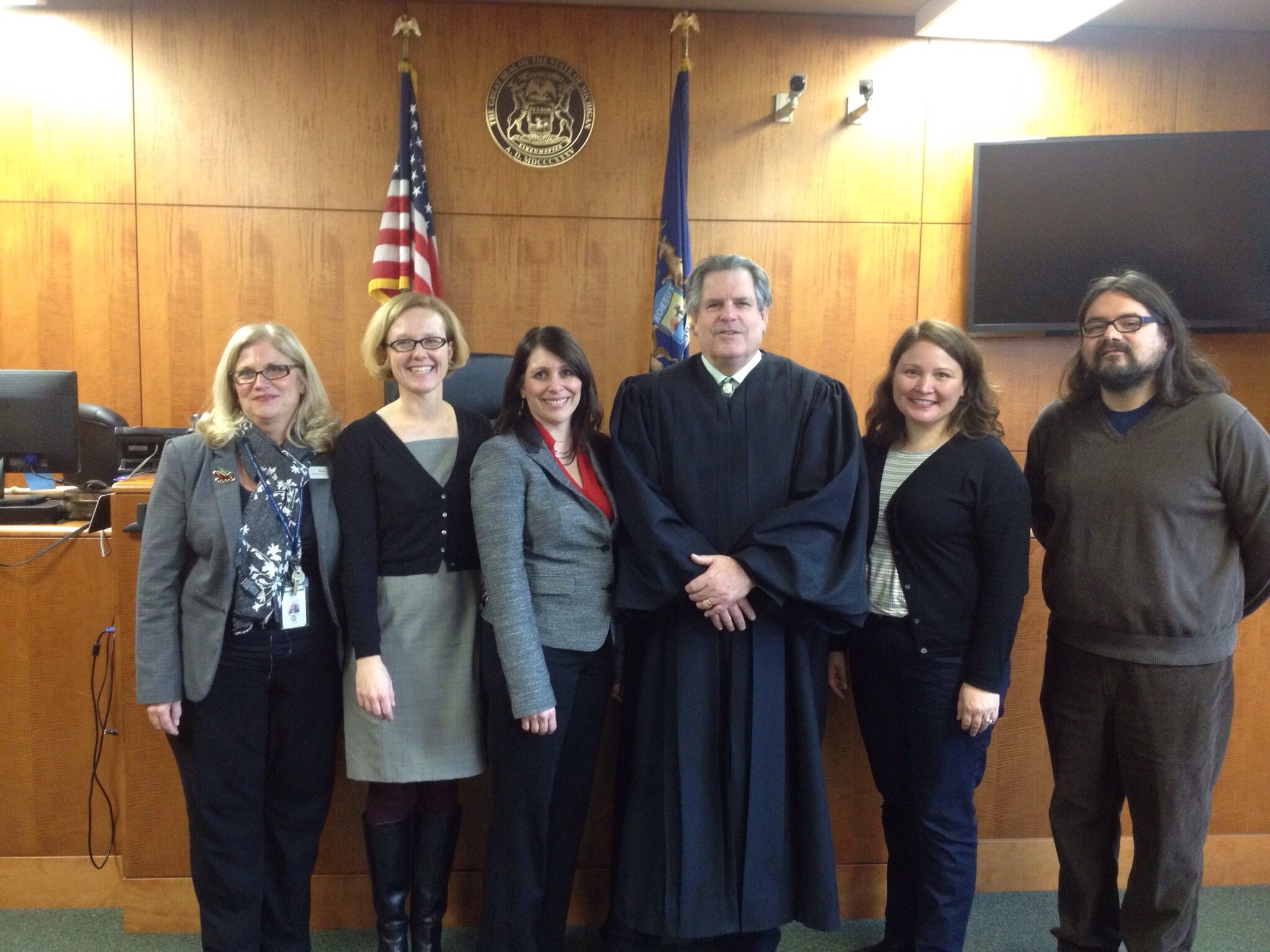
ILPC Fellow Sworn Into The Minnesota Bar

Congratulations to Victoria Sweet, newest member of the Minnesota Bar. And chi-miigwetch to Judge Connors for doing the ceremony.

20131219-134240.jpg

20131219-134524.jpg

CBC Article on Residential School Case with Court Documents

Here.

St. Anne’s Residential School survivors are before the Ontario Superior Court today in a bid to get the federal government to release documents the former students say would help corroborate their claims of abuse.

The documents they want are from a five-year Ontario Provincial Police investigation in the 1990s, as well as files from the subsequent trials that resulted in several convictions against school staff and supervisors.

Documents in Penn West v. Ominayak, et al

The ex parte application for injunction here. Hearing on the application is this afternoon.

Affidavit of a general manager of Penn West, with supporting documentation (PDF, 100+ pages).

Thanks to and via @LandOccupations

Senate Confirms Patricia Millett for D.C. Circuit Court of Appeals

Coverage via How Appealing here. Vote was 56-38–one more yes than the original vote that started the limited filibuster reform.

New Yorker: Supreme Court’s Contempt for Congress

Here.

“The Roberts Court has lost faith in the democratic process,” Professor Karlan wrote, noting that the conservative justices, at least in practice, reject the idea that the political branches have a “special institutional competence” in addressing certain questions. In his argument in the voting-rights case, Solicitor General Donald Verrilli tried this line, too, insisting on “the deference that Congress is owed… because, frankly, of the superior institutional competence of Congress to make these kinds of judgments.” This is probably a losing proposition on its face, unless one is talking about Congress’s superior competence at walking in circles with its shoes tied together. But when the legislative branch is not only disrespected but disabled—when the Court waves away the intent of Congress and takes away its tools to redress social and economic inequities—then Congress may well go to hell, and we’re going with it.

The post does not mention federal Indian law, or Adoptive Parents v. Baby Girl, or the oral arguments in the Bay Mills case, the inclusion of which would only make the argument stronger. And is yet another in a long list of reasons why this Court is no friend to Indian tribes.

Attorney Sanctioned by State for Behavior in Tribal Court

Minnesota Supreme Court decision here.

The Director argues that Michael’s e-mail questioning the tribal court’s impartiality violated Rule 8.4(d). Michael counters that her accusation regarding the tribal court’s impartiality was well founded and, therefore, was not a violation of Rule 8.4(d). Similar to the misconduct in Getty, the conclusion that Michael’s conduct constitutes a violation of Rule 8.4(d) rests on the manner in which she raised her concerns about the tribal court’s alleged unfairness. Even if Michael could establish that her concerns were well founded, Michael’s flippant rhetorical question at the end of the e-mail that she addressed to the presiding tribal court judge and sent to opposing counsel was unprofessional and disrespectful. Michael’s conduct demonstrates a failure to “show . . . restraint and . . . respect for the judicial system even while disagreeing strongly with it or its decisions.” In re Getty, 401 N.W.2d at 671; cf. In re Snyder, 472 U.S. 634, 645-47 (1985)

Reception for MSU Law Trustee Bryan Newland

The ILPC hosted a reception last night for Bryan Newland, MSU double alum, Center alum, and now Trustee.
20131204-104954.jpg

20131204-105052.jpg

20131204-105126.jpg