Reasonably Speaking Podcast — “American Indian Law: When Two Sovereigns Collide”

Here:

In this episode, renowned experts on American Indian law and policy, Matthew Fletcher and Wenona Singel, discuss the nuanced and highly complex field of American Indian Law. Matthew and Wenona begin by exploring the history of tribal sovereignty, and discuss the rights of American Indians as both tribal citizens and U.S. citizens.  We then explore jurisdiction across border lines, particularly in a criminal context. Matthew and Wenona discuss the history of violence against native women, and why, until recently, prosecution has been so difficult. The history of and current U.S. court challenges to the Indian Child Welfare Act are also examined.

Materials in Outliers Collective v. Santa Ysabel Tribal Development Corporation

Here are the materials in Outliers Collective v. Santa Ysabel Tribal Development Corporation (S.D. Cal.):

1 Complaint

11 Motion to Dismiss

16 Response

17 Reply

23 DCt Order

On the Use of a Footnote — More Bullshit about Indians and Slaves and Guns

It is illegal under federal law for a felon to possess a firearm. Naturally, felons keep possessing firearms and keep getting prosecuted for it. One federal judge, almost comically playing for a seat on SCOTUS, wrote 37 pages arguing that felons should be allowed to possess firearms unless the government proves dispossession is “necessary to protect the public safety.” [page 27] This judge argues that the rule is suggested by the Founders, those white guys who owned property in 1791 and therefore had the right to write and voted for the Second Amendment.

On page 41, we get this nugget of truth about the Founders:

Slaves and Native Americans, on the other hand, were thought to pose more immediate threats to public safety and stability and were disarmed as a matter of course. See MALCOLM, supra, at 140–41; WINKLER, supra, at 115–16 (noting “forcible disarmament” out of “fear that these groups would use guns to revolt” or otherwise threaten the “public safety”); DECONDE, supra, at 21–22 (noting “anxiety that slaves would rebel”). And this practice of keeping guns out of the hands of “distrusted” groups continued after the Revolution. For example, many states even constitutionalized the disarmament of slaves and Native Americans. See Volokh, 11 TEX. REV. L. & POL. at 208–09.

So, yeah, “slaves and Native Americans” were disarmed as a matter of course during the Founding era (and until when, exactly?), unlike felons — then and now — who are for our judge still deserving of the right to own guns [at least the safe felons]. So this paragraph proves that the Framers were fearmongering racists? How does this help felons who are not a threat to public safety?

I initially took from this paragraph that modern day felons, many of whom are white, should not be placed in the same category as brown people who are “immediate threats to public safety and stability” and therefore eligible to be “disarmed as a matter of course. One might begin to think that our judge is an adherent to the type of Founding era racism that dominated the thoughts of the Framers, but there’s a footnote at the end, footnote 7, designed I suppose to separate the judge from that very bigotry that permeates originalism: “It should go without saying that such race-based exclusions would be unconstitutional today.” No citation or anything. Seriously? There’s not a single case that says this? You can’t even cite to the Fifth or Fourteenth Amendment? Is it some sort of dog whistle?

Ok. So why is this in a footnote? No one reads footnotes but law professors. Is it in a footnote because it’s bullshit (reckless disregard for the truth)? Is it that our judge doesn’t care if the statement in the footnote is true, she just doesn’t want to be labeled a racist?

Can’t someone just be honest about the Founders? They were racist, misogynist, greedy, elitist bastards. We should stop caring what they thought. Let’s talk about whether the felon dispossession law is fair as a matter of public policy now, not whether those dead white guys thought it was a good idea. And BTW, if we do that, we leave judges out of that conversation.

Update — A law clerk colleague informs me that law clerks also read footnotes.


The Nation: “Defying US Borders, Native Americans Are Asserting Their Territorial Rights”

Here.

Ninth Circuit Motions Panel Denies TransCanada’s Motion for Stay in Challenge to Keystone XL Pipeline

Here is the order in Indigenous Environmental Network v. Dept. of State:

ca9-order-denying-motion-for-stay.pdf

Briefs:

transcanada-motion-for-stay.pdf

indigenous-environmental-network-opposition.pdf

northern-plains-opposition.pdf

fort-peck-amicus-brief.pdf

transcanada-reply.pdf

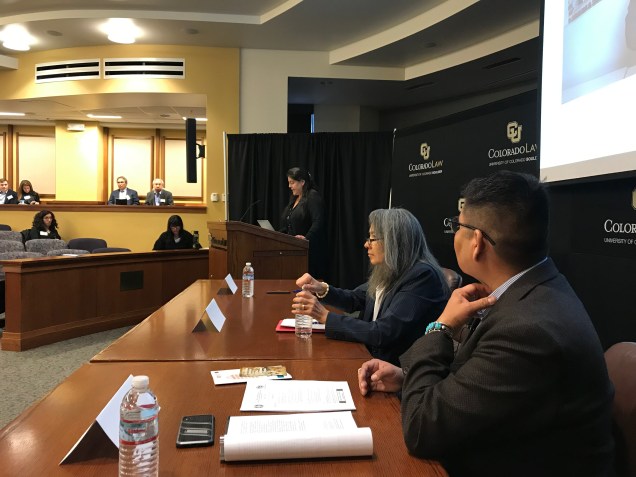
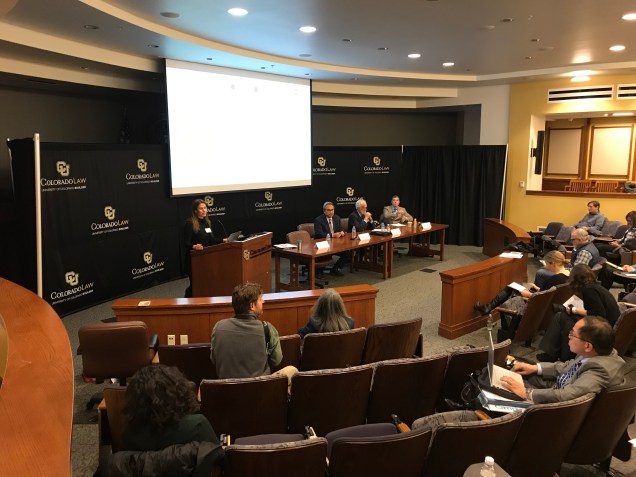
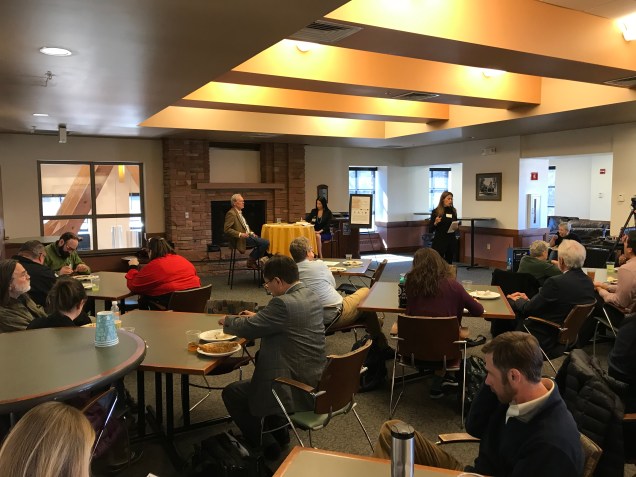
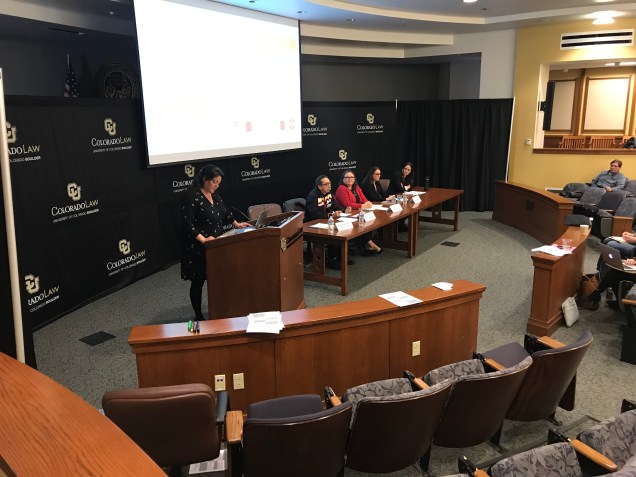
CU/NARF Conference Pics

Kristen Carpenter
Dean James Anaya
John Echohawk
Heather Whiteman Runs Him, Dalee Sambo Dorough, Nathaniel Brown

Kristen Carpenter, James Anaya, Steven Moore, Greg Johnson
Rob Williams
Charles Wilkinson, Rebecca Tsosie, Kristen Carpenter
Erika Yamada, Alexey Tsykatev, Cristina Coc, Tracey Whare, Kunihiko Yoshida
Heather Whiteman Runs Him, Greg Bigler, Wenona Singel, Angela Riley, Carla Fredericks

Colorado Law School Indian Law Conference Livestream

Here:

Pi Day National Indian Law Library Bulletin (3/14/2019)

Here:

The National Indian Law Library added new content to the Indian Law Bulletins on 3/13/19.

U.S. Supreme Court Bulletin
http://www.narf.org/nill/bulletins/sct/2018-2019update.html
Petition for certiorari was filed on 3/4/19 in:
Teck Metals LTD v. The Confederated Tribes of the Colville Reservation (Comprehensive Environmental Response, Compensation, and Liability Act)

Law Review & Bar Journal Bulletin (contact us if you need help finding a copy of an article)
https://www.narf.org/nill/bulletins/lawreviews/2019.html

  • State of Wyoming v. U.S. Dep’t of the Interior confused agency overlap with preclusion: BLM had authority to promulgate the fracking rule for public lands, not tribal lands.
  • Tribal sovereign authority and self-regulation of health care services: The legal framework and the Swinomish Tribe’s dental health program.
  • Monetizing tribal and state sovereign immunity in patent law: An attempt to neutralize the patent death squad.
  • Tribal (De) termination? Commercial speech, Native American imagery and cultural sovereignty.
  • The last judicial frontier: The fight for recognition and legitimacy of tribal courts.

Federal Courts Bulletin
https://www.narf.org/nill/bulletins/federal/2019.html
Little Traverse Bay Bands of Odawa Indians v. Whitmer (Reservation Boundaries)
Blue Lake Rancheria Economic Development Corporation v. Commissioner of Internal Revenue (Employment Taxation)

State Courts Bulletin
https://www.narf.org/nill/bulletins/state/2019.html
Smith v. State (Jury Selection)
Matter of A. J. M. R. (Indian Child Welfare Act – Notice)

News Bulletin
https://www.narf.org/nill/bulletins/news/currentnews.html
In the Health & Welfare section, we feature articles about missing Native American women and children.

U.S. Legislation Bulletin
https://www.narf.org/nill/bulletins/legislation/116_uslegislation.html
The following were added:

  • H.R.1514: To sever United States Government relations with the Creek Nation of Oklahoma until such time as the Creek Nation of Oklahoma restores full Tribal citizenship to the Creek Freedman disenfranchised in the October 6, 1979, Creek Nation vote and fulfills all its treaty obligations with the Government of the United States, and for other purposes.
  • H.R.1643: To establish a grant program that provides grants to States, Territories of the United States, and Indian tribes for the pre-exposure prophylaxis (PrEP) programs, and for other purposes.
  • S.689: A bill to amend the Animal Health Protection Act to support State and Tribal efforts to develop and implement management strategies to address chronic wasting disease among deer, elk, and moose populations, to support research regarding the causes of chronic wasting disease and methods to control the further spread of the disease, and for other purposes.
  • S.Res.100: A resolution recognizing the heritage, culture, and contributions of American Indian, Alaska Native, and Native Hawaiian women in the United States.

Fifth Circuit Rules in Favor of Texas over Alabama-Coushatta Tribe on Gaming

Here is the opinion in State of Texas v. Alabama-Coushatta Tribe.

Briefs and lower court materials here.

High Country News: “The Karuk Tribe fights a growing wildfire threat and a lack of funding”

Here.