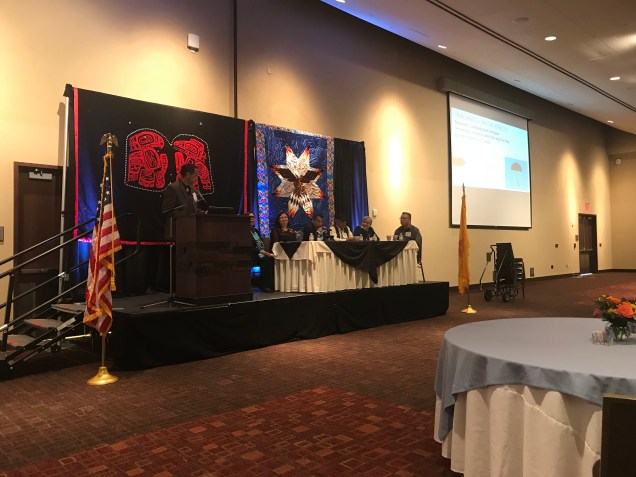
NAICJA 2018 Annual Conference Panel #1


Here.
An excerpt:
“In many ways, it’s almost like gaslighting,” Wenona Singel says of the Johnson v. M’Intosh case. “You’re learning about … certain rights that are associated with property rights … knowing all along that these rights have not been respected, and were not enforced for your own ancestors.”
Here is “Pokagon Band starts $25M building project.”
Here. See “Pipeline to Tribal Sovereignty: Celebrating the Pre-Law Summer Institute’s 50th Class” beginning on page 6.
Here.
Elizabeth Reese has posted “Or to the People: Popular Sovereignty and the Power to Choose a Government,” published in the Cardozo Law Review, on SSRN.
Here is the abstract:
To protect state sovereignty, contemporary textualism has reinvigorated the Tenth Amendment as a judicially enforceable limit on federal powers. However, in casting the Tenth Amendment as the states’ rights amendment, these textualists have inexplicably glossed over the Tenth Amendment’s final four words, which reserve powers to “the people.” This Article highlights this inconsistency and argues that this omission ignores a vital structural protection against federal and state tyranny. Viewed through the same textualism that reinvigorated state sovereignty, the Tenth Amendment’s final words cannot be redundant or superfluous but rather define and protect the people as a sovereign body capable of wielding specific powers — particularly those powers that the Constitution places beyond the reach of our governments. Primarily, the Tenth Amendment protects that power which is at the heart of popular sovereignty as well as the foundation of our democracy, the power of the people to choose their government. The Tenth Amendment ought to protect popular sovereignty — as it protects state sovereignty — by serving as a source for robust judicial review of federal and state laws that infringe on popular sovereignty. Recognizing this overlooked portion of the Tenth Amendment could alter current legal doctrine surrounding voting rights by treating free, fair, and accessible elections as a matter of competing sovereign powers rather than individual voting rights. By ignoring the people in the Tenth Amendment, American jurisprudence has ignored a vital structural protection against federal and state tyranny and risked government-driven erosion of democracy in America.
 Turtle Talk
You must be logged in to post a comment.