Ninth Circuit Decides Klamath-Trinity River Flow Dispute in Favor of Feds and Tribes

Here is the opinion in San Luis & Delta-Mendota Water Authority v. Haugrud.

From the court’s syllabus:

The panel affirmed in part and reversed in part the district court’s judgment, and held that the Bureau of Reclamation had the authority to implement the 2013 release of Trinity River water from the Lewiston Dam, above and beyond the amount designated in the applicable water release schedule.

Reversing the district court, the panel held that the Act of August 12, 1955, gave the Bureau the authority to implement the 2013 flow augmentation release to protect fish in the lower Klamath River. Affirming the district court, the panel also held that the 2013 flow augmentation release did not violate Central Valley Project Improvement Act (“CVPIA”) section 3406(b)(23), which called for a permanent water release that would serve only the Trinity River basin. The panel further held that the 2013 flow augmentation release did not violate California water law and, in turn, did not violate the Reclamation Act of 1902 or CVPIA section 3411(a), both of which require the Bureau to comply with state water permitting requirements.

Briefs here.
Neil Gorsuch Senate Judiciary Committee Questionnaire

Here.

And yes Judge Gorsuch mentions Yellowbear v. Lampert as one of his top 10 decisions (see pages 30-31).

Our post on Judge Gorsuch’s Indian law record is here.

Fletcher on Statutory Divestiture of Tribal Sovereignty

“Statutory Divestiture of Tribal Sovereignty” is now available on SSRN, here. Forthcoming in the Federal Lawyer, April 2017.

The abstract:

The Supreme Court’s non-decision in Dollar General v. Mississippi Band of Choctaw Indians is evidence not only of disagreement on tribal civil jurisdiction but perhaps also uncertainty in how to analyze divestiture of tribal sovereignty. Most scholars (including myself) have described the Court’s behavior in tribal sovereign authority cases as one of judicial supremacy, in that the Court merely makes policy choices based on its own ideological views of tribal power. That is a mistake. Persuaded by the federal government’s argument in Dollar General, I now argue that the proper analysis rests with federal statutes. Indian law practitioners can and should reconsider the Court’s prior decisions in this vein, as the best ones already do, and analyze tribal sovereign powers in the paradigm of statutory divestiture rather than judicial supremacy.

Moyers & Co.: “The Trump Administration’s Lies About Voter Fraud Will Lead to Massive Voter Suppression”

Lies have a purpose.

Here.

Ninth Circuit Briefs in Northern Arapaho Tribe v. LaCounte

Here:

BIA Opening Brief

Northern Arapaho Tribe Answer Brief

Other briefs TK.

Lower court materials here.

North Dakota SCT Awards Attorney Fees to Defendants in Indian Country Tort Claim Brought in State Court

Here is the opinion in Tillich v. Bruce.

An excerpt:

Don Bruce, Vinier Davis, and Linda Davis (“Defendants”) appeal from a judgment granting their motion to dismiss and denying their request for attorney fees. We reverse the district court’s denial of the Defendants’ request for attorney fees under N.D.C.C. § 28-26-01(2) and remand for calculation of attorney fees based upon accepted factors and order the district court award attorney fees to the Defendants.

Briefs:

1. Tillich v. Bruce – Appellee Brief
Abstract: Argument date: Oct. 2016. Topic: Torts (Negligence, Liab., Nuis.). Judge: Hon. M. Richard Geiger.


2. Tillich v. Bruce – Appellant Brief
Abstract: Argument date: Oct. 2016. Topic: Torts (Negligence, Liab., Nuis.). Judge: Hon. M. Richard Geiger.


3. Tillich v. Bruce – Reply Brief
Abstract: Argument date: Oct. 2016. Topic: Torts (Negligence, Liab., Nuis.). Judge: Hon. M. Richard Geiger.

Carolina Academic Press Book Announcement — Graham & Van Zyl-Chavarro: “Education, Media, and the UN Declaration on the Rights of Indigenous Peoples”

Here:

Education, Media, and the UN Declaration on the Rights of Indigenous Peoples

Lorie M. Graham & Amy Van Zyl-Chavarro

Education and media are important societal tools for sustaining and transmitting cultures. Yet for Indigenous Peoples, just the opposite has been true for much of modern history.  They have been used to silence indigenous voices, support forced assimilation, and perpetuate inequalities and marginalization. This book examines the three articles of the UN Declaration on the Rights of Indigenous Peoples aimed at countering these injustices: Article 14 on the right to education, Article 15 on the right to non-discrimination and accuracy in public information, and Article 16 on the right to media.  It explores the intrinsic and instrumental value these international norms hold for self-determining indigenous polities, and how additional domestic laws and policies can lead to their robust implementation.

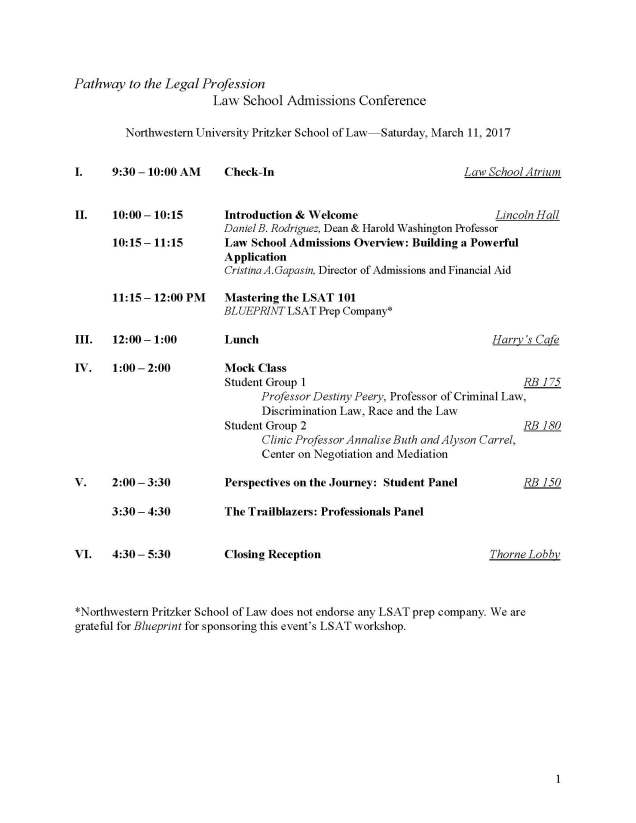
8th Spokane County Bar Association Indian Law Conference

Here (PDF):

2017-02-24-spokane-indian-law-conference-flyer_page_1

Continue reading

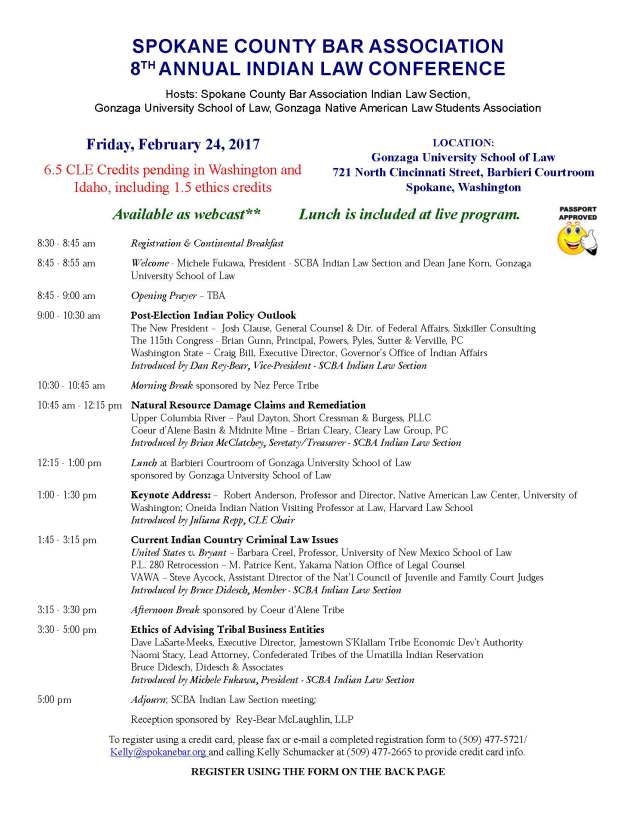
Northwestern Pritzker School of Law: Law School Admissions Conference

Here are details:

Pathway to the Legal Profession Law School Admissions Conference

Saturday, March 11, 2017 10:00 a.m. – 5:30 p.m. 

Check-in starts at 9:30am

We cordially invite you to attend the Pathway to the Legal Profession Conference. This conference will give prospective law school applicants a comprehensive overview of the law school application process and advice on how to successfully navigate it from applicant to law student. Current law students from diverse, non-traditional backgrounds, including first generation students and students with limited financial means, want to help attendees from similar backgrounds journey from law school applicant, to law school student, to lawyer.

The all-day conference consists of:

  • A workshop on mastering the LSAT
  • A law school admissions presentation
  • Mock law class taught by a real law school professor
  • Various panels made up of diverse lawyers and current law students sharing their wisdom and insight as well as answering your questions
  • Mentorship opportunities
  • Lunch will be provided

The conference will take place at: Northwestern Pritzker School of Law

375 East Chicago Avenue, Chicago, Illinois 60611

Please RSVP at https://goo.gl/forms/THk4Msx1vIjjHuos1. Registration closes March 6th at 5:00 p.m. Space is limited.

Agenda (PDF):

2017-pathway-conference-agenda