Here is the order list today.
Briefs here.
From Mother Jones, here is “The Obama Administration Is Using Racist Court Rulings to Deny Citizenship to 55,000 People.”
HT to How Appealing.
Here is the opinion in Timbisha Shoshone Tribe v. Dept. of Interior.
The court’s syllabus:
The panel dismissed, as moot, an appeal from the district court’s dismissal of a case challenging the Department of the Interior’s recognition of the election results for leadership authority over the Timbisha Shoshone Tribe. The panel held that the Tribe’s recent adoption of a new constitution, which overhauled tribal membership requirements, mooted the appeal because there was no chance that a remand to the Bureau of Indian Affairs would make any difference whatsoever in the election results.
Briefs here.
Here:
| The National Indian Law Library added new content to the Indian Law Bulletins on 5/26/16.
State Courts Bulletin News Bulletin U.S. Legislation Bulletin |
Here is the complaint in Caddo Nation of Oklahoma v. Witchita and Affiliated Tribes (W.D. Okla.):
Here, filed in the Central District of California:
Book page here. Highly recommended.
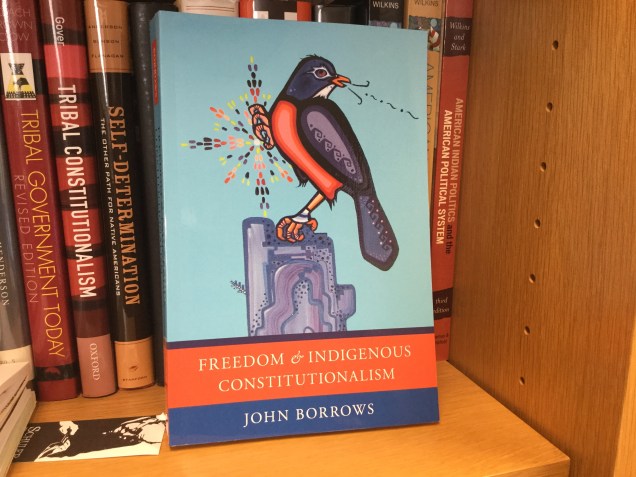
Blurb:
Indigenous traditions can be uplifting, positive, and liberating forces when they are connected to living systems of thought and practice. Problems arise when they are treated as timeless models of unchanging truth that require unwavering deference and unquestioning obedience.Freedom and Indigenous Constitutionalism celebrates the emancipatory potential of Indigenous traditions, considers their value as the basis for good laws and good lives, and critiques the failure of Canadian constitutional traditions to recognize their significance.
Demonstrating how Canada’s constitutional structures marginalize Indigenous peoples’ ability to exercise power in the real world, John Borrows uses Ojibwe law, stories, and principles to suggest alternative ways in which Indigenous peoples can work to enhance freedom. Among the stimulating issues he approaches are the democratic potential of civil disobedience, the hazards of applying originalism rather than living tree jurisprudence in the interpretation of Aboriginal and treaty rights, American legislative actions that could also animate Indigenous self-determination in Canada, and the opportunity for Indigenous governmental action to address violence against women.
Here.
Here are those briefs:
I should be specific — here is what the order says:
We decline to rule on the show cause motion at this time. However, we cannot ignore the allegation there has been noncompliance with our April 25th Order. Therefore, we hereby order the Petitioners and the Court Clerk to each respond in writing on or before June 3, 2016, on whether Petitioners complaints and related motions have been accepted for filing. The parties shall submit their written responses by mail to the Northwest Indian Court System ….
Here is the order:
Briefs in that petition are here.
The April 25 order is here.
The lower court returned a Galanda filing on May 23 (note “rejected” stamp in upper court):
Galanda v Bernard Rejected Motion for Injunction
And again on May 25:
 Turtle Talk
You must be logged in to post a comment.