Here is the complaint in Little River Band of Ottawa Indians and Its Employee Welfare Plan v. Blue Cross Blue Shield of Michigan (W.D. Mich.):
Author: Matthew L.M. Fletcher
NAGPRA Regs on Unclaimed Ancestors and Funerary Objects, etc.
The summary:
This final rule provides procedures for the disposition of unclaimed human remains, funerary objects, sacred objects, or objects of cultural patrimony excavated or discovered on, and removed from, Federal lands after November 16, 1990. It implements section 3(b) of the Native American Graves Protection and Repatriation Act.
“High Death Rates on the High Plains: A Call for Better Data on American Indian Communities”
From the Federal Reserve Bank of Minneapolis’ Center for Indian Country Development, here.
National NALSA Executive Board Luncheon with Fletcher
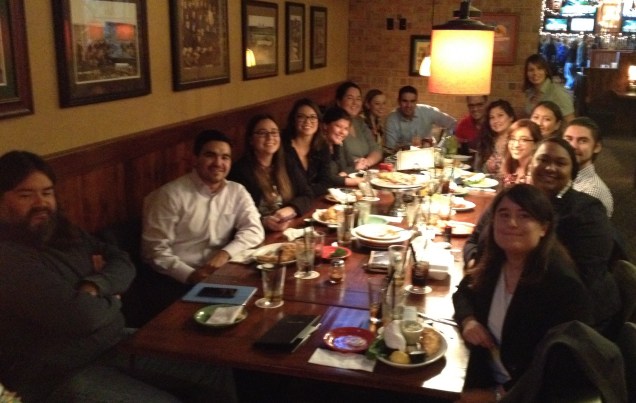
After much laziness and delay on my part, here is the 2015-16 NNALSA ed board about to devour a carb-heavy lunch at Pizza House in The EL (yes, it’s true I’m thinking about pizza in this pic, but having a great time!):
Federal Court Denies Discovery into Tribal Judicial Bias Claims
Here is the order in FMC Corp. v. Shoshone-Bannock Tribes (D. Idaho):
43 DCT Order Denying Discovery
An excerpt:
To allow a litigant to conduct full-blown discovery here, after he failed to conduct discovery in the tribal court litigation, would ignore National Farmers and Iowa Mutual. Those cases directed that all issues be fully presented to the tribal court so that it might cure any problems and give the federal court the benefit of its expertise. If a due process issue like judicial bias is not fully developed through discovery before being presented to the tribal court – and the litigant simply sits on his discovery rights until he gets into federal court – the tribal court never gets a chance to review the discovery, apply its expertise, and cure any unfair judicial bias revealed by the discovery. That is antithetical to the analysis of National Farmers and Iowa Mutual.
Penn. Law Review Note on the Constitutionality of VAWA’s Tribal Jurisdiction Provisions
The abstract:
Special domestic violence criminal jurisdiction for Indian tribes took effect nationally on March 7, 2015, and it was a historic moment for the tribes. Ever since the Supreme Court’s 1978 decision in Oliphant v. Suquamish Indian Tribe, tribes had been powerless to exercise criminal jurisdiction over non‐Indian defendants. Because the Court held that “Indian tribes do not have inherent jurisdiction to try and punish non‐Indians,” an unfortunate gap in enforcement resulted: for crimes committed in Indian country, where states’ criminal jurisdiction is limited and where the federal government lacks the resources to prosecute crimes effectively, non‐Indian offenders regularly escaped prosecution. This problem was particularly disturbing in the context of domestic violence and related crimes. For example, sixty‐seven percent of the sexual abuse and related offenses committed in Indian country and charged in fiscal years 2005–2009 were left unprosecuted by the federal government.
Enter VAWA 2013 and special domestic violence criminal jurisdiction for Indian tribes. Recognizing that “much of the violence against Indian women is perpetrated by non‐Indian men” who “regularly go unpunished,” Congress intended special domestic violence criminal jurisdiction to fill the prosecutorial enforcement gap for domestic violence offenses. Codified at 13 U.S.C. § 1304, the new provisions recognize tribes’ “inherent power . . . to exercise special domestic violence criminal jurisdiction over all persons”—including non‐Indians.
Although tribes and their advocates have celebrated VAWA 2013’s partial override of the Oliphantdecision, special domestic violence criminal jurisdiction has yet to withstand constitutional scrutiny at the Supreme Court. In the debates before VAWA 2013’s passage, tribal jurisdiction over non‐Indians sparked controversy because legislators and commentators understood that non‐Indian defendants prosecuted and tried in tribal court would not receive the full protection of the federal Constitution. This constitutional question—whether the Constitution applies in full force in prosecutions brought under special domestic violence criminal jurisdiction—turns on whether the expanded tribal jurisdiction is an exercise of “inherent” tribal sovereignty or delegated federal authority. If the new jurisdiction is an exercise of inherent tribal sovereignty, then tribes are not obligated to provide non‐Indian defendants with the full protection of the federal Constitution. But if the new jurisdiction is delegated federal authority, then non‐Indian defendants would be entitled to the full panoply of rights under the federal Constitution—including, potentially, the right to an Article III judge appointed by the President and confirmed by the Senate under Article II of the Constitution. The bounds of inherent tribal sovereignty could thus determine whether special domestic violence criminal jurisdiction lives or dies.
This Comment begins in Part I by outlining the history of tribal criminal jurisdiction in Indian country, with a focus on the law most relevant to analyzing the bounds of tribes’ inherent sovereignty to adjudicate crimes over non‐Indians. Part II explains VAWA 2013’s special domestic violence criminal jurisdiction in more detail and summarizes how it has been implemented since the statute’s enactment. Part III discusses the arguments for and against finding that tribes have inherent tribal sovereignty to exercise special domestic violence criminal jurisdiction, and why the outcome matters for both tribes and non‐Indian defendants. Part IV takes an aside to note the lurking influence of the congressional plenary power doctrine, which gives Congress broad authority to legislate in the realm of Indian affairs. And Part V outlines how courts’ ultimate rulings (and their underlying reasoning) would affect special domestic violence criminal jurisdiction’s future. The Conclusion addresses the underlying questions: What are the bounds of tribes’ inherent sovereignty? From what does that sovereignty derive? The answer will affect not just special domestic violence criminal jurisdiction under VAWA 2013, but also possible future expansions of tribal criminal jurisdiction by Congress.
Salt River Pima Maricopa Indian Community Assistant General Counsel
Assistant General Counsel (Government)
Salary: $118,122.00 – $174,233.00 Annually
OPENING DATE: 11/09/15
CLOSING DATE: 12/08/15 11:59 PM
Application instructions: To apply or view full job description go to www.srpmic-nsn.gov/employment<http://www.srpmic-nsn.gov/employment> *Resumes alone will not be accepted. Apply before closing date 12/08/2015
DEFINITION:
This position will primarily provide legal advice to the Community’s Treasury Department and the Community’s Risk Management and Benefit Committees. Primary consideration will be given to applicants who have experience in tribal taxation, employee benefit plans, self-funded insurance plans, and risk management. Applicants must have experience and knowledge of the IRS Code, ACA, ERISA, and other relevant federal, state, and tribal laws.
Under general supervision of the General Counsel, provides legal review and advice to the Salt River Pima-Maricopa Indian Community (SRPMIC or Community) government. Ensures that applicable laws are followed so that tribal sovereignty is protected and enhanced. Provides assistance to avoid or prevent expensive legal disputes and litigation and protects the Community’s legal interests. This job class is treated as FLSA Exempt.
EXAMPLES OF TASKS:
Essential Functions: Essential functions, may vary among positions, but may include the following tasks, knowledge, skills, abilities, and other characteristics.This list of tasks ILLUSTRATIVE ONLY and is not intended to be a comprehensive listing of tasks performed by all positions in this classification.
Tasks:
- Reviews documents and provides legal advice to protect SRPMIC interests; may be assigned as counsel for civil litigation involving the Community and its departments. Advises supervisor, Community departments, divisions and enterprises and the Community Council. Reviews law, rules, regulations, contracts, intergovernmental agreements, grant documents and related legal documents.
- Provides legal guidance on personnel, program and other related issues to various departments of the SRPMIC. Drafts legal documents, ordinances and policies. May provide functional, project specific supervision to support staff.
- Works with a broad range of clients such as Council members, government employees, boards, and committees and other officials, many of whom are Community members. Interacts with Community members and the public on a day-to-day basis.
- Represents SRPMIC at internal, external or intergovernmental meetings related to the various interests of the Community. Attendances at after-hour meetings may be required.
- Conducts legal research and provides advice related to Community interests, tribal sovereignty, tribal jurisdiction, taxation, membership, health and human resources, law enforcement, human resources/personnel matters, civil litigation, commercial transactions, business law and/or other areas.
- Assists in the preparation of legal and technical correspondence for the President, Vice President, Community Manager, and General Counsel.
- Keeps informed of federal law, regulations, administrative and court decisions in Indian law and interacts with other tribal, federal, state or local agencies on behalf of the Community.
- May supervise non-attorneys, law clerks, interns, and/or externs.
- Performs other job related duties that enhance and/or facilitate department operations.
Knowledge, Skills, Abilities and Other Characteristics:
* Knowledge of the history, culture, laws, rules, customs and traditions of the Salt River Pima-Maricopa Indian Community.
* Knowledge of Federal Indian law.
* Knowledge of case law appropriate to the issues and cases assigned.
* Knowledge of legal research methods, legal research software, and use of data bases.
* Skill in interpreting and applying statues, ordinances and other laws.
* Skill in interpreting and applying rules, regulations, and policies.
* Skill in establishing and maintaining effective working relationships with SRPMIC Administration, Community Council members, Community members officials and appropriate outside entities.
* Skill in communicating and instructing others, using both technical and non-technical language as appropriate to provide legal counsel and explanation to those for whom the subject matter is unfamiliar and/or difficult to understand.
* Ability to get along well and cooperate with others.
* Ability to communicate orally and in writing with administrative staff, community member officials, outside entities and co-workers.
* Ability to perform legal research.
* Ability to analyze difficult and complex legal issues and apply legal principles.
* Ability to adapt to changing work situations and assignments.
* Ability to exercise resourcefulness in addressing new problems.
* Ability to present statements of fact, law and argument clearly and logically, in both written and oral form.
* Ability to produce written documents with clearly organized thoughts, using proper sentence construction, punctuation and grammar.
* Ability to set priorities and be organized in order to meet deadlines.
* Ability to analyze and aid in drafting and commenting on proposed legislation.
* Ability to appear as counsel of record in litigation or other adjudicatory proceedings.
MINIMUM QUALIFICATIONS:
Qualifications:
Education and Experience: Graduation from an American Bar Associated accredited college or university with a Law Degree (Juris Doctor) and at least three (3) years of experience as a licensed attorney representing Native American tribes in legal affairs. Experience that has provided knowledge of social, political, and legal framework of tribal governments is essential.
Equivalency: Any equivalent combination of experience and education that will allow the applicant to satisfactorily perform the duties of the job may be considered when filling this position.
SPECIAL REQUIREMENTS:
Special Requirements: Must be a member in good standing with a state bar association or if currently not a member of the Arizona Bar must take and pass the Arizona Bar Exam and be admitted to the Arizona Bar within one (1) year from the date of hire. In addition, candidates must have the ability to practice in Federal District Court if required. Must attend a minimum of 15 hours annual continuing legal education as related to job and approved by supervisor.
Important Notes
Prior to hire as an employee, applicants will be subject to drug and alcohol testing. Will be required to pass a pre-employment background/fingerprint check. Employees are subject to random and alcohol testing. “SRPMIC is an Equal Opportunity/Affirmative Action Employer” Preference will be given to a qualified Community Member, then a qualified Native American and then other qualified candidate.
Application instructions: To apply or view full job description go to www.srpmic-nsn.gov/employment<http://www.srpmic-nsn.gov/employment> *Resumes alone will not be accepted. Apply before closing date 12/08/2015
General Counsel for the Saint Regis Mohawk Tribe in Akwesasne, NY
General Counsel for the Saint Regis Mohawk Tribe in Akwesasne, NY
Division: Legal
Job Code: 22-1011
Status: Full-time, Exempt
Deadline: Open Until Filled
Description of position:
Under the direction of Tribal Council, General Counsel is responsible for legal advice, representation, assistance and support to the Saint Regis Mohawk Tribe, its government, departments and enterprises. General Counsel represents the Tribe in all aspects of tribal government, including, but not limited to, Commercial Transactions, Contracts, Gaming, application of environment and natural resources laws and other federal laws relating to Tribal and reservation agencies and enterprises, federal-state jurisdiction issues, taxation issues, economic development, construction law, employment law, federal administrative proceedings, Tribal court jurisdiction issues, hunting and fishing rights and tribal taxation law and policy. General Counsel advises Tribal Council on intergovernmental agreements, drafting ordinances and resolutions, advises tribal agencies such as social services, police department, and tribal enterprises, drafts leases and other commercial documents. The General Counsel is responsible for the administration of all assignments to the staff of the Office of the General Counsel including planning, development and legal strategy of all assignments and directives of the Saint Regis Mohawk Tribal Council. General Counsel will meet the aforementioned objectives by performing the following duties:
Essential Duties & Responsibilities:
- Exhibit a friendly and courteous manner when dealing with our employees and fellow associates.
- Supervise staff to include orientation, training, scheduling and evaluation. Coordinate with Tribal Council on the hiring of all professional legal staff of the Office of the General Counsel.
- Report regularly to Tribal Council on all assigned directives and assignments.
- Negotiate, draft and review contracts for the Tribe and its enterprises.
- Represent the Tribe, its government, departments and enterprises in various proceedings before federal, state, local and tribal court and administrative agencies.
- Draft and review ordinances, codes, rules, regulations and policies for the Tribal government.
- Provide legal advice and assistance to the Tribal government, departments and enterprises in various matters.
- Negotiate, draft and review agreements with other governments and governmental agencies.
- Coordinate with the Tribe’s outside attorneys any pending litigations and other legal projects to ensure that litigation does not negatively impact the Tribe’s future.
- Review and approve outside legal counsel’s bills in accordance with policies determined by Tribal Council.
- Maintains a comprehensive record of all past and pending legal matters involving or affecting the Tribe.
- Other related duties as assigned by Tribal Council.
Supervisory Requirements:
General Counsel shall carry out supervisory responsibilities in accordance with the organization’s policies and applicable Tribal procedures. General Counsel’s responsibilities also include interviewing, hiring, and training employees; planning, assigning, and directing work; appraising performance; rewarding and disciplining employees; addressing complaints and resolving problems within the Legal Department.
Qualification Requirements:
To perform this job successfully, an individual must be able to perform each essential duty satisfactorily. The requirements listed below are representative of the knowledge, skill, and/or ability required. Reasonable accommodations may be made to enable individuals with disabilities to perform the essential functions.
Education and/or Experience:
Required :
- Juris Doctor (JD) Degree from an accredited Law School with a license to practice law in New York State.
- At least 8-10 years’ experience practicing law and must have experience working with Federal and State legislation and administrative process.
- At least 3-5 years’ experience with Federal Indian Law Field.
- At least 3-5 years’ experience working with Federal and State legislation and administrative process.
- Experience drafting ordinances, codes, resolutions, policies and procedures and other governmental and administrative documents as required.
Preferred :
- Litigation experience preferred.
Other Skills and Abilities: Research, Strong oral and written communication skills along with research skills required in conjunction with the following:
- Talking to others to convey information effectively.
- Considering the relative costs and benefits of potential actions to choose the most appropriate one.
- Bringing others together and trying to reconcile differences.
- Considering the relative costs and benefits of potential actions to choose the most appropriate one.
- Identifying complex problems and reviewing related information to develop and evaluate options and implement solutions.
- Using logic and reasoning to identify the strengths and weaknesses of alternative solutions, conclusions or approaches to problems.
- Observing, receiving, and otherwise obtaining information from all relevant sources.
- Using relevant information and individual judgment to determine whether events or processes comply with laws, regulations, or standards.
- Developing specific goals and plans to prioritize, organize, and accomplish your work.
- Communicating with people inside and outside the organization, representing the organization to customers, the public, government, and other external sources. This information can be exchanged in person, in writing, or by telephone or e-mail.
Reasoning Ability:
Ability to solve practical problems and deal with a variety of concrete variables in situations where only limited standardization exists. Ability to interpret a variety of instructions furnished in written, oral, diagram, or schedule form.
Job Closing Date: Open Until Filled
Applicants must submit letter of interest, resume, supporting documents and proof of native preference eligibility by email to human.resources@srmt-nsn.gov or by mail to Human Resources, Saint Regis Mohawk Tribe, 412 State Route 37, Akwesasne, NY 13655.
NATIVE PREFERENCE POLICY
The Saint Regis Mohawk Tribe strives to be an equal opportunity employer dedicated to the policy of nondiscrimination based on race, sex, marital status, sexual orientation, religion, national origin, age, physical disability, veteran status or any other non-job related factor. Among qualified applicants, the SRMT will give preference to the qualified native applicant.
DRUG TESTING POLICY
The successful applicant for employment must submit to and pass a drug test for illegal substances prior to employment being confirmed.
BACKGROUND CHECK
All positions require candidates to successfully pass a background check prior to employment. Some positions require candidate(s) to successfully pass a criminal background check prior to beginning employment, used solely for employment related purposes.
FLEET POLICY
Must be at least 21 years of age, have and maintain a valid driver’s license with a clean driver abstract.
ELIGIBILITY LIST
A list of qualified candidates is created from interviews that may be used to appoint individuals to similar positions within the Saint Regis Mohawk Tribe for a period of six months.
# # # #
http://www.srmt-nsn.gov/employment/detail/general_council
Aimée Benedict
Publications Manager / Webmaster
Saint Regis Mohawk Tribe
412 State Route 37
Akwesasne, NY 13655
518-358-2272 ext. 2285
Iakhiienawá:se’ Sénha Aioianerénhake ne Enióhrhen’ne
(Helping Build A Better Tomorrow)
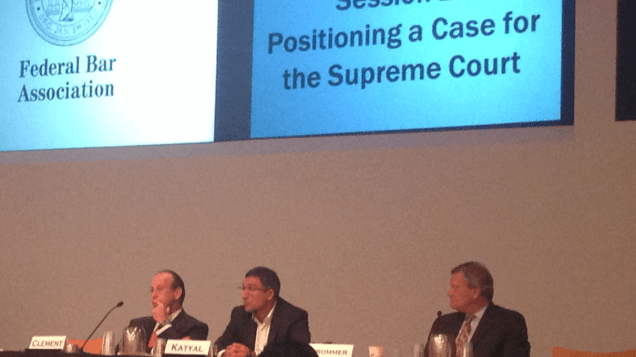
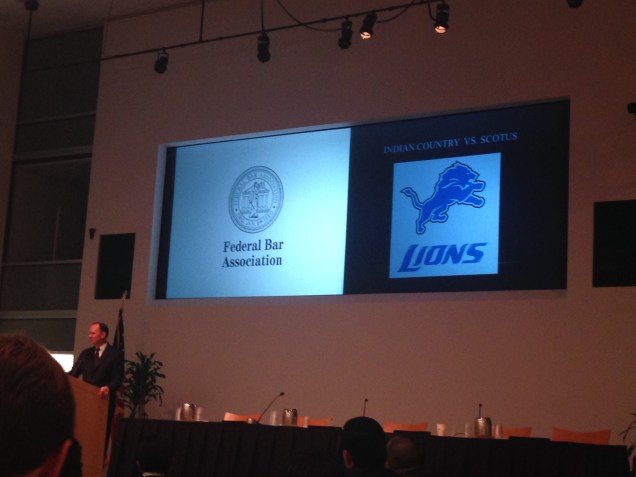
FBA D.C. Indian Law Conference Highlights
Here (miigwetch to John Simermyer and Venus Prince):

New in the Turtle Talk Bookshelf — Sarah Deer’s “The Beginning and End of Rape: Confronting Sexual Violence in Native America”
Highly, highly recommended.
Here is the website.

Here is the blurb:
How to address widespread violence against Native women—practically, theoretically, and legally—from the foremost advocate for understanding and change
The Beginning and End of Rape makes available the powerful writings in which Sarah Deer, who played a crucial role in the reauthorization of the Violence Against Women Act in 2013, has advocated for cultural and legal reforms to protect Native women from endemic sexual violence and abuse. These essays point to the possibility of actual and positive change in a world where Native women are systematically undervalued, left unprotected, and hurt.
 Turtle Talk
You must be logged in to post a comment.