Interior Solicitor — Indian Affairs Division Seeks Environmental Lawyer

Here. The description:

Providing legal advice to the Assistant Secretary – Indian Affairs and the Director of the Bureau of Indian Affairs and their staff on a range of Indian law matters, but with a particular focus on Federal environmental law as it applies to Indian lands. This attorney will analyze complex legal issues and provide oral and written legal advice on the application of several Federal environmental laws, including, but not limited to, the National Environmental Policy Act, the Comprehensive Environmental Response, Compensation, and Liability Act, and the Clean Water Act. This attorney will also work on legal issues involving reservation boundaries, land-into-trust, forestry and grazing, and rights-of-way. Attorney-Advisors in the Branch of Environment and Lands draft legal memoranda and review and comment on client documents, including correspondence, policy papers, draft decisions, regulations, and handbooks. Attorney-Advisors also engage in administrative litigation before the Interior Board of Indian Appeals and work closely with the Department of Justice on litigation in federal district and appellate courts.

Navajo Civil Jurisdiction over Deceased Tribal Member’s Body at Issue

Here is “California woman battles Navajo Nation over husband’s body.

CTAS Funding and Domestic Violence Courts for Special Domestic Violence Criminal Jurisdiction

CTAS Funding and Domestic Violence Courts for Special Domestic Violence Criminal Jurisdiction

Join us for a webinar on Feb 06, 2015 at 2:00 PM EST.

Register now!

https://attendee.gotowebinar.com/register/609568511130919169

NCAI, NCJFC, and TLPI are hosting this webinar for tribes considering exercising the Special Domestic Violence Criminal Jurisdiction under VAWA 2013. One way to meet the equal protection requirements is to establish a Domestic Violence Court/Docket. Under the current CTAS RFP purpose area #5 tribes (who do not currently have a CTAS grant from OVW) can apply for funding to support a Domestic Violence Court/Docket.

Presenters:
Honorable Steven D. Aycock, (Ret.), Judge-in-Residence, National Council of Juvenile and Family Court Judges
Kelly Gaines Stoner, Victim Advocacy Legal Specialist, Tribal Law & Policy Institute
Ginger Baran Lyons, Program Specialist, Office on Violence Against Women

Moderators:
Virginia Davis, Senior Policy Advisor, National Congress of American Indians
Chia Halpern Beetso, Tribal Court Specialist, Tribal Law & Policy Institute

Below are some possible resources relevant to creating a domestic violence court:

1)       Tribal Code Development,  tribal domestic violence case law resource, tribal protection orders, and other articles found at http://www.tribal-institute.org/lists/domestic.htm


2)       Article on Protecting Sovereignty : The Role of Tribal Courts at http://law.und.edu/tji/_files/docs/protecting-sovereignty-tribal-courts-2013.pdf

3)       Articles on protocols on prosecuting sexual assaults in Indian Country at www.swclap.org

4)       Tribal Code Checklist for Implementing Special Domestic Violence Criminal Jurisdiction at http://www.ncai.org/tribal-vawa/getting-started/tribal-code-development-checklist-for-implementation-aug-20142.pdf

5)       Domestic Violence Courts Key Principles (non-tribal specific) at http://www.courtinnovation.org/research/key-principles-domestic-violence-court-accountability

6)       History of Domestic Violence Courts (non-tribal specific) at http://www.courtinnovation.org/topic/domestic-violence

7)       Tulalip’s DV Court at http://www.tulaliptribes-nsn.gov/Home/Government/Departments/TribalCourt/DomesticViolence.aspx
After registering, you will receive a confirmation email containing information about joining the webinar.
Federal Court Denies Western Sky-Related Debt Collector’s Arbitration Claims; Class Action under Fair Debt Collection Practices Act May Proceed

Here are the materials in Bopp v. Zenith Financial Network Inc. (D. Ariz.):

25 Zenith Motion to Dismiss

26 Bopp Opposition

28 Zenith Reply

35 DCT Order Denying Motion to Dismiss

(Likely) Fake Indian Claim Dismissed by Detroit Federal Court

Here are the materials in El Nefertit v. Powelson (E.D. Mich.):

1 Complaint

5 DCT Order Dismissing Complaint

New York Bar Journal Article: “The Dutch, Munsees, and the Purchase of Manhattan Island from Opening Statements—Law, Jurisprudence, and the History of Dutch New York”

The Dutch, Munsees, and the Purchase of Manhattan Island
from Opening Statements—Law, Jurisprudence, and the History of Dutch New York
by Paul Otto
Edited by Albert M. Rosenblatt and Julia C. Rosenblatt

PDF here:

Otto Journal January 2015

Two New Indian Law Articles in Alaska Law Review

Here:

Fate Control and Human Rights: The Policies and Practices of Local Governance in America’s Arctic
Mara Kimmel
PDF

The loss of territoriality over lands conveyed under the Alaska Native Claims Settlement Act had adverse impacts for Alaskan tribal governance. Despite policy frameworks that emphasize the value of local governance at an international, regional, and statewide level, Alaskan tribes face unique obstacles to exercising their authority, with consequences for both human development and human rights. This Article examines how territoriality was lost and analyzes the four major effects of this loss on tribal governance. It then describes two distinct but complimentary strategies to rebuilding tribal governance authority that rely on both territorial and non-territorial authority.

Traditional Cultural Districts: An Opportunity for Alaska Tribes to Protect Subsistence Rights and Traditional Lands
Elizaveta Barrett Ristroph
PDF

Alaska tribes have limited control over their traditional lands and waters. Tribes may increase their influence through a Traditional Cultural District designation under Section 106 of the National Historic Preservation Act. This designation does not stop development, but requires federal agencies to consult with tribes regarding potential development that may impact the district. The consultation right applies regardless of whether a tribe owns or has formally designated the district. In Alaska, where no Traditional Cultural Districts exist as of 2014, there is potential for designating large areas of land or water that correspond to the range of traditionally important species.

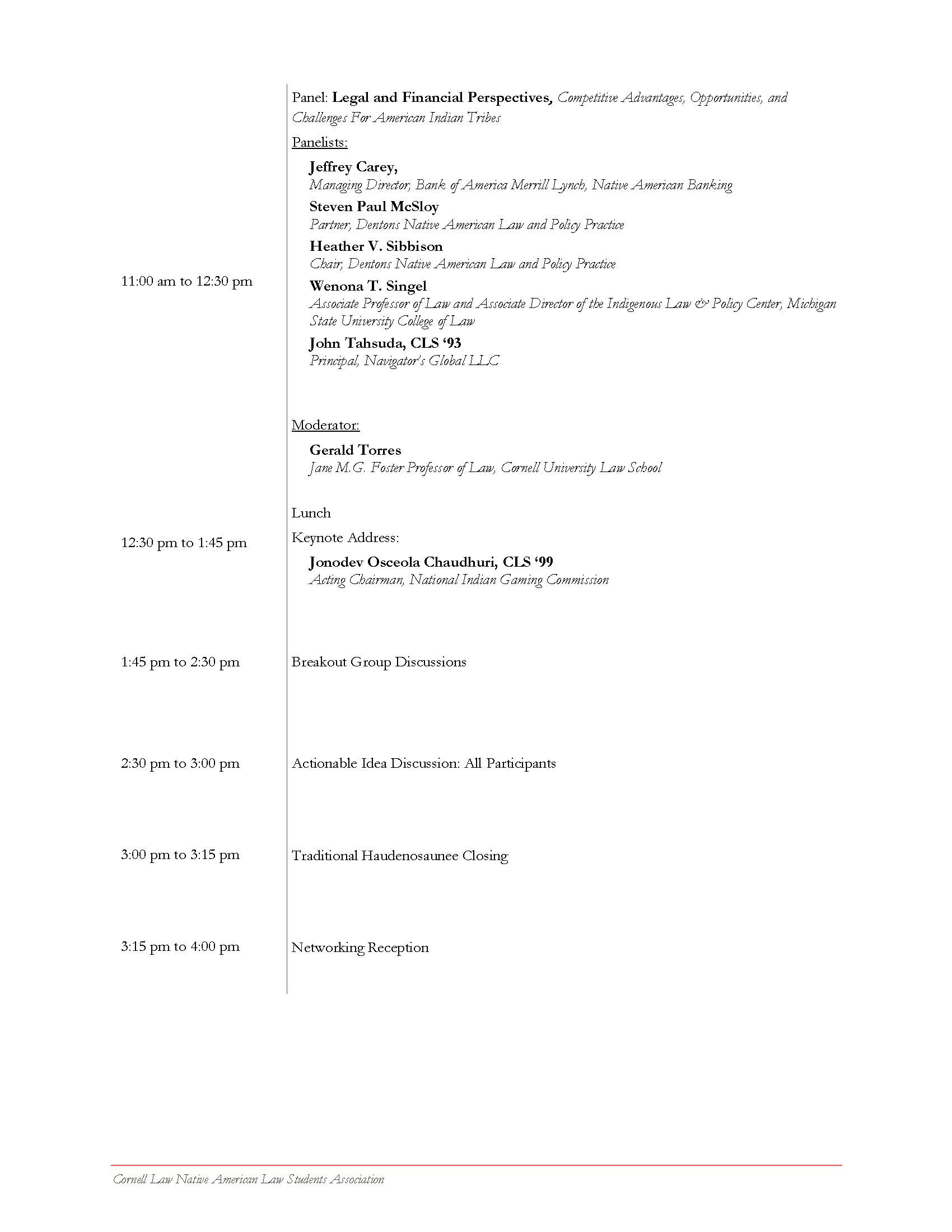
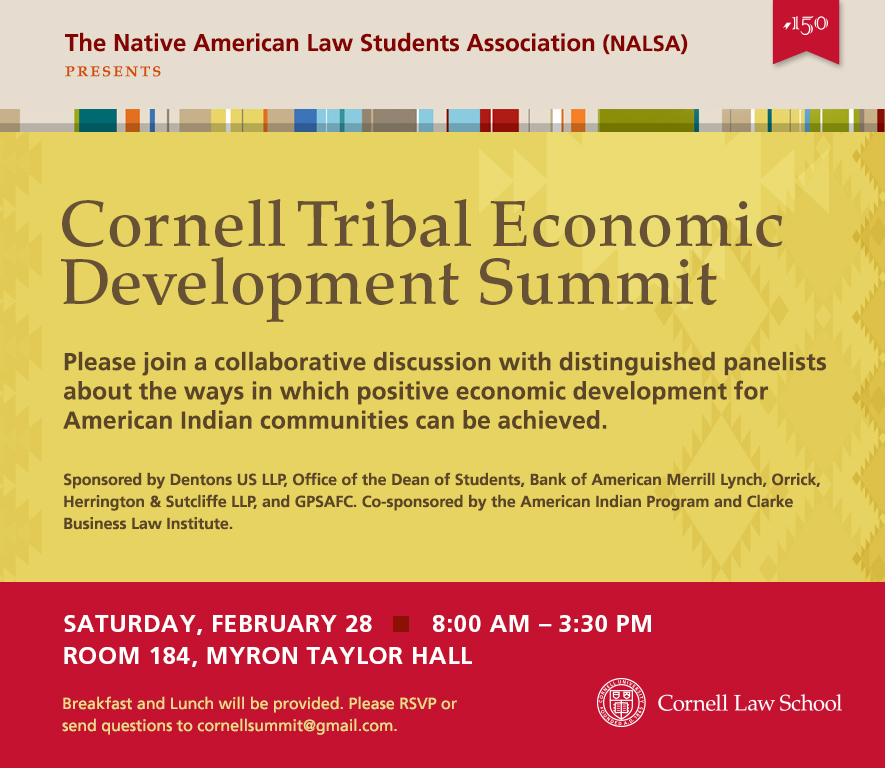
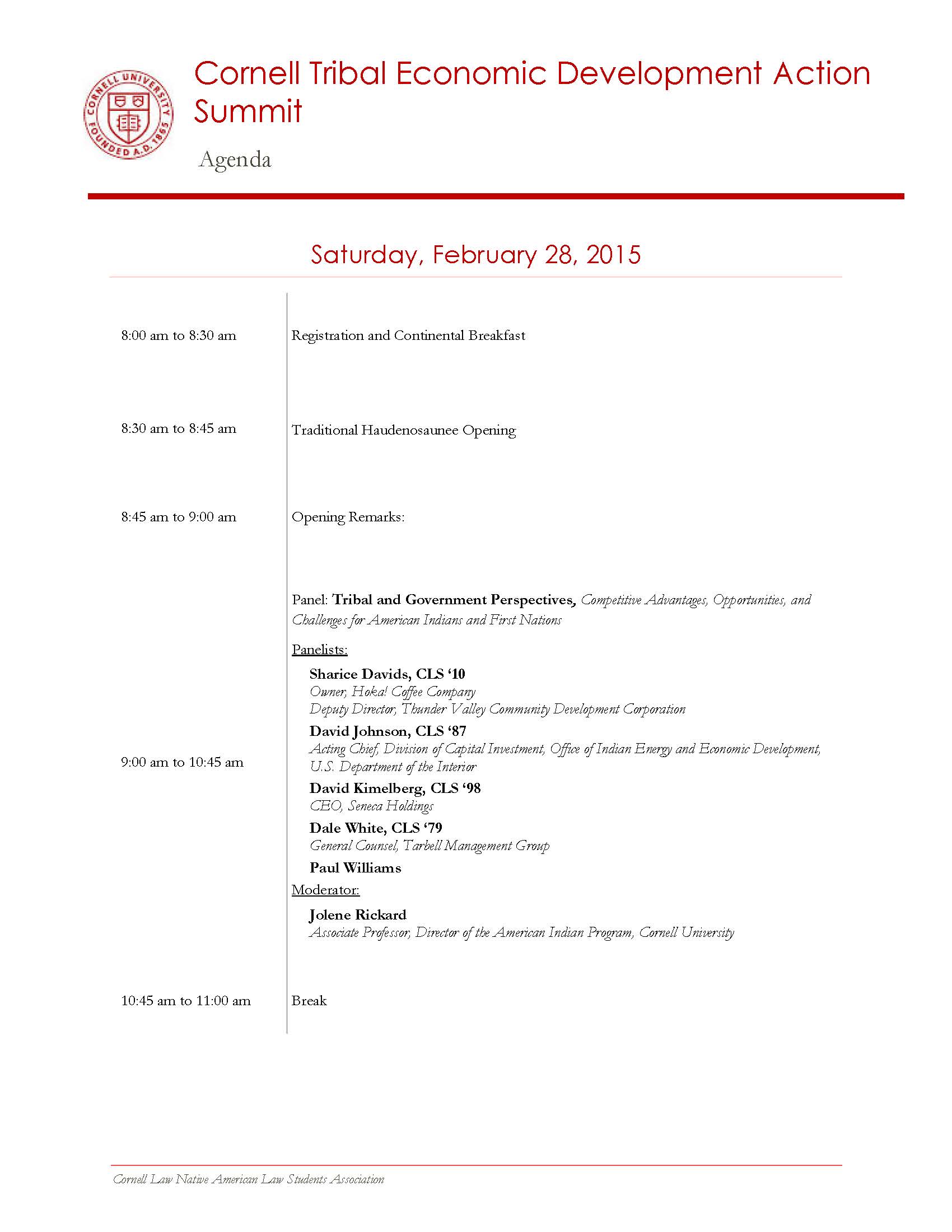
Cornell NALSA Tribal Economic Development Action Summit

Here:

2-28 NALSA_Summit

Agenda here (PDF):

Summit Tentative Agenda - February 4th_Page_1 Summit Tentative Agenda - February 4th_Page_2

Federal Forfeiture Action over $400,000 of NY Indian Tobacco Retailer

Here is the complaint in United States v. $400,000 (W.D. N.Y.):

1 Complaint for Forfeiture

Excerpts:

During the investigation, it was determined that the parties involved in the shipping of the contraband cigarettes in interstate commerce also filed false information to the appropriate taxation authorities as required under the Jenkins Act, Title 15, United States Code, Sections 375-378. All cigarette sales made by a stamping agent are required by New York State law to be recorded on a form known as Form CG which had to be sent on a monthly basis to the NYSDT in Albany, New York, with a certificate that the information contained therein was true and correct.

And:

During the time period of September 24, 2012 – January 14, 2013, AARON PIERCE through his corporation, AJ’s Wholesale LLC (“hereafter “AJ’s”) sold 403,413 cartons of cigarettes in a manner designed to make it look on paper as though the untaxed cigarettes were legitimately obtained through Ho-Chunk, Inc. (“HCID”) a tribal cigarette and tobacco distributor, a corporation operated by the Winnebago Tribe of Nebraska, as well as other Native American cigarette and tobacco suppliers.

Finally:

Ho-Chunk, Inc. is the parent company of HCI Logistics (HCIL) which is a commercial transportation company that HCID would use to transport product from the HCID warehouse in Winnebago, Nebraska. Neither HCID nor HCIL are licensed tobacco wholesalers or state stamping agents in Nebraska or New York State.

Oakland County Legal News Interview with Fletcher

Here.

Excerpts:

Pursglove: Is Indigenous Law a good field for law students?

Fletcher: For many Native students, Indian law is the reason they chose law school. Few other students have a chance to take classes where the history of their tribes and families is embedded in the cases and statutes we teach. For any student, it’s a good field, too. Indian gaming is a $30 billion a year business. Indian country natural resources extraction is probably even larger than that, or soon will be. Tribal governments routinely are the largest employers of their regional economies. We never have much trouble placing our alums in Indian law jobs if they want to do that work. It’s a hugely growing field.

Pursglove: Why are attorneys that understand Native American culture, and how it impacts legal issues, in high demand?

Fletcher: Tribal government and enterprise clients usually are American Indian people, and they want to hear the views and advice of people who have shared many of their same experiences. Also, the tribal client differs from the fundamental goals of corporate and state or federal governmental clients. Tribes are not wealth-maximizing entities with pressures from shareholders to prioritize profit; tribes may pass up opportunities for revenues because of the social or environmental costs. And tribes are governments, so their goals are similar to those of other governments, to maximize governmental revenue and services. But tribal governmental constituencies are more narrow than other governmental constituencies. In other words, there is no Citizens United-inspired relationship between tribes and business entities, and no Tea Party-inspired efforts to gut government services. And tribes must do all of this without a tax base similar to that enjoyed by states and the federal government.

Pursglove: What were the main issues in this field in the past year?

Fletcher: The main issues always involve tribal efforts to expand their governmental revenue. This past year saw the beginnings of a backlash against tribal efforts to engage in what they’re calling e-commerce, which includes things like payday lending, internet gaming, and other electronic business activities. Tribes usually try to avoid state regulation by asserting their immunity from state authority, and the Supreme Court decided a case affirming tribal immunity this year captioned Michigan v. Bay Mills Indian Community.