NARF Press Release re: Hunter Cox

Meet Hunter Cox – Siletz Grant Recipient from the Native American Rights Fund!

Each summer NARF hosts the summer clerkship program, a ten to twelve week program clerkfor second year law students.  Unlike most law clerk projects that consist mainly of legal research and writing, NARF’s projects are extremely challenging because NARF practices before federal, state, and tribal forums, and because most of its cases – whether at the administrative, trial, or appellate level – are complex and involve novel legal issues.
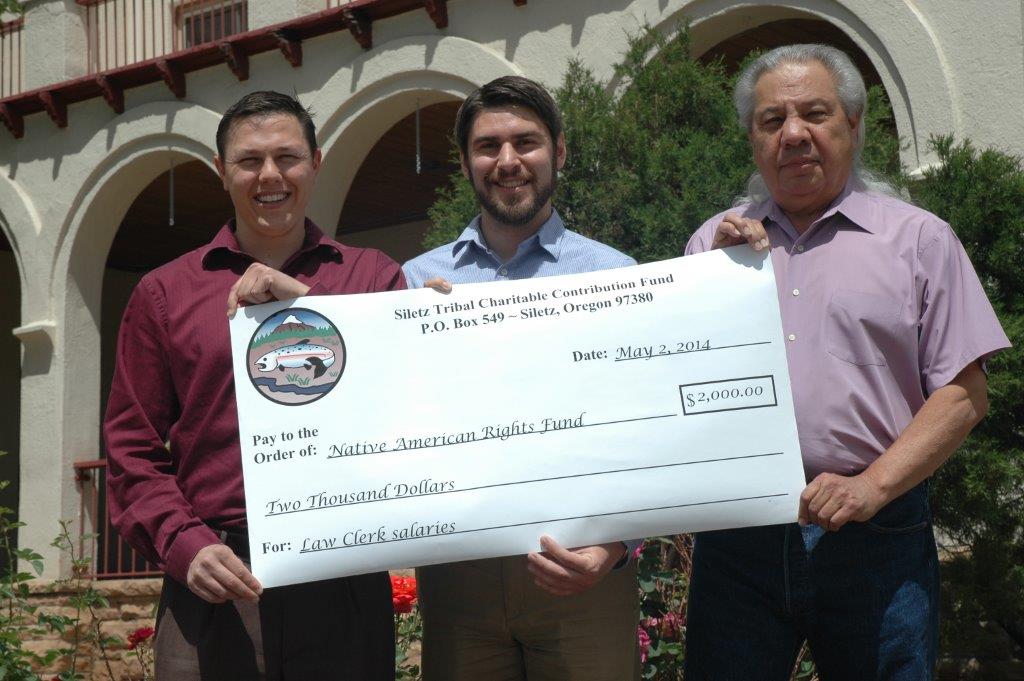
This summer the law clerk program was supported by a grant from the Confederated Tribes of Siletz Indians through the Siletz Tribal Charitable Contribution Fund.  This summer NARF has six law clerks – two in the Alaska office, one in the D.C. office, and three in the Boulder office. Law Clerk Hunter Cox (Prairie Band of Potawatomi Nation), was chosen to be the recipient of this grant due to his recent and impactful work collaborating with NARF attorney Steve Moore to protect the rights of Native high school students to wear their eagle feathers during their graduation ceremony.

Earlier this month, NARF, California Indian Legal Services (CILS), and the American Civil Liberties Union (ACLU) of Northern California advocated on behalf of Native students in Lemoore, California, who wanted to wear eagle feathers at their graduation ceremony.  The gift of an eagle feather is a great honor and is typically given to recognize an important transition in a young person’s life.  Many graduates are given eagle feathers in recognition of their educational journey and the honor the graduate brings to his or her family, community, and tribe.  Hunter, along with Steve, CILS, and ACLU, sent a letter on the students’ behalf requesting the school district to allow the students to wear their eagle feathers during graduation.  After initially denying the students requests, the school district relented once receiving the letter, and allowed the students to wear their feathers despite originally denying the students request.

To read the letter sent on the students’ behalf, click here.  And, to read the press about the students wearing their feathers, click here.

NARF thanks the Confederated Tribes of Siletz Indians and the Siletz Tribal Charitable Contribution Fund for its grant to further the NARF law clerk program, which allows Native law students to make an impact on Indian law and to Native people during their term at NARF.

CONTACT: For questions regarding eagle feathers – Steve Moore, Native American Rights Fund – 303-447-8760
For questions about NARF’s Law Clerk Program – Matthew Campbell, Native American Rights Fund – 303.447.8760

Bond Reformation/Tribal Court Jurisdiction Matter: Stifel v. LCO

Here are the materials so far in Stifel, Nicolaus & Company, Incorporated v. Lac Courte Oreilles Band of Lake Superior Chippewa Indians of Wisconsin (W.D. Wis.):

1 Stifel Complaint

10 LCO Motion to Dismiss or Stay

13 LCO Tribal Court Motion to Dismiss or Stay

14 Stifel Response

18 LCO Tribal Court Reply

19 LCO Reply

25 Stifel Motion for PI

29 Joint Stipulation re Stay of Tribal Court Proceedings

30 DCT Order Allowing Dismissal of Prior Motions wo Prejudice

38 Stifel Motion for Summary J

44 LCO Opposition

49 Stifel Reply

76 DCT Order

An excerpt:

Plaintiff Stifel, Nicolaus & Company, Inc. (“Stifel”) seeks equitable reformation of its Bond Purchase Agreement with defendant Lac Courte Oreilles Band of Lake Superior Chippewa Indians of Wisconsin (the “Band”), as well as a declaratory judgment that the Band may not proceed to sue Stifel in a currently-pending action in Lac Courte Oreilles Tribal Court. Before the court now is plaintiff’s motion for summary judgment on both claims. (Dkt.# 37.) Based on the undisputed facts of record, the court holds that Stifel is entitled to reformation of the Bond Purchase Agreement, but also concludes that the Band may proceed with its pending claims against Stifel in Lac Courte Oreilles Tribal Court. Although Stifel has had ample opportunity to do so already, because the Band did not affirmatively move for summary judgment, the court will give Stifel yet another opportunity to proffer additional evidence, if any, that the forum selection clause in the Bond Purchase Agreement clearly precludes the Band from proceeding in Tribal Court.

ABA Panel on Tribal Sovereignty — August 7, 2014

Here (PDF):

Sovereignty Economic Development FLYER 5-15-14

Second Circuit Affirms Dismissal of Stockbridge-Munsee New York Land Claims

Here is the opinion in Stockbridge-Munsee Community v. New York:

Stockbridge-Munsee CA2 Order

Briefs are here.

Eid: “Reasons to be optimistic about Alaska’s public safety crisis”

From the Alaska Dispatch.

An excerpt:

The report of the all-volunteer, bi-partisan commission, “A Roadmap for Making Native America Safer,” highlights Alaska’s violent crime epidemic. This includes  a domestic violence rate 10 times the national average and sexual assault rates 12 times higher.  It’s a crisis in the Bush, but also in Anchorage and other cities where families flee when village life becomes unbearable. Where criminals keep victimizing women and children because they were never held accountable for their crimes back home.

Randall Akee: “The press for Native Hawaiian federal recognition is presumptuous”

From the Hawaii Independent. A response to this news.

An excerpt:

In moving forward, what should be done? The process for Federal recognition was a knee-jerk reaction to the Rice v. Cayetano decision. Surely there are other legal strategies and plans that the Office of Hawaiian Affairs and State officials can undertake to protect the OHA trust assets and Native Hawaiian entitlement programs. In the 14 years since the decision, the trust and programs have survived without a serious attack. It should be noted that political winds change all the time and there is no absolute certainty with Federal recognition either. For instance, during the 1940s, 1950s and 1960s the US Federal government’s policy was to terminate the legal and political existence of some Federally recognized American Indian tribes in California, Oregon and a number of other US States. During the Civil Rights era of the 1960s and 1970s, the US Federal government made a significant change in that policy and worked to empower tribal governments. However, it is impossible to guarantee that future US Federal policies will not shift back in that direction again. 

538 on Impact of Washington Football Team Trademark Decision on National Electoral Politics

In short, virtually none.

Here.

New Scholarship on Employment Preferences and Statutory Exemptions for Alaska Native Corporations

Gregory S. Fisher & Erin “Faith” Rose have published “Selling Ice in Alaska: Employment Preferences and Statutory Exemptions for Alaska Native Corporations 40 Years After ANCSA” in the Alaska Law Review.

Here is the abstract:

In 1971, Congress enacted the Alaska Native Claims Settlement Act (ANCSA) in order to settle land disputes between Alaska Natives and the federal government. ANCSA established Alaska Native Corporations (ANCs), which were tasked with managing settlement funds to provide for the health, education, and economic welfare of Alaska Natives. To enable the ANCs to promote the interests of their shareholders, Congress exempted ANCs from certain employment restrictions contained in Title VII of the Civil Rights Act, but did not exempt ANCs from other worker-protective legislation. In subsequent decades, courts reviewing the preferential practices of ANCs have often construed these statutory exemptions narrowly, thus exposing ANCs to liability under various anti-discrimination statutes. This Article argues that Congress never intended to subject ANCs to these pieces of worker-protective legislation, despite court holdings to the contrary. The Article proposes two possible solutions to this discrepancy: (1) congressional amendment of ANCSA to clarify and further limit the extent of ANC liability; and (2) judicial adoption of a two-part test which would consider employment policies giving preference to Alaska Native shareholders in light of Congress’s intent to protect such preferences.

Godfrey & Kahn Environmental/Energy/Indian Law Associate Posting

GODFREY & KAHN SEEKS ENVIRONMENTAL/ENERGY/INDIAN LAW ASSOCIATE

Godfrey & Kahn, S.C., a general business practice firm with over 180 attorneys, is seeking an associate to work with the firm’s environmental/energy and Indian Nations law teams.

Strong academic credentials and an interest in environmental and sustainable energy solutions, as well as federal Indian law and tribal law, is required. Indian country experience preferred, but not required.

Most importantly, we are looking for individuals that are detail-oriented with strong business acumen and analytical and communication skills who will fit in with our team-oriented culture.

We offer an excellent benefit package, competitive compensation commensurate with experience and reasonable billable hour expectations. Please visit www.gklaw.com to apply.

Federal Court Issues TRO in Paskenta Leadership Dispute to Prevent Disturbance of Gaming Operations

Here are the updated materials in State of California v. Paskenta Band of Nomlaki Indians (E.D. Cal.):

8 Response to Motion for TRO

12 Supplemental Authority

13 Supplemental Authority

14 Supplemental Authority

18 DCT Order Granting TRO

An excerpt:

Based upon the forgoing findings of fact and conclusions of law, and good cause appearing, it is hereby ordered that the State’s motion for a temporary restraining order is GRANTED without requiring the State to post security, and that the Tribe, and all of its officers, agents, servants, employees and attorneys and all persons acting under the Tribe’s direction and control, including both factions or groups currently claiming to constitute the tribal government, are hereby ENJOINED AND RESTRAINED from:

1. Attempting to disturb, modify or otherwise change the circumstances currently in effect with respect to operation of the Rolling Hills Casino in Corning, California.

2. Deploying any armed personnel of any nature within 100 yards from the Casino, the property on which the Casino is located, and tribal properties surrounding the Casino including the nearby hotels, gas station, and RV park (collectively, Tribal Properties).

3. Possessing, carrying, displaying, or otherwise having firearms on the Tribal Properties. This order will remain in effect until 6 p.m. on July 2, 2014 unless modified by the court before then, or extended by the court to continue in effect thereafter. FED. R. CIV. P. 65(b)(2).

At the preliminary injunction hearing on June 30, 2014, the court will entertain further argument regarding whether the court should enter a broader injunction preventing any class III gaming activity on Paskenta lands. 25 U.S.C. § 2710(d)(7)(A)(ii). Any supplemental briefing advancing this position must be filed by June 23, and any opposition briefing by June 27; no brief shall exceed 20 pages.

Complaint and motion here.