Here is a new class action filed in California, Labajo v. First International Bank & Trust (C.D. Cal.), alleging involvement by Miami Tribe and Santee Sioux:
And another First International-related suit, Graham v. BMO Harris Bank NA (D. Conn.):
Here is a new class action filed in California, Labajo v. First International Bank & Trust (C.D. Cal.), alleging involvement by Miami Tribe and Santee Sioux:
And another First International-related suit, Graham v. BMO Harris Bank NA (D. Conn.):
Here is the unpublished opinion in United States v. Pego.
We posted the indictment and a procedural matter on the blog.
Here, from Alaska Indigenous Blog. Links to several news outlets on this story are on the blog.
An excerpt:
Every Alaska Native language will now be recognized as official languages of the State of Alaska in addition to English. The lone precedent is Hawai’i, which recognizes Hawai’ian as official in addition to English via constitutional convention in 1987. Many, many people worked very hard to get this bill through the 28th Alaska State Legislature, which will adjourn today or very early tomorrow morning.
Here.
An excerpt:
A second lesson from the conflict is the double standard employed by the federal government in enforcing its grazing laws. The treatment of Bundy stands in stark contrast to the human rights violations committed against Carrie and Mary Dann (Mary Dann passed in 2005) by the U.S. government. The Dann sisters, members of the Western Shoshone tribe, grazed cattle on their ancestral lands in what is now central Nevada. In contrast to the Bundy incident, where the federal government had clear jurisdiction over the lands, the Dann sisters exercised reserved rights to use the land under the 1863 Treaty of Ruby Valley – a treaty that ceded no lands to the United States, only granting the U.S. certain access rights to lands. The Indian Claims Commission – created in 1946 to “compensate” tribes for unfairly taken lands (but not return the lands) – decided that U.S. title to Western Shoshone lands had been obtained through gradual encroachment by whites – that is, United State’s title to the land was based on simply taking it!
Anna O’Brien has published Misadventures in Indian Law: The Supreme Court’s Patchak Decision in the University of Colorado Law Review
Here is the abstract:
Ever since European colonization of the Americas began in the fifteenth century, there has been friction between the new arrivals and the native inhabitants. The United States has dealt with its “Indian problem” through assimilation, reservations, and eventually, self-determination for Indian tribes. But Indian tribes have never truly lost their sovereignty. Over the years, the United States has developed a vast body of Indian law to try and find a place for tribal sovereignty in a legal and political system created by the conquerors. In a recent case, the Supreme Court created a new rule that will allow non-Indians to sue the Federal Government to divest the government of title to land held in trust for Indian tribes. The decision has dealt a blow to tribal sovereignty by rendering the trust status of tribal lands uncertain. That uncertainty should be removed by legislative action.
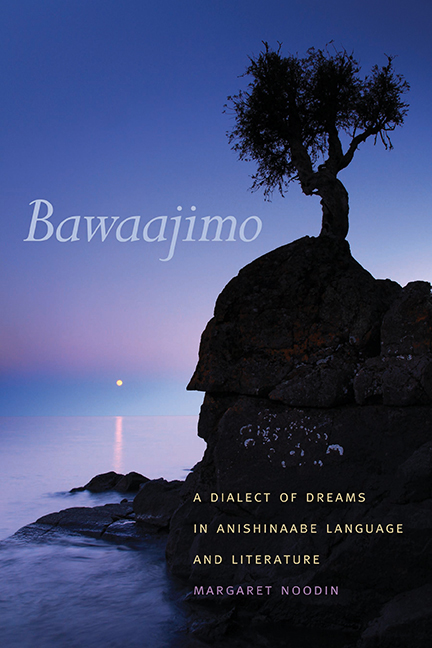
From the MSU Press Website:
Bawaajimo: A Dialect of Dreams in Anishinaabe Language and Literature combines literary criticism, sociolinguistics, native studies, and poetics to introduce an Anishinaabe way of reading.
Although nationally specific, the book speaks to a broad audience by demonstrating an indigenous literary methodology. Investigating the language itself, its place of origin, its sound and structure, and its current usage provides new critical connections between North American fiction, Native American literatures, and Anishinaabe narrative. The four Anishinaabe authors discussed in the book, Louise Erdrich, Jim Northrup, Basil Johnston, and Gerald Vizenor, share an ethnic heritage but are connected more clearly by a culture of tales, songs, and beliefs. Each of them has heard, studied, and written in Anishinaabemowin, making their heritage language a part of the backdrop and sometimes the medium, of their work. All of them reference the power and influence of the Great Lakes region and the Anishinaabeakiing, and they connect the landscape to the original language. As they reconstruct and deconstruct the aadizookaan, the traditional tales of Nanabozho and other mythic figures, they grapple with the legacy of cultural genocide and write toward a future that places ancient beliefs in the center of the cultural horizon.
Here are the materials in Great Elk Dancer for his Elk Nation v. Miller (S.D. Ohio):
An excerpt:
Plaintiff, who is proceeding pro se and in forma pauperis, brings this civil rights action under 43 U.S.C. § 1983. In a nutshell, Plaintiff asserts Defendants arbitrarily and capriciously interfered with his business operations and targeted him for harassment because he is a Native American, thereby violating his federal constitutional rights. On August 19, 2013, the Magistrate Judge issued a Second Initial Screening Report and Recommendation (“R & R”) in which he recommended that the Court allow this lawsuit to proceed against Defendants Mayor J. Martin Irvine, Fire Chief Brian Robertson, Officer Josh Mowery, and City Services Director Steve Shaw (collectively, “City Defendants”). R & R 11, ECF No. 17. He also recommended that the Court dismiss the remaining Defendants. Id. In addition, the Magistrate Judge recommended that the Court deny Defendants’ motions to strike Plaintiffs first amended complaint. Id. at 11 (denying ECF Nos. 9 & 13). The City Defendants filed timely objections to the R & R. ECF No. 19. The Court now considers those objections.
Here.
News coverage via pechanga.
If anyone has the opinion, please send along.


You must be logged in to post a comment.