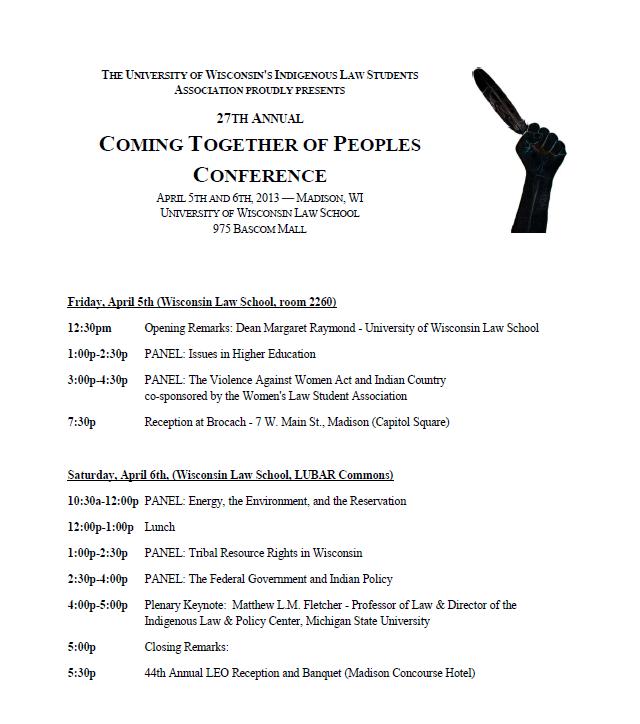
2013 Wisconsin ILSA Annual Conference Agenda — Today and Tomorrow

Here.

From the ILSA website:

Please join us at the UW Law School on April 5-6, 2013, for our 27th Annual Coming Together of Peoples Conference.
ILSA is also pleased to announce that this year’s keynote speaker will be Matthew L.M. Fletcher, Professor of Law and Director of the Indigenous Law and Policy Center at Michigan State University.
More details are below.
Following the Coming Together of Peoples Conference, the UW Law School and Latino Law Student Association will be hosting the 44th Annual LEO Banquet at the Concourse Hotel that evening. There will be a reception from 5:30 to 7:00 p.m. with dinner immediately following. ILSA invites you to join us in celebrating the Legal Education Opportunities program.

2013-CTOPC1

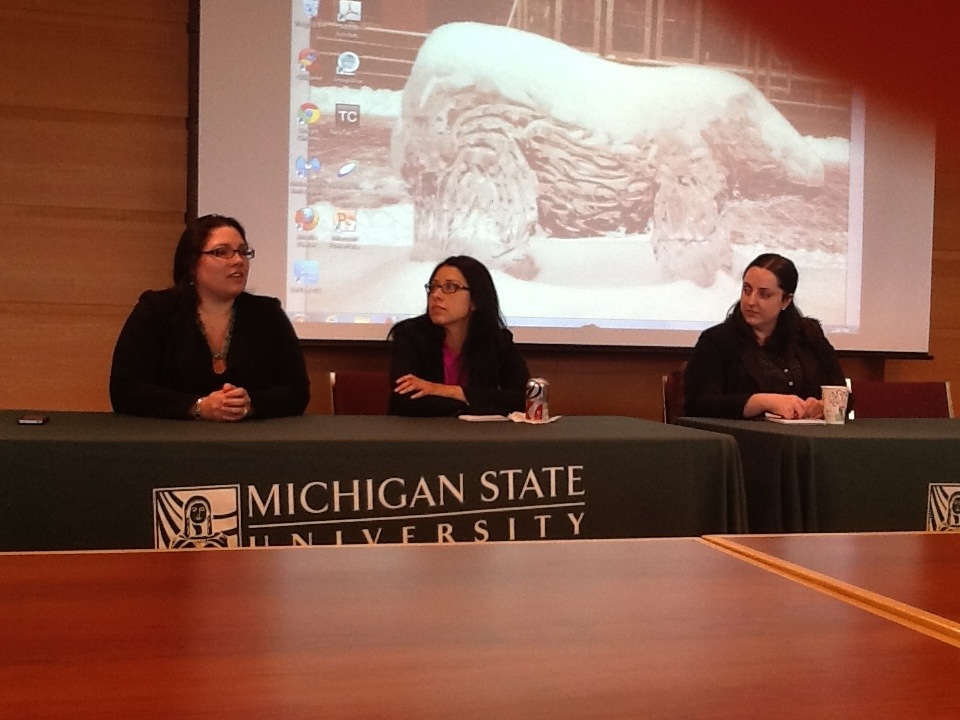
Michigan State Law Career Panel

Karrie Wichtman, Sharon Avery, Erin Lane

20130404-131139.jpg

NYTs: Hopis Try to Stop Paris Auction of Artifacts

Here.

An excerpt:

The Néret-Minet auction house in Paris says that its sale, on April 12, will be one of the largest auctions of Hopi artifacts ever, and it estimates that it will bring in $1 million. Many of the objects are more than 100 years old and carry estimates of $10,000 to $35,000. The auction house says that among the spirits represented are the Crow Mother, the Little Fire God and the Mud Head Clown.

“Sacred items like this should not have a commercial value,” said Leigh J. Kuwanwisiwma, director of the Hopi Cultural Preservation Office in Kykotsmovi, Ariz. “The bottom line is we believe they were taken illegally.”

Christine Haight Farley on the Washington Redskins Trademark Question

Here. Thanks to Ezra for this.

An excerpt:

How would you feel about a wine called “Khoran?” Apparently, the word “Khoran” is Armenian for altar, which is why a company sought to trademark “Khoran” for wine in the United States. But should such a trademark be registered by the US government when, being phonetically equivalent to the sacred text of Islam, it may offend Muslims when used to denote an alcoholic beverage? In this case, the trademark was refused registration by the US trademark office.

Should a trademark application for jeans called “Jesus Jeans” be treated any differently? In the US and European Union, this registration was allowed, however, China, Switzerland, Australia, Norway, Cuba, Turkey, Uzbekistan, Tajikistan and Kyrgyzstan have all refused the trademark, and Britain’s trademark office rejected its as “morally offensive to the public”.

What should we do about offensive trademarks? Granted, this is not the biggest problem that plagues us today and there are very few offensive trademarks that are still in use. Perhaps the most obvious thing to do is to vote with our dollars. That is, generally the market will correct the problem since merchants usually do not want to offend their customers.

And yet there still are some trademarks out there that offend. And some of them offend deeply. One of those trademarks is “Redskins”, which is the trademark for the professional American football team in Washington, DC.

List of Law Schools that Regularly Offer Indian Law Courses

Chi-miigwetch to Angelique EagleWoman and Micah Runnels at Idaho Law for putting together this spreadsheet — according to the info, 95 out of 202 law schools (47 percent) offer Indian law classes regularly.

Here is the excel spreadsheet:

Law Schools Offering Indian Law Course Regularly

And here is a pdf (not as pretty):

Law Schools Offering Indian Law Course Regularly

Luckerman v. Narragansett Indian Tribe: Suit to Recover Attorney Fees

Here is the tribe’s notice of removal to federal court, and the state court complaint is attached:

Notice of Removal + State Court Complaint


New Mexico Court of Appeals Reaffirms Holding that Fort Wingate Military Reservation (Navajo) is Indian Country

Here is the opinion in State v. Steven B.:

CA31,322

An excerpt:

In State v. Dick, 1999-NMCA-062, 127 N.M. 382, 981 P.2d 796, this Court held that the State does not have jurisdiction to prosecute a criminal defendant within Parcel Three of the former Fort Wingate Military Reservation (Parcel Three). A subsequent decision by the United States District Court for the District of New Mexico, United States v. M.C., 311  F. Supp. 2d 1281 (D.N.M. 2004), decided otherwise. In this appeal, the State asks this Court to agree with the federal court decision and overrule its holding in Dick. Because we continue to believe that Parcel Three is within “Indian country” as defined by 18 U.S.C. § 1151 (1949) and discussed in Alaska v. Native Village of Venetie Tribal Government (Venetie), 522 U.S. 520 (1998), we affirm the ruling of the district court dismissing the State’s prosecution.

The federal court decision referenced in the opinion is here: 311_F.Supp.2d_1281

Ninth Circuit Decides Competency Question in Criminal Case Involving Tohono O’odham Nation Juvenile

Here is the opinion in United States v. LKAV.

From the court’s syllabus:

Reversing an order committing a juvenile for a study of his competency to stand trial, the panel held that the district court erred by committing the juvenile under 18 U.S.C. § 4241(d), rather than proceeding pursuant to Federal Juvenile Delinquency Act.

Montana Federal Judge Cebull Retires over Racist Obama Email

Here. Via. News coverage. From the CA9:

In March 2012, U.S. District Judge Richard F. Cebull, District of Montana, wrote to Ninth Circuit Chief Judge Kozinski and asked that an inquiry be conducted as to whether Judge Cebull’s transmittal of an email containing racially offensive content constituted misconduct under the Judicial Conduct and Disability Act. 28 U.S.C. § 351 et seq.

Judge Cebull’s self-filed complaint and another were referred to a Special Committee which conducted a thorough and extensive investigation, interviewed numerous witnesses, considered voluminous documentation, including emails, and conducted an interview with Judge Cebull. The Special Committee’s Report was submitted to the Judicial Council in December 2012. On March 15, 2013 the Judicial Council issued an Order and Memorandum. Judicial Conduct Rule 20(f). Pursuant to Judicial Conduct Rules 22 and 24(a), the Order and Memorandum remains confidential during the appeal period.

At this time, Judge Cebull has submitted his retirement letter, pursuant to 28 U.S.C. § 371(a), effective May 3, 2013. The Council will have no further statement on this matter until Judge Cebull’s retirement is effective.

We posted about this last year here.

Lac Du Flambeau Declares State of Emergency — Synthetic and Illegal Drugs

Lac du Flambeau Band of Lake Superior Chippewa Indians Declares State of Emergency (2013 04 03 LDF Press Release LDF State of Emergency re Synthetic and Illegal Drugs FINAL).

Lac du Flambeau, Wisconsin – The Lac du Flambeau Band of Lake Superior Chippewa Indians Tribal Council declared a State of Emergency on March 29, 2013 as it relates to the threat of synthetic cannabinoids, synthetic cathinones and other illegal drugs affecting the Reservation and Tribal Members. Due to the rising popularity and proliferation of synthetic cannabinoids, synthetic cathinones and other illegal drugs within the Tribal Nation and surrounding community, the Tribal Council is taking decisive action against the new wave of drugs commonly referred to as K2, Spice, Potpourri, Bath Salts and Plant Food. The Tribal Council recognizes that Indian Country cannot remain idle when national reports and scientific information repeatedly publish that many first-time and repeat users are under the misconception that synthetic cannabinoids and synthetic cathinones are legal and/or safe when, in fact, they are not. Common side effects from a single use of synthetic cannabinoids include: hallucinations, panic attacks, anxiety, paranoia, agitation, extreme anger, seizure, tremors, kidney failure, liver failure, increased heart rate, elevated blood pressure, stroke, coma, and death. Due to the great irreparable harm and permanent effects that can result from using synthetic cannabinoids, synthetic cathinones and other illegal drugs, the Tribal Council is committing the necessary Tribal resources to rid the Reservation and the surrounding community of this catastrophic menace that will not only entail swift prosecution but will also include a Tribal campaign focused on prevention and a committed Tribal effort to provide extensive rehabilitation services. The Tribal Council remains firm that every Tribal department will partake in the war against synthetic cannabinoids, synthetic cathinones and other illegal drugs. As detailed in the Tribal Council Resolution, the Lac du Flambeau Tribe is dedicated to following extensive and comprehensive changes to return the Tribal Nation to the teachings of our ancestors:


  • Restructuring the Tribal Code to criminalize synthetic cannabinoids and synthetic cathinones;
  • Working with federal, local and state governments to ensure offenders are prosecuted;
  • Treatment and rehabilitation for those who have become addicted to synthetic cannabinoids and synthetic cathinones;
  • Revising the Tribal Housing Regulations and Policies to implement drug tests for tenants;
  • Banishment, Disenrollment and/or Forfeiture of Per Capita payments for those caught using, selling and/or manufacturing synthetic cannabinoids and synthetic cathinones;
  • Review of current and future grant funding specific to substance abuse prevention and intervention to specifically target this developing problem;
  • Mobilize existing “community-based” task forces to participate in door to door distribution of prevention materials and begin community education; and,
  • Introduction of an educational campaign in community schools and youth programs.