Atlantic: “Trump’s Nativism Is Transforming the Physical Landscape”

Here.

An excerpt:

Last December, Trump issued two orders that removed more than a million acres of federal land from Bears Ears National Monument and more than 800,000 acres from the Grand Staircase-Escalante National Monument, both in southern Utah. The immediate effect was to open much of the declassified land to mining for coal and uranium and drilling for oil and gas. This was also a dramatic assertion of presidential power, marking the first time national monuments have been shrunk in more than half a century. With suits underway before a federal judge in Washington, D.C.,  it will be the first time the president’s power to shrink or eliminate monuments has been tested in court. But it is also a first look at how Trumpian nationalism could shape the American landscape.
WaPo Story on Banned Poisons Still Being Used to Kill Eagles

Here is “Thirteen bald eagles were found dead in a field. This is what killed them.

South Dakota SCT Dismisses Appeal Challenging State Utility Approval of Keystone XL Pipeline

Here is the opinion:

in re keystone xl pipeline

Iowa Law Review Student Scholarship on How NHPA Fails Tribal Interests

Amanda M. Marincic has published “The National Historic Preservation Act: An Inadequate Attempt to Protect the Cultural and Religious Sites of Native Nations” in the Iowa Law Review.

An excerpt:

Beginning in 2016, the Standing Rock Sioux Tribe engaged in a highly-publicized, year-long legal battle with Energy Transfer Partners regarding the construction of the Dakota Access Pipeline (“DAPL”). The Tribe initially argued that the DAPL’s construction would destroy ancient burial sites and potentially poison their only source of drinking water, the Missouri River. The Tribe also argued that the agency involved in the project, the Army Corps of Engineers, did not fulfill the obligations required by the NHPA. For a while, the fate of the DAPL was uncertain, with permits for construction being denied and then granted. After the Army Corps of Engineers granted the permit pursuant to President Trump’s memorandum, construction on the DAPL was completed. After several failed attempts by the Standing Rock Sioux to halt operation of the DAPL, a federal district judge ruled in June 2017 that the environmental impact studies done on the DAPL were inadequate. While this ruling is a small victory for the Standing Rock Sioux Tribe, the NHPA was useless in protecting its cultural sites from significant damage.

Seminole Tribe v. FCC Petition for Review [NHPA]

Here is the petition in Seminole Tribe of Florida v. Federal Communications Commission (D.C. Cir.):

complaint

Sacred Dakota peace pipe sells for $40,000 — and buyer gives it back to Minnesota tribe

Story is HERE.

Consultation Webinar Announcement

Defending Tribal Sovereignty: The Ongoing Battle Over “Meaningful Consultation” and Self-Governance Over Natural and Cultural Resources

May 23, 2018

12:00 PM – 1:30 PM EST

Non-CLE Webinar

REGISTER NOW

(direct link: https://shop.americanbar.org/ebus/ABAEventsCalendar/EventDetails.aspx?productId=326797486)

The Dakota Access Pipeline, Bears Ears National Monument, de-listing of the gray wolf and the Greater Yellowstone Ecosystem Grizzly Bear, and the Bureau of Land Management’s rule regulating hydraulic fracturing on Federal and Indian land. These high-profile courtroom dramas are about more than the protection and use of natural resources: they encapsulate the ongoing struggle between tribes and federal agencies over the government’s obligation as trustee to engage in “meaningful consultation” about actions impacting Indian Country. These developments are just the latest in a centuries-long debate about the meaning of tribal sovereignty, and they offer an indigenous perspective into the promise of true environmental justice.

Continue reading

Eighth Circuit Decides Sisseton-Wahpeton Oyate v. U.S. Corps of Engineers

Here is the opinion. The court’s syllabus:

Action challenging the issuance of Clean Water Act permits allowing a farm owner to dredge and fill portions of Enemy Swim Lake in furtherance of the owner’s activities in building a road over an inlet of the lake; a 2010 letter from the Corps was not a final agency action for purposes of the permit and exemptions determinations as the letter did not affect the legal rights of the farm owner, the Tribe or the Corps; Tribe’s recapture claim under 33 U.S.C. Sec. 1344(f)(2) was a nonjusticiable enforcement action; Tribe’s claims arising from the Corps’s permit and exemption determinations made from 1998 to 2003 were barred by the statute of limitations and the Tribe was not eligible for equitable tolling because it had not diligently pursued its rights; dismissal of the Tribe’s arbitrary-and-capricious challenge to the Corps’s 2009 permit decision rejected as the Corps did not violate its own regulations in issuing the 2009 nationwide-permit determination; the district court did not make a final decision with respect to the lawfulness of the Corps’s regulations enacted pursuant to the National Historic Preservation Act, and the court lacked jurisdiction to review the lawfulness of the regulations.

Briefs.


Federal Court Rejects Diné CARE Challenge to Fracking Near Chaco Canyon

Here are the materials in Diné Citizens Against Ruining Our Environment v. Zinke (D.N.M.):

112 dine care opening brief

113 us response

117 reply

132 dct order


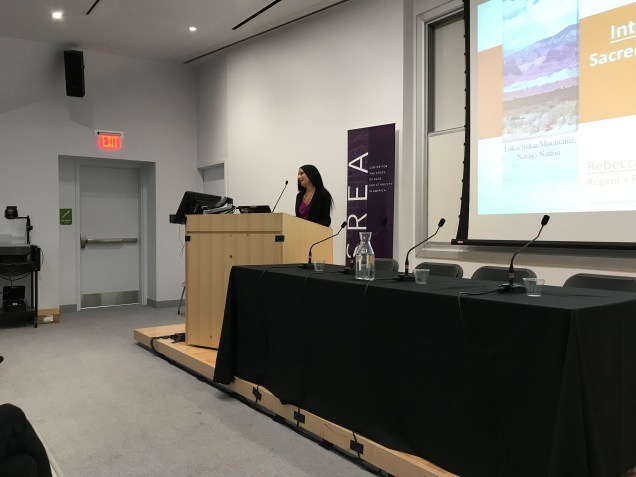
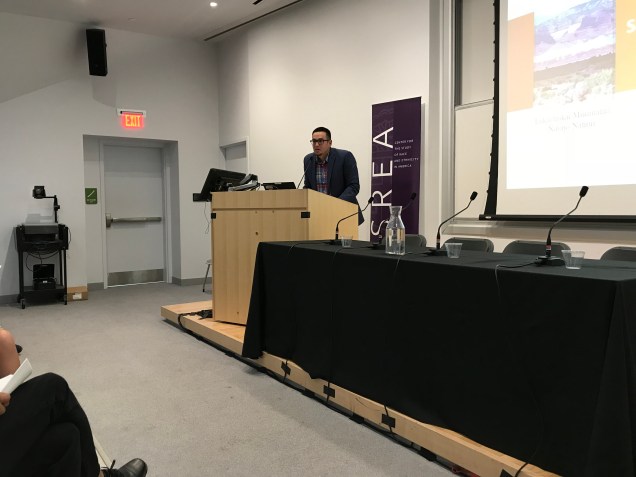
Brown U/CSREA Keynote Address: Rebecca Tsosie

619F08EB-9993-4539-8295-20FCEF826CA3
Rebecca Tsosie
BE4F2FF0-D455-486C-8E4E-CCADC09BE360
Nick Laluk