Here is “Standing Rock and the Erosion of Tribal Rights.”
cultural resources
NYTs Profile of One Mind Youth Movement
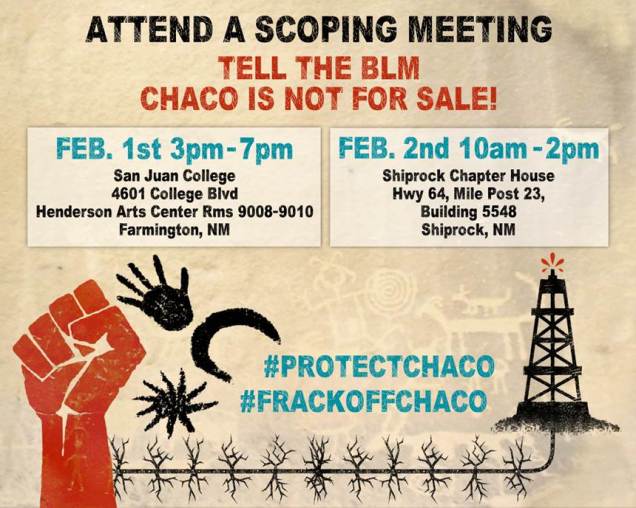
Tell Them Chaco Canyon is not For Sale (Scoping Meetings This Week)
Here:
ACLU: “President Trump Says the Dakota Access Pipeline ‘Serves the National Interest,’ Yet It Threatens Indian Rights and the Drinking Water of 18 Million People”
Here.
TICA CLE: “International Treaties, Agreements, and Instruments which include Traditional Knowledge, Genetic Resources, or Traditional Cultural Expressions” (Feb. 2, 2017)
Here.
The description:
This CLE will provide an overview of select international treaties, agreements and other instruments that have provisions regarding Traditional Knowledge (TK), Genetic Resources (GR), or Traditional Cultural Expressions (TCE).
Primarily in the past 25 years, many such documents have been negotiated, adopted or approved globally and regionally among various nation states, including the United States. TK, GR and TCE generally include those of Indigenous Peoples. Provisions on TK, GR, or TCE are contained in global or multi-national documents addressing, among other subjects: Human Rights, Climate Change, the Environment, Natural Resources, Free Trade, Food, Biological Diversity, Genetics, and Intellectual Property.
Currently, the World Intellectual Property Organization (WIPO), through an Inter-Governmental Committee, is considering a treaty or other instrument on TK, GR, and TCE. The U.S. Patent and Trademark Office likely will be conducting Listening Sessions with American Indian and Alaska Native Tribes in 2017 on the WIPO TK, GR and TCE instrument negotiations. This CLE will help tribal governments and their attorneys and advocates prepare for important discussions at the Listening Sessions.
Lee v. Tam Oral Argument Transcript
Here.
Ninth Circuit Oral Argument Video in Havasupai v. Provencio (Grand Canyon Uranium Mine)
Mohawk Descendant Prevails in Texas RFRA Action against Dept. of Corrections
Here is the opinion in Walters v. Livingston (Tex. Ct. App.)
Cathay Smith: “Oral Tradition and the Kennewick Man”
Cathay Y.N. Smith has published “Oral Tradition and the Kennewick Man” (PDF) in the Yale Law Journal Forum.
An excerpt:
On the eve of the upcoming repatriation of the Kennewick Man, this Essay focuses on the Ninth Circuit Court of Appeals’ summary rejection of the oral-tradition13 evidence introduced by Native American claimants in Bonnichsen v. United States which, as we now know, was ultimately more reliable than the then-available written historical and scientific records upon which the court relied. Courts disadvantage Native American claimants when they summarily reject oral-tradition evidence and prohibit “a major source of their knowledge, transmitted orally, across time, and in a distinctive style, [from being] meaningfully . . . entered as evidence, with the same consideration as written historical evidence.”14 Furthermore, courts’ inconsistent treatment of oral tradition also results in uncertainty and deprives Native American claimants of clear guidelines on what evidence they should or should not submit to prove their claims. This Essay suggests four factors for courts to consider on a case-by-case basis in the future to evaluate the probative value of oral-tradition evidence. It then proceeds to examine the inconsistent treatment of oral tradition evidence by U.S. courts, and urges courts to employ a balanced approach and adopt the factors offered in this Essay when evaluating Native American oral tradition in legal cases involving Native Americans claimants.
Federal Court Denies Rule 11 Sanctions Motion against Native American Arts by Party Whose Arguments Were Borderline Frivolous
Here are the materials in Native American Arts v. Peter Stone Co. (N.D. Ill.):
An excerpt:
In that briefing, the defendant’s primary position was that the plaintiff was collaterally estopped from establishing standing. Its secondary position was that plaintiff did not qualify as an Indian arts and crafts organization under the Indian Arts and Crafts Act (“IACA”), 25 U.S.C. § 305 IACA. Both arguments were rejected as non-starters. Native Am. Arts, Inc., 2015 U.S. Dist. LEXIS 74187, 2015 WL 3561439, at *5-7. An intemperate opponent might have called them frivolous, but the mere fact that a position is a loser does not make it frivolous.
Another:
As for this time, however, it’s worth noting that the defendant was unable to mount a challenge to plaintiff’s standing until six years into this litigation; that tends to further undermine defendant’s position that this was an obvious flaw in the plaintiff’s suit and one that plaintiff should have readily conceded and should have dropped its suit early on. Indeed, if it were such a frivolous suit it would seem that defendant could have put together a successful motion for summary judgment based on the standing issue some time ago, thereby avoiding many of the costs and expenses of which it now complains.
 Turtle Talk
You must be logged in to post a comment.