Federal Court Dismisses Pro Se Effort to Return “Peace Flag”

Here are the materials in Gopher v. Cascade County (D. Mont.):

Complaint

DCT Order Dismissing Complaint

An excerpt:

Ms. Gopher seeks the return of a 13-star peace flag bundle and its contents. She contends that Cascade County has exercised illegal control over the Gopher family’s artifacts. She seeks an immediate injunction barring the effect of a November 12, 2012 state court order, the return of her family’s property which was subject to a probate action which commenced in Cascade County on July 22, 2010, and a stay of all state court proceedings.

The Montana Supreme Court ruled on this matter previously.

Oneida Dancers at Packers Halftime Show

Here.

Kirsten Carlson’s “Priceless Property”

Kirsten Matoy Carlson recently published “Priceless Property” in the Georgia State Law Review.

Here is the abstract:

In 2011, the poorest American Indians in the United States refused to accept over one billion dollars from the United States government. They reiterated their long-held belief that money–even $ 1.3 billion–could not compensate them for the taking of their beloved Black Hills. A closer look at the formation of the Sioux claim to the Black Hills helps us to understand why the Sioux Nation has repeatedly rejected compensation for land taken by the United States over 100 years ago. This article seeks to understand why the Sioux view the Black Hills as priceless property by studying the formation of the Black Hills claim. It constructs a new, richer approach to understanding dispute formation by combining narrative analysis with the sociolegal framework for explaining dispute formation. The article argues that narratives enrich the naming, claiming, and blaming stages of dispute creation. It illustrates the usefulness of this new approach through a case study of the Black Hills claim. It uses the autobiographical work of an ordinary Sioux woman to provide a narrative lens to the creation of the Sioux claim to the Black Hills. American Indian Stories by Zitkala-Sa presents a narrative of Sioux life around the time of the claim’s emergence. By contextualizing and humanizing the claim, my analysis provides insights into why the Sioux claim to the Black Hills emerged into a legal dispute and helps to explain why the Black Hills remain priceless property to the Sioux Nation today. The article concludes with a suggestion for successful resolution of the Black Hills claim based on acceptance of the Black Hills as priceless property to the Sioux Nation.

20131023-070414.jpg

Coverage of Elsipogtog via Twitter Feed

As with Idle No More coverage (and for the same reasons), we’re using twitter (@ILPCTurtleTalk) to retweet coverage and photos from Elsipogtog and other related protests. Our retweets are also automatically posted to our Facebook page.

Report on the Polar Law Conference and Arctic Circle Conference in Iceland – Long

I just returned from Iceland, where I participated in the 6th annual Polar Law Conference and the inaugural Article Circle Conference. The events drew an impressive array of speakers. It was almost a “who’s who” in Arctic affairs, bringing in heads of state, ambassadors, special envoys, lawyers, scholars, business executives, scientists, activists, students, and other interested people. Coverage of both events can be found online.

Polar Law Conference

Arctic Circle Conference

Instead of simply reviewing the events, I thought I’d mention a few of the presentations and events that were of particular interest to me and that might be interesting to some of you.

This is the second time I have attended the Polar Law Conference. I was impressed both times with how open the attendees are to discussing the implications of Arctic development on the Indigenous peoples who reside in Arctic regions. In fact, I found myself engaged in fascinating discussions with legal scholars from many locations who do not understand the U.S. domestic legal policies toward tribes (does anyone truly understand this?) as well as what appears to the international community as the United States’ hesitance to apply UNDRIP, join ILO 169 or UNCLOS, or apply international customary law norms in US courts. Even more interesting are the discussions on how Indigenous groups around the world are dealing with issues that face us all such as: access to sacred sites, protection of subsistence rights, violence against women, preservation and protection of cultural knowledge, among other things.

Here are some highlights from presentations made at both conferences:

Timo Koivurova, Director of the Northern Institute for Environmental and Minority Law, referred to the evolving indigenous law regime that is developing internationally and the need for this regime to trickle down to the domestic level to be truly effective.

Antje Neumann, Researcher at the Univ of Akureyri and PhD Candidate at the University Tilburg presented a compelling paper on the role of Indigenous knowledge in environmental protection and how assisting Indigenous groups to preserve traditional knowledge may benefit all nations when working on ways to protect and preserve the environment.

Kári á Rógvi, Member of Parliament, Faroe Islands spoke on the struggles that Faroe Islanders face as a self-governing nation under the sovereign authority of Denmark. The similarities in legal struggles between the Faroe Islands and Tribes in the US were striking, and Kári and I both agreed that we might be able to learn much from each other since the issues we face are quite similar.

Leena Heinämäki, Research Fellow, Northern Institute for Environmental and Minority Law, shared a project she is involved with on reclaiming sacred natural sites of Indigenous Peoples in the Circumpolar Arctic. Researchers from various countries are bringing together the similarities and differences that Indigenous Peoples in all Arctic countries are facing, and trying to created a unity of purpose between these groups.

Mara Kimmel, an Alaskan attorney and PhD Candidate, Central European University, gave a fascinating paper called “Land, Governance and Well-Being – An Alaskan Case Study.” Her PhD thesis will be coming out soon, and I am looking forward to reading about Alaska Native land claims, governance issues, and the link to the well-being of the people. Since my presentation had to do with human security issues for Indigenous communities in Alaska and Canada related to economic development, we found a lot of cross issues between human security and the ability to self-govern effectively.

Aqqaluk Lynge, Chair, Inuit Circumpolar Council spoke about the question of whether Indigenous people in the Arctic will thrive or just survive. He said that he is not yet convinced that the Arctic will become a place of peace. He challenged the international community to focus on honesty, integrity, transparency and accountability in its dealings with Indigenous Peoples.

Edward Itta (Inupiaq), Commissioner, U.S. Arctic Research Commission gave a powerful presentation. He wanted to know how the Inupiaq can participate more meaningful in economic opportunities. Perhaps, as he said, it is time for Indigenous peoples to ponder a challenge to the current status quo. As he also said, the Inupiaq “degree” in the Arctic world is their survival!

Gudmundur Alfredsson, Univ of Akureyri (and influential part of the creation of UNDRIP), chaired the session where Mr. Itta spoke. He pointed out the less-than-stellar human rights and Indigenous rights records that many of the Arctic states have. He said that it might be time for the world to start focusing on the North and these important issues. He also took a moment and had every Indigenous person in the audience raise their hands. While there were numerous hands raised, we were still quite a small minority. He said that maybe next year we can do better.

The conference had many memorable moments, from the moment when the director of Greenpeace confronted President Putin’s Special Envoy about the arrest of the 30 Greenpeace protestors to the Google Maps presentation showing the in-depth mapping of the ocean to the gorgeous northern lights display (thanks to Mother Nature for that). It was worth the time to attend.

It would be great to see a stronger representation of Alaska Natives getting their voices heard at these conferences along with other legal scholars from the U.S. While I understand that many in the U.S. do not find it worthwhile to spend much time on the international scene, and it is often cost prohibitive, I think we have a unique opportunity related to the Arctic. The attention of the world is turning to that region, and right now we have an opportunity to have our voices heard. Further down the line, the policies will be set and we will be stuck trying to change the practices that we disagree with. Right now we may be able to influence them from the start. It’s something to consider.

NCAI Mascot Report

NCAI Releases Report on History and Legacy of
Washington’s Harmful “Indian” Sports Mascot
Washington, DC – Just days after President Obama joined the growing chorus of those calling for the Washington NFL Team to consider changing its name, the team’s leadership justified the use of their “Indian” mascot as a central part of the team’s “history and legacy.” A new report released today by the National Congress of American Indians (NCAI), titled Ending the Legacy Of Racism in Sports & the Era of Harmful “Indian” Sports Mascots also outlines the team’s ugly and racist legacy, while highlighting the harmful impact of negative stereotypes on Native peoples.  
The report details the position of NCAI, the nation’s oldest, largest, and most representative American Indian and Alaska Native organization. The following is a statement released by NCAI’s Executive Director Jacqueline Pata along with the report:
“The report NCAI has released today provides the history of an overwhelming movement to end the era of harmful “Indian” mascots – including the fact that Native peoples have fought these mascots since 1963 and no professional sports team has established a new ‘Indian’ mascot since 1964.
There is one thing that we can agree with the Washington football team about – the name ‘Redsk*ns’ is a reflection of the team’s legacy and history. Unfortunately, the team’s legacy and history is an ugly one, rooted in racism and discrimination, including the origins of the team’s name. It is becoming more and more obvious that the team’s legacy on racial equality is to remain on the wrong side of history for as long as possible.
The team’s original owner, George Preston Marshall, named the team the ‘Redsk*ns’ in 1932, just months before he led a 13-year league wide ban on African American players in the NFL. Nearly 30 years after the race-based name was chosen, Marshall was forced by the league to hire the team’s first black player in 1962. He was the last NFL owner to do so.
We’ve released this report and have a firm position on this issue because the welfare and future of our youth is at stake. We are working every day to ensure they are able to grow up and thrive in healthy, supportive communities. Removing these harmful mascots is just one part of our effort to encourage our children to achieve their greatest potential. We’re focused on their future; these mascots keep society focused on the negative stereotypes of the past.
NCAI calls on the NFL, other professional sports leagues, and all associated businesses to end the era of harmful ”Indian” mascots.”
The report details a range of issues: the harm stereotypes have on Native Youth and the overwhelming support for ending harmful mascots by organizations, tribal governments, the NCAA, high schools, community groups, and individuals. The report also reviews in depth the well-documented legacy of racism in the Washington football team’s history, including factual rebuttals to the Washington football team’s false claims that NCAI leadership at one point endorsed the use of the “Redsk*ns” mascot.
The report points to the fact that harmful “Indian” mascots exist while Native peoples remain targets of hate crime higher than any other groups, citing Department of Justice analysis that “American Indians are more likely than people of other races to experience violence at the hands of someone of a different race.” The report also reviews in-depth studies that show the harm negative stereotypes and “Indian” sports mascots have on Native youth. The rate of suicide is highest for Native young people at 18 percent, twice the rate of the next highest of 8.4 percent among non-Hispanic white youth.
In the report, NCAI calls on the NFL, MLB, and NHL to address harmful mascots that profit from marketing harmful stereotypes, “Each of these professional sports businesses attempt to establish a story of honoring Native peoples through the names or mascots; however, each one—be it through logos or traditions — diminishes the place, status, and humanity of contemporary Native citizens. What is true about many of the brand origin stories is that team owners during the birth of these brands hoped to gain financially from mocking Native identity. As a result, these businesses perpetuated racial and political inequity. Those who have kept their logos and brands, continue to do so.”
About The National Congress of American Indians:
Founded in 1944, the National Congress of American Indians is the oldest, largest and most representative American Indian and Alaska Native organization in the country. NCAI advocates on behalf of tribal governments and communities, promoting strong tribal-federal government-to-government policies, and promoting a better understanding among the general public regarding American Indian and Alaska Native governments, people and rights. For more information visit www.ncai.org

NYTs Profile of Suzan Shown Harjo and the Quest to Change the Name of the Washington Football Team

Here.

Fifth Circuit Largely Rules Against American Indian Prisoner in RLUIPA Case

Here are the materials in Chance v. Texas Dept. of Criminal Justice:

Chance v. TDCJ Decision

Chance – Opening Brief (FILED)

Amicus Brief of Pan-American Indian Association

Texas– Appellee Brief

An excerpt:

Plaintiff-Appellant William Chance, Jr. (“Chance”) is a prisoner currently incarcerated by the Texas Department of Criminal Justice (“TDCJ”). Chance filed suit under the Religious Land Use and Institutionalized Persons Act (“RLUIPA”) alleging that TDCJ has failed to accommodate several tenets of his Native American religion, including: (1) personal participation in a pipe-smoking ceremony, (2) participation in a minimum number of various ceremonies, (3) indoor smoke-wafting, and (4) personal possession of a lock of a deceased relative’s hair. We agree with the district court that the summary judgment record demonstrated that the prison policies associated with Chance’s first three complaints are the least restrictive means of furthering TDCJ’s compelling interests. However, we disagree with the district court that summary judgment was appropriate on Chance’s claim that prohibiting the possession of a lock of a relative’s hair was not the least restrictive means of furthering TDCJ’s compelling interests. We therefore AFFIRM the district court’s judgment in part, and VACATE and REMAND it in part.

Opening Third Circuit Brief in Thorpe v. Borough of Jim Thorpe — Updated with Amicus

Here:

Borough Opening Brief 3rd Cir (00020639)

Update — Amicus brief:

Grandsons Amicus Brief

Lower court materials here.

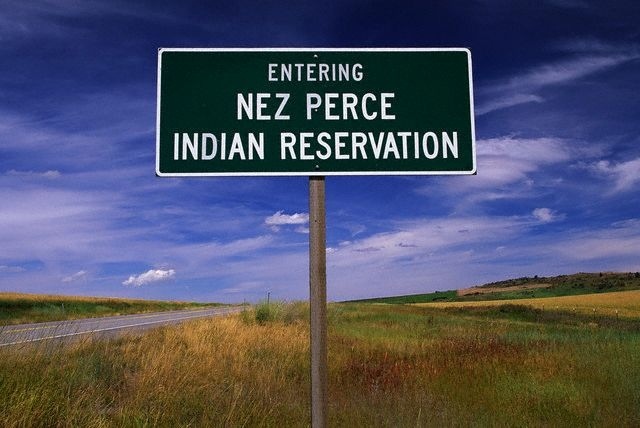
NYTs Coverage of Nez Perce Fight against MegaLoads and Climate Change

Here.

20130926-083837.jpg