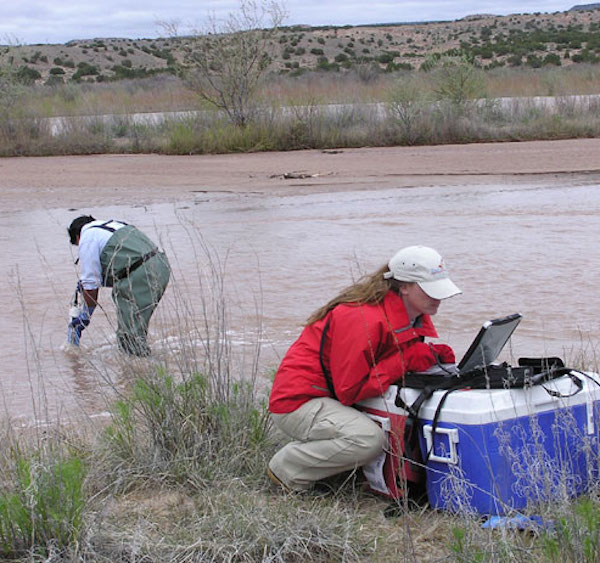
Here.
NYTs: “Native Alaskans Study and Clean Up a Legacy of Pollution”
Here.
Here.
Here.
[James] Botsford, a North Dakota farm owner, learned that in September 2013, when Enbridge informed him that the company was seeking a temporary restraining order against him. Botsford, who is also an attorney and a Supreme Court judge for the Winnebago Tribe of Nebraska, had tried to prevent Enbridge from surveying his land for the Sandpiper’s possible route. Botsford, who strongly opposes the pipeline’s construction, believed that the survey would be “the camel’s nose under the tent.” He attempted to refuse the company access to his farm.
“To that, they basically said, ‘We’re Enbridge, we don’t go around anything, we go through it,’ ” says Botsford.
Enbridge got its restraining order, forcing Botsford to allow the company to complete the survey. The pipeline’s route, Botsford believes, was “basically already a done deal,” and he soon heard from the company again. This time, Enbridge wanted Botsford to grant him an easement—a legal right to use another’s property for a specific purpose, in this case the construction and maintenance of a pipeline. After Botsford refused, twice, to sign an easement agreement, the company filed a civil suit against him in June.
Gofundme link to the Botsford defense here.
Here is the report:
M_Petroleum_Pipeline_Report_2015-10_reducedsize_494297_7
And GTB materials submitted:
Here is the opinion. An excerpt from the court’s syllabus:
The panel reversed the district court’s order granting judgment on the pleadings in an action brought by environmental organizations challenging the Bureau of Land Management’s continuation of 26 geothermal leases in northeastern California’s Medicine Lake Highlands.
The panel held that the district court incorrectly treated the environmental organizations’ claims as arising under only § 1005(a) of the Geothermal Steam Act. BLM’s 1998 decision to continue the 26 unproven leases in the Glass Mountain Unit under § 1005(a) was issued simultaneously with its decision to reverse and vacate its earlier decision to extend those leases on a lease-by-lease basis under § 1005(g). The panel held, thus, that the environmental organizations’ challenge to BLM’s decisions issued on May 18, 1998 implicated both § 1005(a) and § 1005(g).
Because BLM must conduct environmental, historical, and cultural review under the National Environmental Policy Act and the National Historic Preservation Act before granting lease extensions under § 1005(g), the panel held that the environmental organizations’ claim fell within § 1005(g)’s zone-of-interests, and the organizations had
stated a claim under § 1005(g).The panel declined the environmental organizations’ invitation to rule on the merits of its Geothermal Steam Act claims, and remanded for further proceedings.
Briefs:
Here is the opinion in Alaska Eskimo Whaling Commission v. EPA:
From the court’s syllabus:
The panel granted in part and denied in part a petition for review brought by the Alaska Eskimo Whaling Commission, challenging the Beaufort Permit issued by the U.S. Environmental Protection Agency under the National Pollutant Discharge Elimination System provisions of the Clean Water Act, authorizing the discharge of oil and gas exploration facilities of 13 waste streams into marine waters of the Beaufort Sea in accordance with conditions set forth in the Permit.
The panel granted the petition on one issue on which the EPA admitted error in the record, and remanded to the EPA for a determination regarding whether the discharge of noncontact cooling water (alone or in combination with other authorized discharges) into the Beaufort Sea will cause unreasonable degradation of the marine environment because
of the effect of such discharge on bowhead whales, including deflection from their migratory paths.The panel denied the petition in all other respects because the EPA’s issuance of the Permit was otherwise supported by the record evidence, did not reflect a failure to consider an important respect of the problem, and was not otherwise arbitrary or capricious.
Here are the new materials in Southern Ute Indian Tribe v. Dept. of Interior (D. Colo.):
The complaint is here.
Here is the complaint in Southern Ute Indian Tribe v. Dept. of Interior (D. Colo.):
From the tribe’s press release:
Ignacio, Colorado: The Southern Ute Indian Tribe filed suit yesterday in the United States District Court in Denver against the Department of the Interior challenging the Department’s new hydraulic fracturing rule for federal and Indian lands. The suit alleges that the rule conflicts with the Indian Mineral Leasing Act (IMLA) and asks the court to vacate those parts of the rule that violate the IMLA and frustrate the Tribe’s authority over its own lands. “The Tribe values the Reservation environment, but the BLM was overreaching when it enacted this rule for tribal lands. Tribal lands should be treated differently than federal lands,” said Clement J. Frost, the Tribe’s Chairman. “Some of the provisions in this new rule are just burdensome regulations that are not tied to an environmental benefit. This rule is one more regulatory burden that delays energy development on the Reservation and these delays have a very real effect on the Tribe’s ability to provide services and benefits to the tribal membership,” he said.
Tribes are currently authorized by federal regulation to supersede the Secretary’s regulations governing lease operations, and the Tribe has passed its own Hydraulic Fracturing and Chemical Disclosure Regulations. “The BLM’s new rule did not strike the right balance. We can do better,” said Chairman Frost. Bob Zahradnik, Operating Director of the Southern Ute Growth Fund, explained that the Tribe’s regulations vary from the new federal regulations in two important ways: “The Tribe’s regulations provide more protection for aquifers with less bureaucratic morass. It’s a win-win. Our regulations are compatible with Colorado’s regulations, and they also avoid the pre-approval delays that will be caused by BLM’s hydraulic fracturing rule. Those delays put the Tribe in a bad position relative to adjacent fee landowners. If it is too burdensome to do business on tribal lands, operators just take their business elsewhere.”
Here are the materials in Colorado River Indian Tribes v. Dept. of Interior (C.D. Cal.):
We posted the complaint here.
The materials are here, on PEER’s website. Among the arguments being made are that tribes are not entitled to “special rights” for gathering on NPS lands, absent an act of Congress.
You must be logged in to post a comment.