“Faith in Paper,” First Spring Speakers Event on January 15th at 2pm

No registration necessary. We hope to see you here:

13-I&P-33 ILPC Spring Speaker Series_JAN

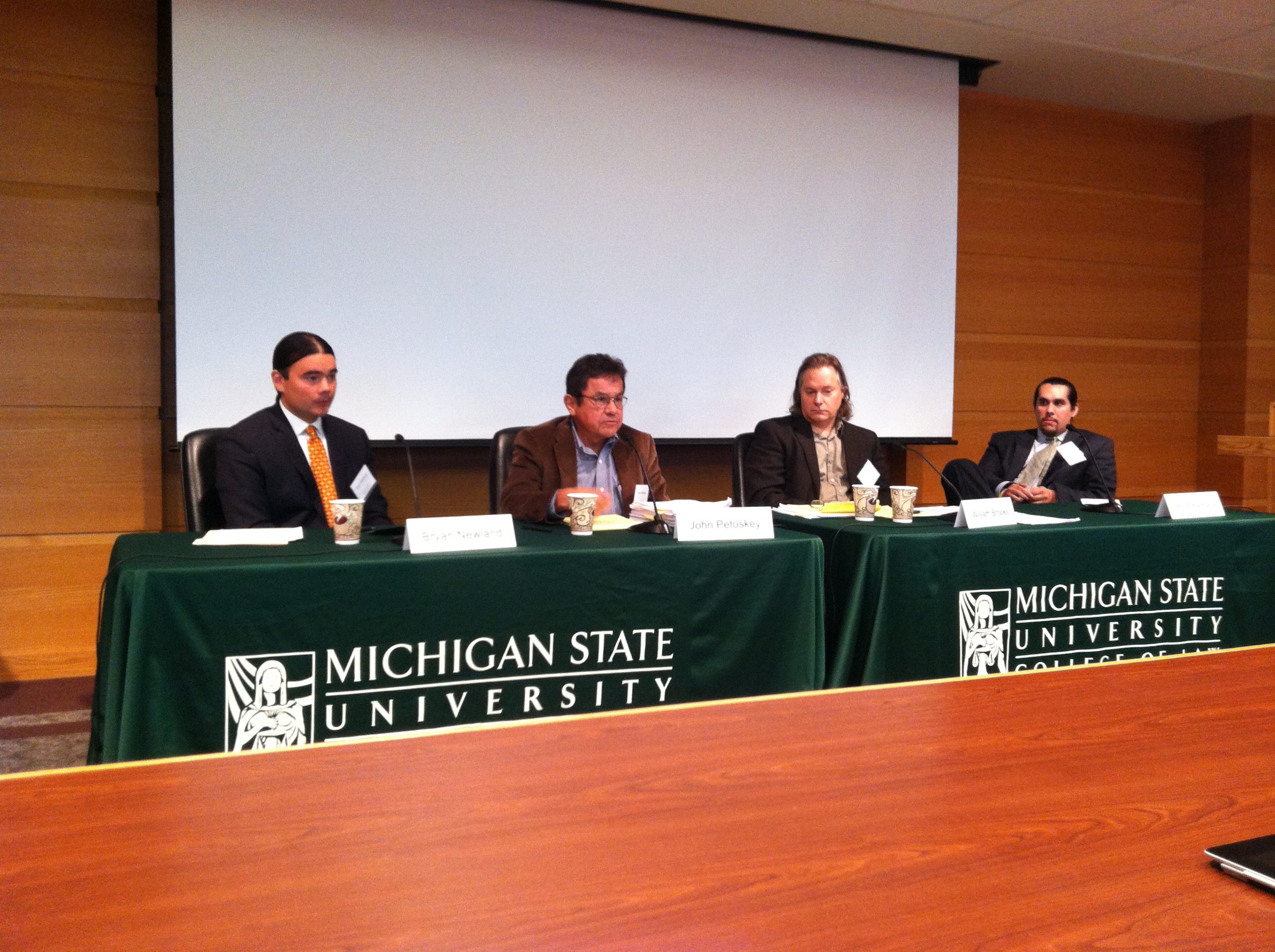
First Panel: Gaming Landscape in Michigan

L-R, Brian Newland, John Petoskey, Bill Brooks, and moderator John Simermeyer

Michigan Radio: Great Lakes Futures Project

Another story from Michigan Radio this morning. We hope the January meeting will include invitations to tribes as well.

A new project is going to try to predict the future of the Great Lakes.

It’s called… wait for it… the Great Lakes Futures Project.  It’s a collaboration of 21 universities from the U.S. and Canada.

Don Scavia is the director of the Graham Sustainability Institute at the University of Michigan. He’s one of four project leaders.  He says students will team up with a counterpart from the other country, along with a faculty mentor.  The teams will develop white papers outlining the biggest things driving change in the Great Lakes region.

“They’ll be looking at things like climate, economics, demographics, chemical and biological pollution, invasive species. Looking back, what have the trends been in the past 50 years and what do we expect trends to look like in the next 50 years?”

Prof. Singel Sworn In to the St. Lawrence Seaway Advisory Board

The post from Secretary Ray LaHood’s blog is here.

Deputy Secretary John Porcari, Secretary LaHood, Prof. Singel, Prof. Fletcher, the ever adorable E & O, Seaway Acting Administrator Craig Middlebrook:

Tribal Comments on Wisconsin Mining Proposal

Related to Matthew’s Dec 13 post on tribal objections to proposed Wisconsin mining legislation, see this post here outlining tribal comments at a recent public hearing. Representatives from several Wisconsin tribes pointed out the failure to consult with tribes about legislation that could negatively impact their treaty rights, tribal lands/waters and culturally significant resources.

Newberry Library Opens Site on Indian Peoples of the Midwest

The Newberry Library has developed a very nice website, “Indians of the Midwest, Past and Present.”

Here is a description:

The Newberry Library announces the launch of a multimedia educational website supported by National Endowment for the Humanities, titled “Indians of the Midwest, Past and Present”. The website focuses on Native people of Minnesota, Wisconsin, Michigan, Illinois, Indiana, and Ohio to explore several contemporary issues with roots in the history of the region: tribal sovereignty, hunting and fishing rights, casinos, treaties, identity, repatriation, and stereotypes.

Dr. Scott Manning Stevens (Mohawk) is the director of the Indians of the Midwest project and Dr. Loretta Fowler is the editor. Stevens also directs the D’Arcy McNickle Center for American Indian and Indigenous Studies and Fowler is an anthropologist and Professor Emerita at Indiana University. The site was developed in consultation with an advisory committee consisting of members of tribal colleges and university scholars. The site features Newberry-produced, videotaped interviews with several scholars, including Raymond J. DeMallie, Larry Nesper, Dave Edmunds, Nancy Lurie, and John Low.

Sault Ste. Marie Tribe of Chippewa Indians rejects proposed Michigan moose hunt

As reported in the September 2nd issue of Win Awenen Nisitotung, Sault Tribe Inland Conservation Committee elected not to support a moose hunting season in Michigan. Provisions in the 2007 Inland Consent Decree require tribal (and state) approval of moose hunting. This outcome may frustrate people interested in moving forward with a moose hunt in Michigan; but for Sault Tribe officials, the precautionary route was prudent given the small number of moose that currently reside in the Upper Peninsula and the uncertainty over their population dynamics.

State Bar of Wisconsin Mining Law Symposium, Thursday, August 25, 2011

The State Bar of Wisconsin will host a Mining Law Symposium CLE on Thursday, August 25, 2011 which in many ways is in response to the proposed mine to be situated in the Penokee-Gogebic Iron Range in northwest Wisconsin, very near the Bad River Band of Lake Superior Chippewa Tribe Reservation, by Gogebic Taconite.

Here is information on the CLE:

http://www.wisbar.org/AM/Template.cfm?Section=View_calendar1&template=/Conference/ConferenceDescription.cfm&ConferenceID=5382

Here is a Milwaukee Sentinel Journal article discussing Bad River Chairman Mike Wiggins’ concerns with the proposed mine:

http://www.jsonline.com/news/wisconsin/119739399.html

Here is recent article describing the mine from Northwoods Wilderness Recovery:

http://www.northwoodswild.org/component/content/article/57-sulfide-and-uranium-mining-news/93-proposed-mining-in-northern-wisconsins-penokee-range

Ojibwe Treaty Rights Article in American Indian Quarterly

After the Storm: Ojibwe Treaty Rights Twenty Five Years after the Voigt Decision” by Patty Loew and James Thannum was published in the American Indian Quarterly, vol. 25, no. 2 (Spring, 2011).  Here’s an excerpt/abstract:

This article examines the socioeconomic, political, and cultural fac- tors that contributed to the spearfishing crisis twenty-five years ago and the state of relations between Native and non-Native residents in the ceded territory today. It focuses on Wisconsin, where the most virulent protests occurred. Because most residents learned about the controversy through newspaper and television news accounts, the article pays special attention to media coverage of the boat landing struggles. It argues that the relative calm that exists today is attributable to increased public awareness about treaty rights and sovereignty, largely due to education efforts and better reporting by the media. It also argues that the contributions of the Ojibwe bands themselves over the past twenty-five years to maintain and improve the natural resources within the ceded territory has also had a positive effect.

Article on McGulpin Rock

Once the reader is past the part where the French “discovered” the rock, were the first to use it as a navigational tool, and realize its importance in 1749, the article quotes Eric Hemenway about its role in Anishnabek history.

From UpNorthLive.com:

MACKINAW CITY, MI — Now when you think of Thanksgiving and a historical rock, Plymouth Rock in Massachusetts probably comes to mind with its connection to Pilgrims and the landing of the Mayflower, and it could be the most popular rock in America.

But a rock on the shores of the Straits of Mackinac has just as much history, if not a lot more.

This giant boulder on the Straits of Mackinac, just west of Mackinaw City, has a rockin’ history.  Its name–McGulpin Rock.  It’s something that Sandy Planisek, a member of the Emmet County Historical Commission, said never made this history books because the French discovered it, and much of American history is based on the English and East coast America.

“It’s bigger, it has more historical value, and it’s something people should be aware of,” Planisek said.

Before the English settled on the east coast, French explorers traveled the Great Lakes.  In 1615, Etienne Brule was the first believed to cross the Great Lakes, and he took note of McGulpin rock, five years before the Mayflower landed at Plymouth.  He wrote Native Americans used the rock as a Navigational tool and to gauge the lakes’ water levels.  In 1749, it was mentioned in the first known map of the Great Lakes, and was placed on it as a navigational aide for the French’s Fort Michilimackinac.

“It’s a perfect water level indicator and the people back in 1749 realized that and used it in that way,” said Planisek.

To give you an idea of how enormous McGulpin rock is, I stood next to it.  I’m six foot four.  The rock towers over me and is as wide as a semi.  It’s also about 10 times as big as Plymouth Rock.  And if you dig deeper in the history, the boulder dates way back before any European explorers settled in the Americas.

“When the Anishnabek were traveling back and forth, they’d see the rock and know that they were close to home, and you can just imagine, in conditions like this, if you’re traveling in a canoe, you’d want the most visible sign, and this rock would fulfill that,” said Eric Hemenway, an Odawa Historian.

Eric Hemenway, an Odawa historian, says the rock has a rich history with the Native tribes and also is an indicator of the Michigan Native American role in pre-America.

“There’s so much history in the Plains and out west, we like to say, hey, a lot went on in the Great Lakes that had a big influence on American History and this is a big part of it,” said Hemenway.

No, it’s not guarded or encased like Plymouth Rock, nor does it have near the amount of notoriety as the east coast Pilgrim landing marker, but Emmet County is trying to change that.  The county is challenging people out east in Plymouth, saying, if you send your visitors here, we’ll send our visitors there.  They’re hoping to increase the number of people to come check out this long-lasting piece of history.

Emmet County is working on getting a historical marker for the rock at McGulpin Point.

Last year, about 25,000 visitors visited McGulpin Rock.

They hope this challenge will increase that number.