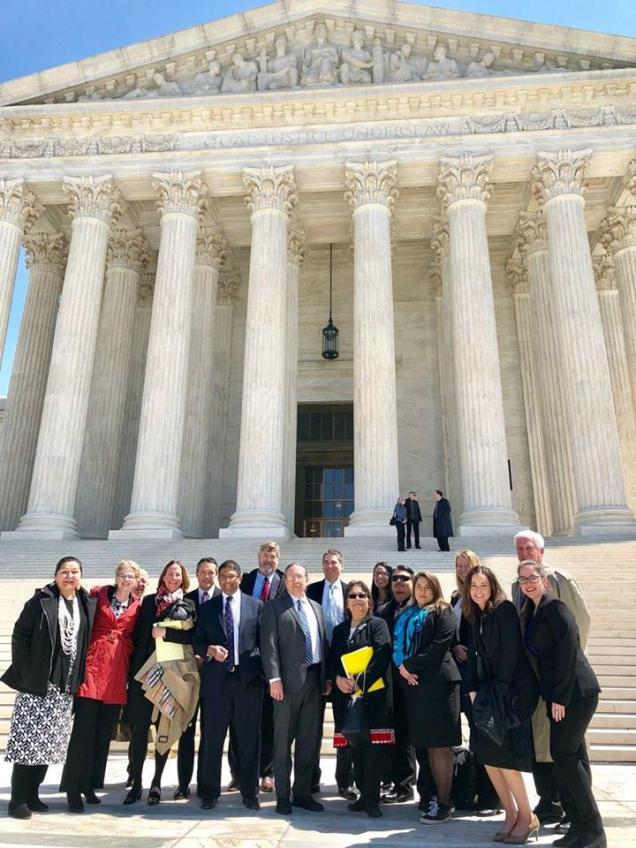
After the Culverts Argument on Wednesday
Here is “Failed Protectors: The Indian Trust and Killers of the Flower Moon,” forthcoming in the Michigan Law Review.
Abstract:
This Review uses Killers of the Flower Moon as a jumping off point for highlighting for readers how so many Indian people in Indian country can be so easily victimized by criminals. And yet, for however horrible the Osage Reign of Terror, the reality for too many Indian people today is much much worse. The federal government is absolutely to blame for these conditions. This Review shows how policy choices made by all three branches of the federal government have failed Indian people. Part I establishes the federal-tribal trust relationship that originated with a duty of protection. Part II establishes how the United States failure to fulfill its duties to the Osage Nation and its citizens allowed and even indirectly encouraged the Osage Reign of Terror. Part III offers thoughts on the future of the trust relationship in light of the rise of tribal self-determination. Part IV concludes the Review with a warning about how modern crime rates against Indian women and children are outrageously high in large part because of the continuing failures of the United States.
Gregory Abalvsky has posted “History, Power, and Federal Indian Law” on Process, the blog of the Organization of American Historians, The Journal of American History, and The American Historian.
An excerpt:
Indian law is not unique in involving judicial uses of history. But not only is Indian law exceptionally historically focused, it is also different from, for instance, the more familiar fights over originalism. While struggles over constitutional history often concern grand and abstract principles and attract significant attention, Indian law cases are often viewed as minor—Justice Brennan reportedly once referred to them as “chickenshit”—and their outcome likely turns on the very local and specific pasts of a particular reservation, treaty, or centuries-old statute. The indeterminacy of these histories gives judges remarkably wide rein to craft the law as they see fit: “[W]hen it comes to Indian law,” the late Justice Scalia once quipped, “most of the time we’re just making it up.”
Professor Ablavsky is the author of “Beyond the Commerce Clause.” Part I is here.
One interesting aspect about Upstate Citizens is the underlying dispute’s highly ironic origins in upstate New York—ironic because it was largely struggles over New York’s abuses under the Articles and its efforts to dispossess the Haudenosaunee Confederacy in this region that helped prompt Madison and others to centralize federal power over Indian affairs in the first place. Sadly, this constitutional shift was often unavailing, as New York freely violated federal law. Even Haudenosaunees literally waving copies of the Trade and Intercourse Act in front of New York’s agents failed to stop this illegal process.
But New York is also significant in another respect. Thomas correctly notes that the Indian Commerce Clause was “virtually unopposed at the founding,” but there was opposition in New York, from the Anti-Federalist Abraham Yates, Jr, writing pseudonymously as Sydney. Thomas may not know about the full depth of Yates’s opposition, however, because he has relied frequently, and primarily, on a law review article by Robert Natelson. Here’s how Natelson describes Yates’s view (Natelson relies on an older strain of scholarship that attributed “Sydney” to Robert Yates, but newer scholarship attributes it to Abraham, Robert’s uncle; emphasis added).
Robert Yates, a New York Anti-Federalist who had served as a delegate to the federal convention, argued against ratification. He opposed the Indian Commerce Clause in particular, so if there had been any reasonable interpretation of that provision that included plenary authority over Indian affairs, he certainly would have pointed it out. Yet he also equated the Indian commerce power to no more than a power over trade. If New York were to ratify the Constitution, Yates wrote that New York would thereby totally surrender into the hands of Congress the management and regulation of the Indian trade to an improper government, and the traders to be fleeced by iniquitous impositions, operating at one and the same time as a monopoly and a poll tax.
And here is the actual quotation from Sydney (with emphasis added):
It is therefore evident that this state, by adopting the new government, will enervate their legislative rights, and totally surrender into the hands of Congress the management and regulation of the Indian affairs, and expose the Indian trade to an improper government—and the traders to be fleeced by iniquitous impositions, operating at one and the same time as a monopoly and a poll-tax.
One can quibble about whether Sydney here was speaking exclusively of the Indian Commerce Clause—which he cited alongside the Supremacy Clause and the prohibition on state imposts in the immediately preceding paragraph—but the quotation is unambiguous on Yates’s understanding of the Constitution’s implications for Indian affairs. Natelson’s paraphrase significantly and materially changes the meaning of the cited essay: when the original language is restored, it reveals that Yates did point out at least one interpretation that “included plenary authority over Indian affairs,” in fact nearly verbatim. Recovering the correct quotation and the evidence that Natelson omitted compromises Thomas’s argument, drawn solely from silence, that it was “highly implausible that the Founders understood the Indian Commerce Clause” to encompass a significant expansion of federal power.
Finally, I wanted to stress one significant new aspect of Thomas’s dissents that hasn’t appeared in his prior writings on this topic—his emphasis on the IRA as a threat to “States’ territorial integrity,” which he argues that the Founders surely could not have intended. In fact, there was a debate over this question in the early United States. There were proposals at the Constitutional Convention that the federal government guarantee each state’s territory, but they failed, and the guarantee was limited to a republican form of government. When Tennessee sought to become a state in 1796, some in Congress argued that the new state’s borders should be lopped off to exclude Indian country: James Hillhouse suggested drawing the border at the “Indian line,” so as to avoid “incorporating lands within this State to which we had no right.” But the proponents of statehood pointed out the issue was already resolved—“[I]n the act passed this session relative to trade and intercourse with the Indian tribes, the Indian boundary was settled”—and their arguments won the day. In other words, not only did the Founders anticipate the power that Thomas says is implausible, but they used it, enacting a statute that placed around 80% of Tennessee’s territory outside its jurisdiction and criminalizing entry.
Hillhouse and others were nonetheless right to be worried, because claims based on territorial integrity became a potent argument in debates forty years later, over Removal. Then, Tennessee—along with Georgia, Alabama, and Mississippi—disregarded earlier compromises as well as federal law. It is “well established,” Georgia’s courts reasoned, “that where a sovereign state is seized in fee of territory, it has exclusive jurisdiction over that territory.” For his part, President Jackson, pressing for Removal, disclaimed any ability to limit these assertions of sovereignty: “A State can not be dismembered by Congress or restricted in the exercise of her constitutional power.” Thomas’s emphasis on state territorial integrity—like Removal-era claims, unmoored from any plausible interpretation of constitutional text—revives these arguments for the modern era.
Removal also speaks to Justice Thomas’s final concern—his fear that IRA permits an “absurd result” by allowing Congress to entirely displace state authority. Of course, as the Federalists often pointed out during Ratification, all governmental power may be abused, so slippery slope arguments about hypothetical misuses prove little. But this seems an instance where the political “safeguards” of federalism have proven particularly salient; the states, after all, won the Removal struggle despite losing the legal argument by controlling federal power. I encourage Justice Thomas to examine U.S. history to consider which sovereigns—the states or Native nations—have been at greater risk at having their “territorial integrity” compromised by federal overreach.
SCOTUS denied cert in two cases challenging the constitutionality of Section 5 of the Indian Reorganization Act, the statute that authorizes the Secretary of the Interior to take land into trust for Indian tribes. The petitions are here and here.
Justice Thomas dissented from the denial of certiorari [begins on page 13 of the link]. We asked Greg Ablavsky to comment on that dissent [Part II will be later today]:
Just in time for the end of Native American Heritage Month, Justice Thomas has written a dissent from the Court’s denial of certoriari in Upstate Citizens for Equality v. United States, which challenged Congress’s constitutional power to take land into trust under the Indian Reorganization Act. The dissent picks up a familiar refrain in Thomas’s Indian law jurisprudence, running from Lara through Adoptive Couple through Bryant: the argument that the original understanding of the Constitution does not support Congress’s plenary power over Indian affairs, including, in this instance, the authority to enact the IRA.
I find Justice Thomas’s arguments on this theme as unpersuasive now as I did two years ago, when I published a law review article, Beyond the Indian Commerce Clause, that evaluated the Justice’s historical claims and found them lacking. If you want all the details and evidence, you should see the full article, but, in this two-part post, I’ll try to do two things. First, I want to briefly assess Thomas’s arguments about the text of the Indian Commerce Clause. Then, in the second post, I’ll take up the question of ratification debates, and also a new twist that Thomas added in this dissent that warrants its own investigation.
OK, onto Justice Thomas’s take on the Indian Commerce Clause:
1. “[T]he Clause extends only to ‘regulat[ing] trade with Indian tribes.” There is little evidence to support this rewriting of the Indian Commerce Clause. Though the literal phrase “commerce with the Indian tribes” was comparatively rare in eighteenth-century texts, among its handful of appearances were several times when it meant something other than trade as Thomas narrowly construes it. But there was a term that showed up far more often to describe U.S. relations with Native nations—the capacious term “intercourse,” defined as a meaning of commerce in no less than Samuel Johnson’s Dictionary quoted by Justice Thomas’s in his Adoptive Couple concurrence. I offer a more formal tally in my article, but my highly unscientific count within the database of Founding-era Indian affairs documents I’ve compiled identified 142 such uses of the term “intercourse” between 1783 and 1800. (“Commerce,” by contrast, only gets 51 mentions—many of these referring to the Clause itself).
2. “[A]ssuming that land transactions are ‘Commerce’ within the scope of the Clause.” This doesn’t require much of an assumption, since Attorney General Edmund Randolph specifically said they were in 1791: he described such dealing in Indian lands as “this commerce” in the context of the Clause. Clearly, the First Congress also thought it had the constitutional power to regulate Indian lands when, soon into its first sitting, it enacted the Trade and Intercourse Act, which specifically barred the sale of lands by Indians “to any person or persons, or to any state.”
3. “[B]ecause no exchange takes place, these trust arrangements do not resemble ‘trade with Indians.’” This proposes an odd interpretation in which the explicit transfer of formal title from one sovereign owner to another is a transaction in which “neither money nor property changes hands,” a view that would not fare well on my property exam. But you don’t have to take my word for it: we know, again through the repeated revisions of the Trade and Intercourse Act over the course of the 1790s, that Congress thought it had power to regulate any “purchase, grant, lease, or other conveyance of lands, or of any title or claim thereto, from any Indian, or nation or tribe of Indians, within the bounds of the United States”—language that clearly and unambiguously encompasses land-to-trust transfers under the IRA.
4. “[U]nder the Indian Commerce Clause.” Even if one accepts Thomas’s questionable Commerce Clause interpretations, there is still the possibility that Congress has the authority under other constitutional provisions to enact the IRA. For instance, even Thomas’s favorite citation, Robert Natelson’s article on the Indian Commerce Clause (about which more in the next post) concedes that Congress had the authority to enact Trade and Intercourse Act under the Treaty Power to enforce its treaties. If that’s true, then the federal government’s treaties with the Haudenosaunee, including the Oneidas, that acknowledged and protected their lands would seem an additional constitutional hook.
I could continue, but you may not share my passion for eighteenth-century arcana; if you do, there’s plenty more in the full article. But the brief upshot is that there’s little new, other than Thomas’s odd interpretation of land transactions, in this dissent. Rather, Thomas continues to retread the same arguments, ones that rely less on actual historical evidence than Thomas’s repeated and firm convictions about what the Founders must have thought.
In the succeeding post, I’ll take up a bit of what is new and distinctive in Thomas’s dissent.
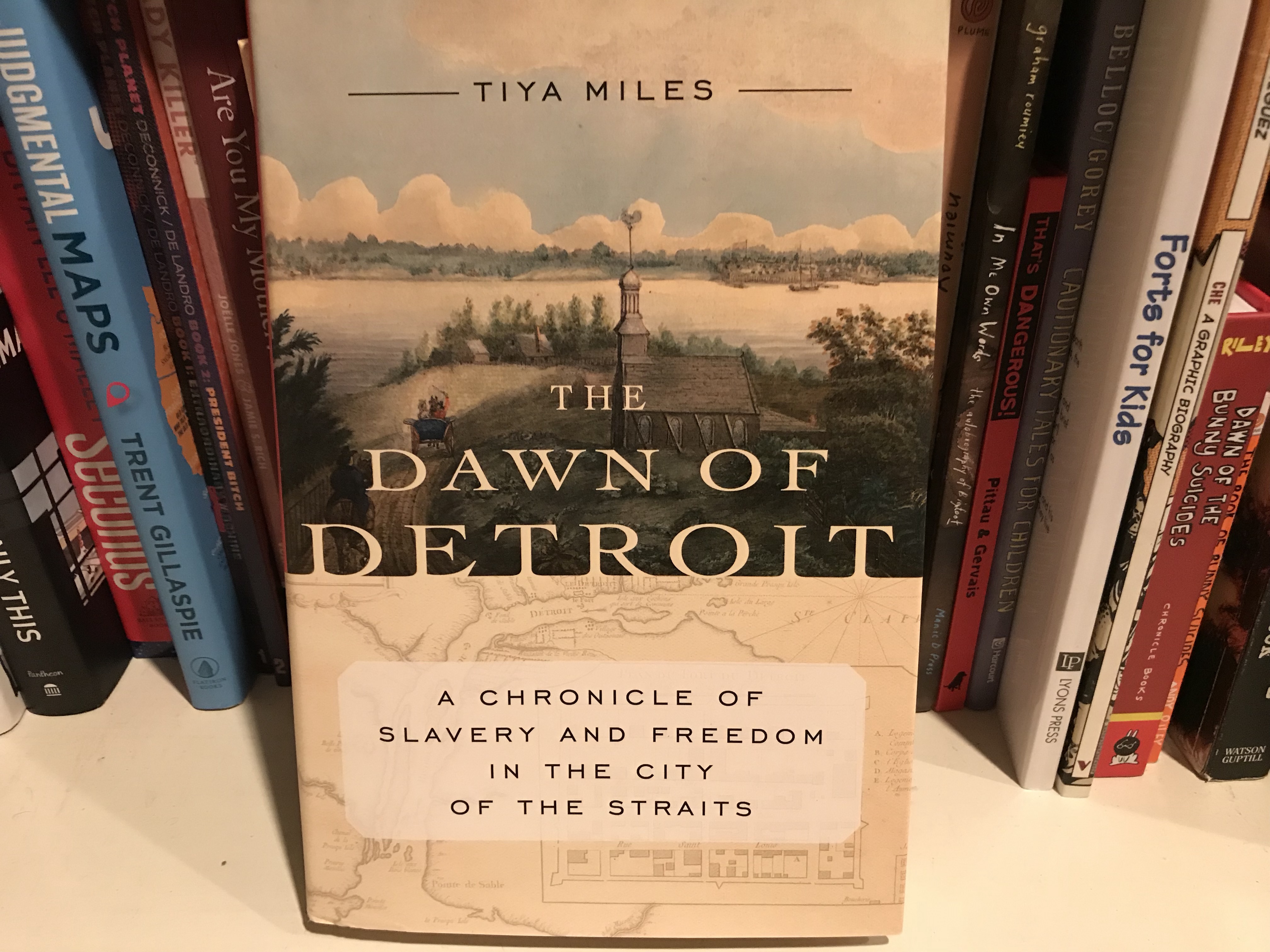
The book page is here. The blurb:
Most Americans believe that slavery was a creature of the South, and that Northern states and territories provided stops on the Underground Railroad for fugitive slaves on their way to Canada. In this paradigm-shifting book, celebrated historian Tiya Miles reveals that slavery was at the heart of the Midwest’s iconic city: Detroit.
In this richly researched and eye-opening book, Miles has pieced together the experience of the unfree—both native and African American—in the frontier outpost of colonial Detroit, a place wildly remote yet at the center of national and international conflict. Skillfully assembling fragments of a distant historical record, Miles introduces new historical figures and unearths struggles that remained hidden from view until now. The result is fascinating history, little explored and eloquently told, of the limits of freedom in early America, one that adds new layers of complexity to the story of a place that exerts a strong fascination in the media and among public intellectuals, artists, and activists.
A book that opens the door on a hidden past, The Dawn of Detroit is a powerful and elegantly written history, one that completely changes our understanding of slavery’s American legacy.
Here:

Here.
Claiming Turtle Mountain’s Constitution: The History, Legacy, and Future of a Tribal Nation’s Founding Documents
By Keith Richotte Jr.
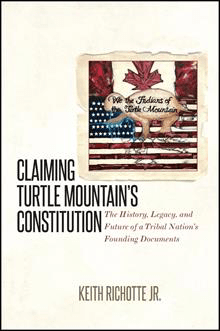
In an auditorium in Belcourt, North Dakota, on a chilly October day in 1932, Robert Bruce and his fellow tribal citizens held the political fate of the Turtle Mountain Band of Chippewa Indians in their hands. Bruce, and the others, had been asked to adopt a tribal constitution, but he was unhappy with the document, as it limited tribal governmental authority. However, white authorities told the tribal nation that the proposed constitution was a necessary step in bringing a lawsuit against the federal government over a long-standing land dispute. Bruce’s choice, and the choice of his fellow citizens, has shaped tribal governance on the reservation ever since that fateful day.
In this book, Keith Richotte Jr. offers a critical examination of one tribal nation’s decision to adopt a constitution. By asking why the citizens of Turtle Mountain voted to adopt the document despite perceived flaws, he confronts assumptions about how tribal constitutions came to be, reexamines the status of tribal governments in the present, and offers a fresh set of questions as we look to the future of governance in Native America and beyond.
For more information and to read an excerpt, visit the book page.
An excerpt:
Carpenter identifies several factors that contributed to Native Americans’4 early and robust use of the administrative petition. One factor was a pattern of congressional deference to the President in matters relating to Indian policy. Presidents, in turn, delegated great power to administrators within the War Department and, later, the Department of the Interior. A second important factor was that these administrators had no intention of leaving Native Americans alone, but rather embarked on prolonged campaigns of dispossession and subordination. In other words, Native Americans had every reason to want to influence administrative decisionmaking. A third factor, Carpenter argues, was a tradition of “complaint and supplication” among indigenous North Americans that was already well established by the time of the Founding. (P. 358.) According to this tradition, all types of authority (i.e., administrators as well as legislators) were appropriate subjects of entreaty.
Here.
 Turtle Talk
You must be logged in to post a comment.