Profs. Watson, Seed, and Pearl:
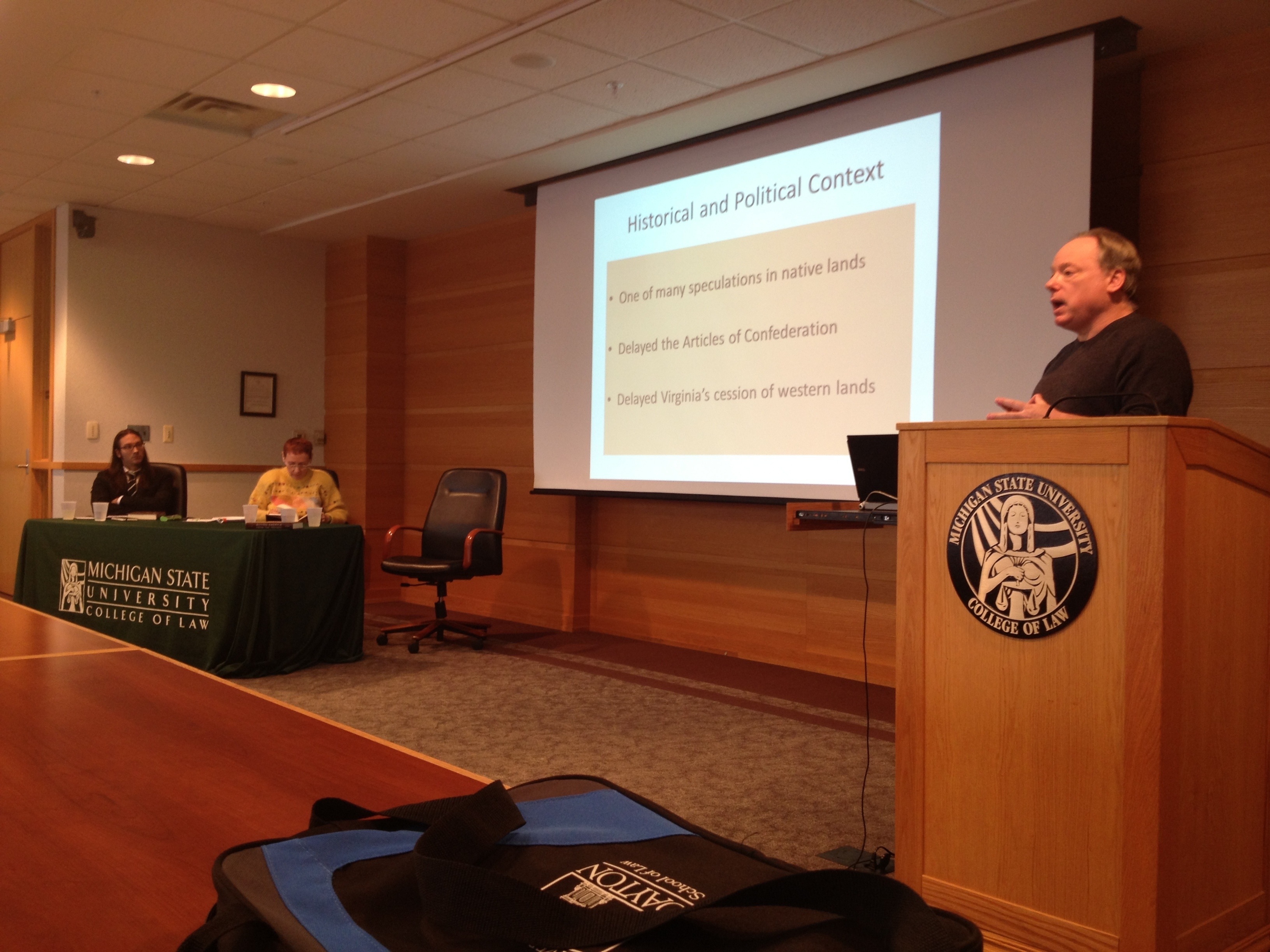
Profs. Watson, Seed, and Pearl:
Please join us Tuesday afternoon for a discussion of Prof. Blake Watson’s book, Buying America from the Indians.
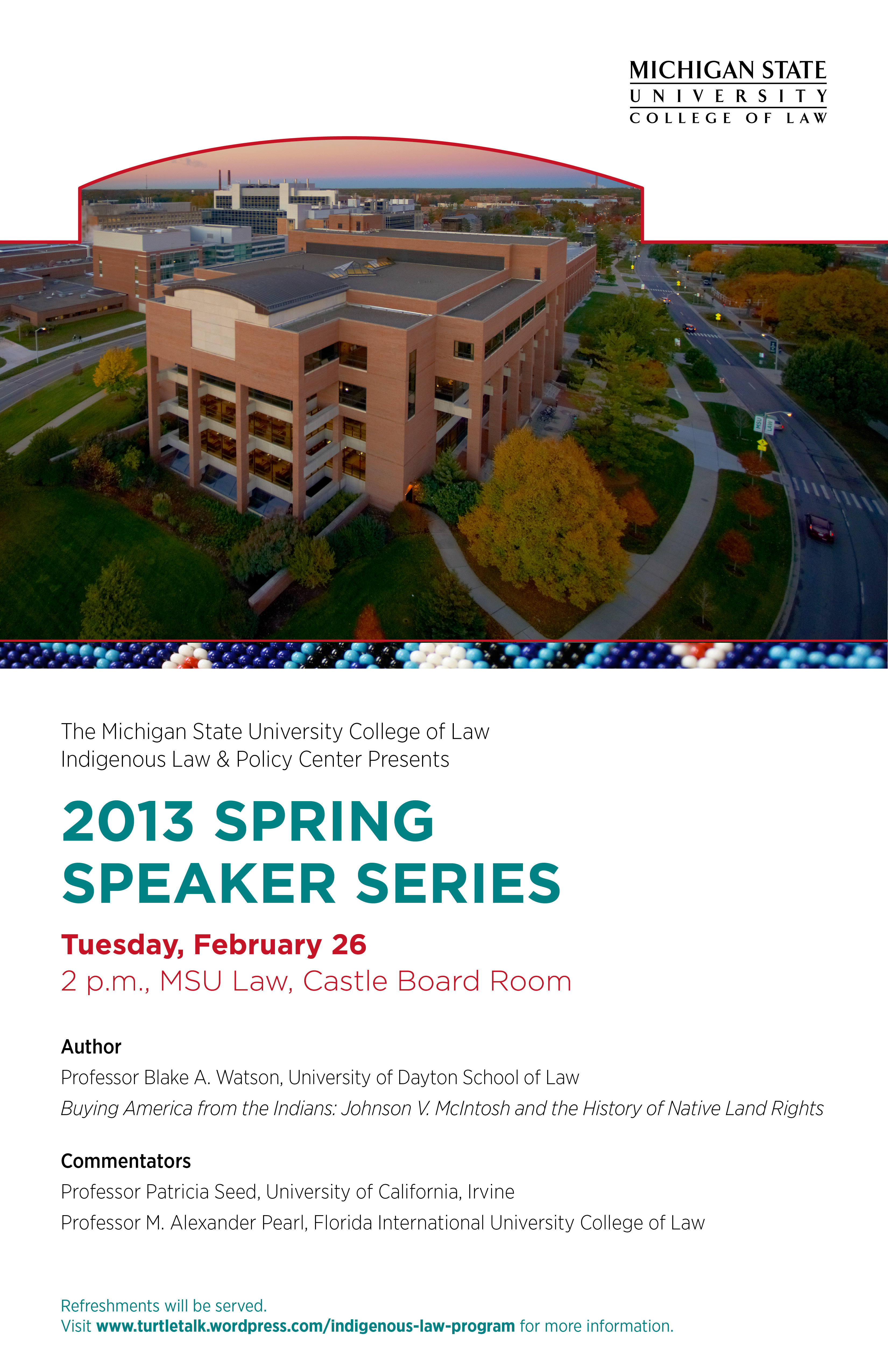
From the website:
Angela Riley spoke in the Supreme Court chamber about the history of the Supreme Court and Native American lands. The lecture, which took place in the Supreme Court chamber, was one in a series hosted by the Supreme Court Historical Society on the Constitution, the Supreme Court, and property rights. Justice Ruth Bader Ginsburg introduced Professor Riley.
Video here.
Mary Kathryn Nagle has published “Nothing to Trust: The Unconstitutional Origins of the Post-Dawes Act Trust Doctrine” in the Tulsa Law Review (48 Tulsa L. Rev. 62 (2012)).
Here is the article:
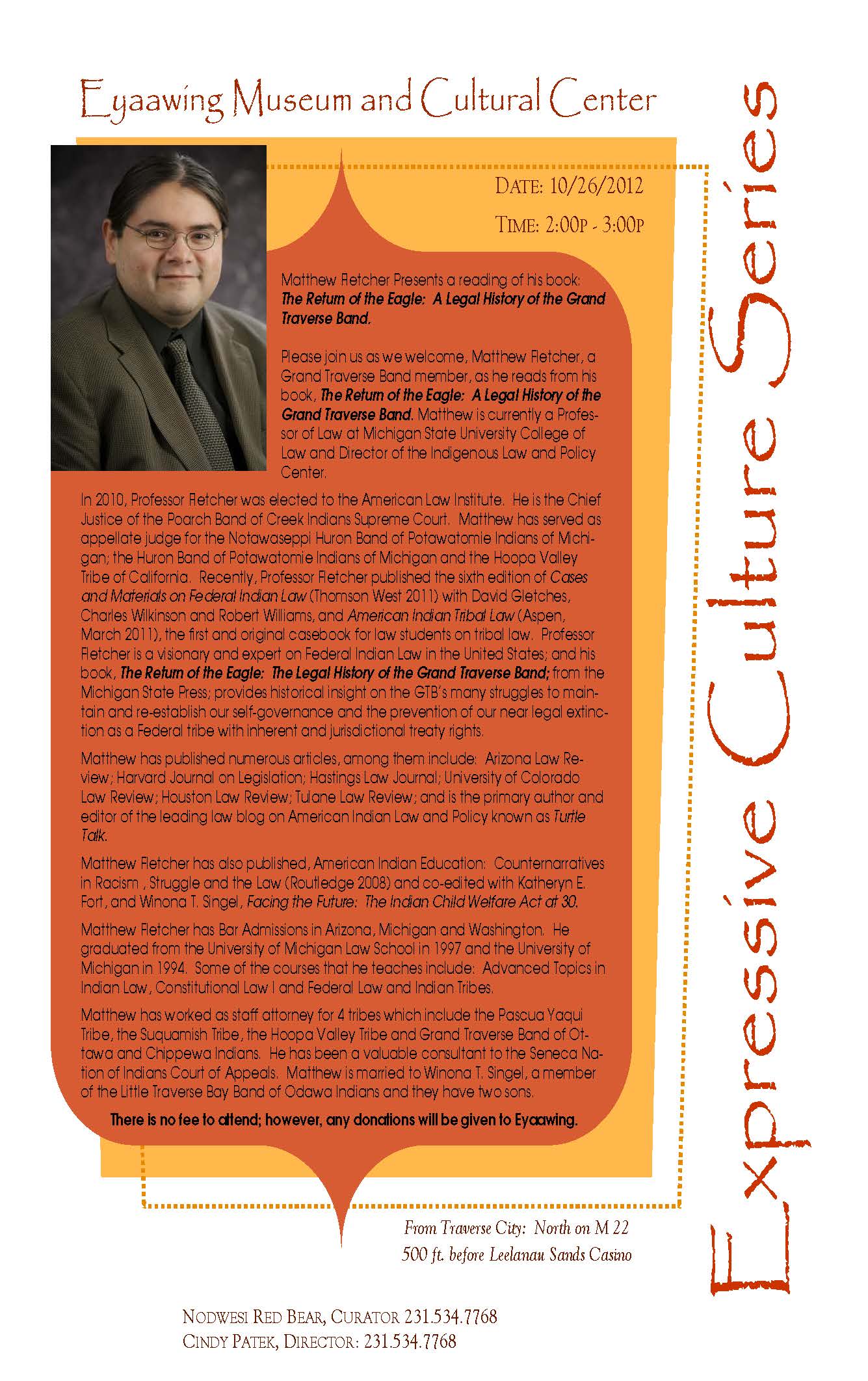
Here is the My North notice:

Time: October 26, 2012 from 2pm to 3pm
Location: Eyaawing Museum & Cultural Center
Street: 2304 North West Bay Shore Dr.
City/Town: Peshawbestown
Phone: 231.534.7768
Event Type: literary
Organized By: Grand Traverse Band of Ottawa and Chippewa Indians
Ann E. Tweedy (Hamline Law) has published her paper “Unjustifiable Expectations: Laying to Rest the Ghosts of Allotment-Era Settlers” in the Seattle University Law Review.
Here is the abstract:
During the allotment era, the federal government took land from tribes and parceled some of it out to individual tribal members, while, in most cases, selling off the remainder to non-Indian settlers. Those actions, which are properly understood as unconstitutional takings, have been reinforced through decades of Supreme Court precedent. Specifically, the Court has used the now repudiated federal allotment policy, which contemplated eventual abolition of tribal governments, to justify contemporary incursions on tribal jurisdictional authority as well as other limitations on tribal sovereign rights. In this way, the Court builds new injustices upon old ones. This Article responds to this Supreme Court precedent with two main points. First, it shows that non-Indians at the time had notice that the allotment policy was unfair to tribes (and that they sometimes directly advocated for its injustices). From this information, I argue that non-Indian purchasers of tribal lands—and subsequent purchasers from them—should not be understood to have had justifiable expectations that the reservations would disappear and that they therefore could not be subject to tribal jurisdiction in the future. Second, I argue that the Supreme Court should stop using the troubled history of allotment, which it construes based on incomplete information and without taking account of tribal interests and perspectives, to justify further restrictions on tribal sovereignty. My purpose in this Article is to question both the substance of these presumed expectations and their justifiability. I begin this questioning with a thorough analysis of previously unexamined historical newspaper articles concerning non-Indian settlement of Indian reservations during the allotment era. I then argue that, as reflected by the above quote from Superintendent King, most non-Indians during the allotment period cared little about whether Indians were treated justly. Furthermore, I argue that many non-Indians had notice that tribes were being unjustly deprived of their lands through the allotment process, and that some non-Indians even advocated for this very injustice to occur. Both notice of injustice and complicity in the government’s unjust actions precluded non-Indian purchasers from forming justifiable expectations. This rigorous, context- specific look at non-Indian expectations suggests that, in sharp contrast to current Supreme Court practice, tribal jurisdiction over nonmembers should generally be upheld and Indian reservations should not generally be held to have been diminished or disestablished as a result of allotment.
Here:
Legend’s Grand Opening Announcement:
Don’t miss the exciting Grand Opening of “Legends of the Grand Traverse Region: Community out of Diversity.” This celebration is on Saturday, Sept. 22nd from 4:00pm to 6:30pm at the History Center of Traverse City. Attendees will tour the brand new Legends’ Exhibit, listen to the featured speaker, and then socialize at an elegant reception featuring adult beverages and tasty hors d’oeuvres. Admission is free, although good will offerings will be requested and are always appreciated!
The speaker is Matthew L.M. Fletcher, Professor of Law and Director of the Indigenous Law and Policy Center at Michigan State University College of Law, and member of the Grand Traverse Tribe of Ottawa and Chippewa Indians. He will be speaking on “The Story of the Grand Traverse Band’s Treaty Rights Fight.”
Professor Fletcher’s talk is designed to complement our fall 2012 Legend’s Exhibit. It highlights three of the “Legends” of the Traverse area: Art Duhamel of the Grand Traverse Band, well known for his stands regarding native fishing rights and federal recognition of the Grand Traverse Band; The Schaub family and their famous relative, Emelia Schaub, who was the first female prosecutor in Michigan; and Augusta Rosenthal-Thompson, who in 1884 arrived in northern Michigan as the first woman physician to practice in this area.
The Legends’ exhibit will be open through October 25th. That Thursday this fall’s Legends’ activities will close with an afternoon workshop and evening presentation by Dr. Elizabeth Faue, Professor of American History and the History of Women at Wayne State University. The afternoon workshop is on genealogy and “Lost Mothers.” The evening talk is entitled: “Barriers and Gateways: Women, Gender, and the Professions in the United States.”
Don’t miss this opening celebration of the Legends of the Grand Traverse Region. These fall 2012 Legends events are only an introduction to continuing Legends activities. Over the next several years we will celebrating more Legends: People and families from diverse backgrounds who came together to build the community we live in today. Our next three Legends will be celebrated starting in March of 2013, with more Legends being announced in Fall of 2013, Spring of 2014, and hopefully far into the future.
The History Center of Traverse City thanks the Michigan Humanities Council for its crucial support of the Legends’ project. We also thank our Legends’ partners: The Grand Traverse Genealogical Society, the Northwest Lower Michigan Women’s History Project, Congregation Beth El, the Hispanic Apostolate of the Diocese of Gaylord, the Traverse City Human Rights Commission, Professor Jim Press of Northwestern Michigan College’s History Department, and Cindy Patek of the Grand Traverse Tribe’s Eyaawing Museum and Cultural Center
Kenneth Casebeer has posted his paper, “Subaltern Voices in the Trail of Tears: Cognition and Resistance of the Cherokee Nation to Removal in Building American Empire,” on SSRN.
Here is the abstract:
Empire, since publication of the book by the same name, by Michael Hardt and Antonio Negri has generated almost an obsession for revisionist social theorists. In this literature, the idea and history of empire is structurally dialectical – the ongoing interaction between imperialist colonizers and subordinated indigenous or subaltern populations and cultures connected with the colonized space. Included in this literature are two recent works that present a curious view of American Empire, and its relatively early and key history of removal of Eastern Native nations to west of the Mississippi. The curiosity in the book by Sean Wilentz, and an article more focused on law by Paul Frymer , is that the exceptional histories of removal they report includes the voice of none of the removed populations, the subalterns by which the imperialists are in part constructed. In this review the record is simply being documented as necessary to recover the subalterns assumed by the histories because they were there, and had to be there, in the history of subordination. Contrasting the stunted reasoning of the federal government with Cherokee resistance and subsequent dénouement links removal’s significant contribution to the legitimation campaign supporting slavery and Dred Scott, and in material terms, contributed to the inevitability of the secession and the Civil War.
 Turtle Talk
You must be logged in to post a comment.