Here:
DOI Carcieri M opinion – M 37029
Here is the link to Interior opinions.
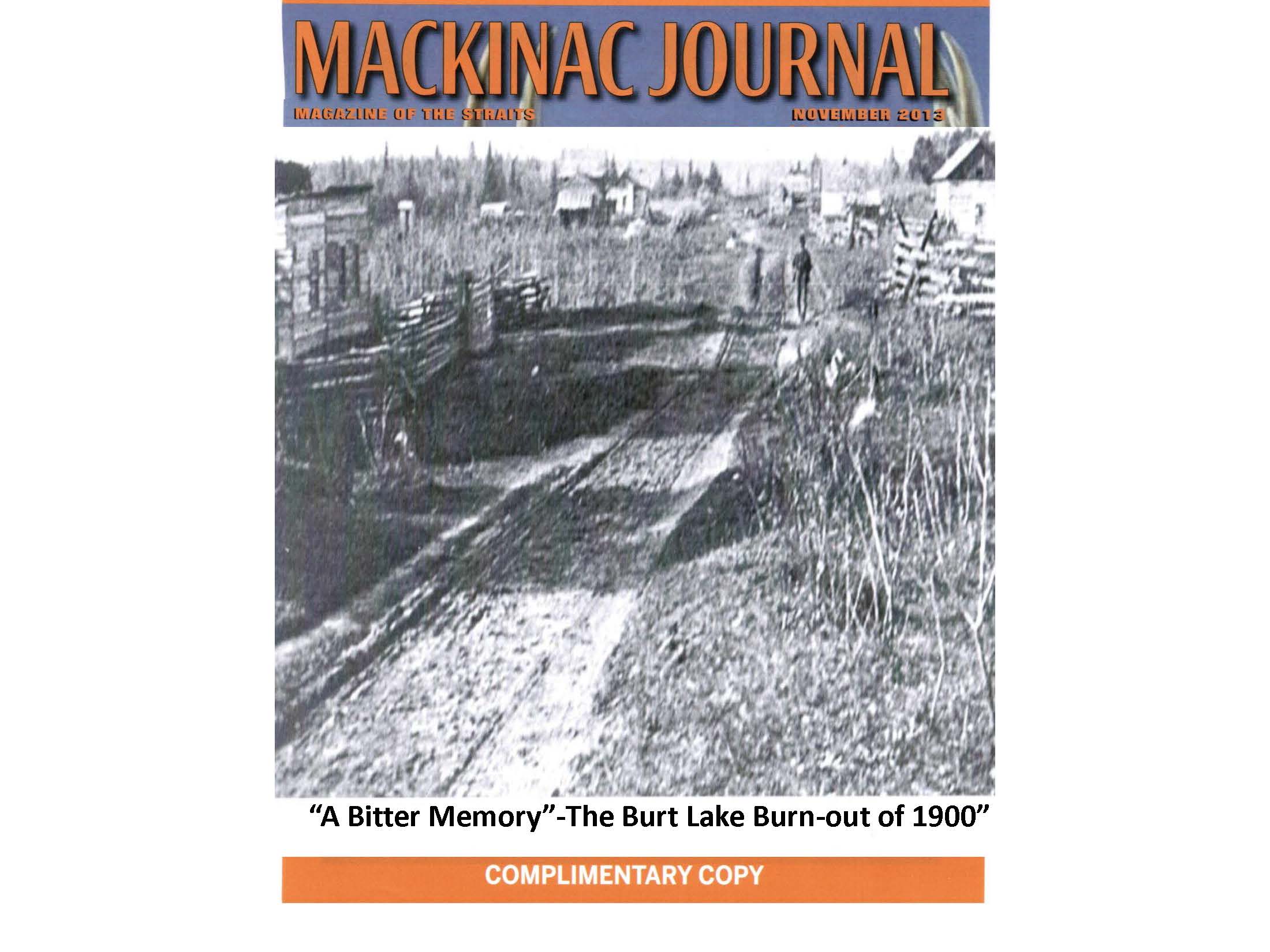
An important read for anyone in northern Michigan:
A Bitter Memory’ — The Burt Lake Burn-out of 1900
Moreover, it is a fairly direct response to the recent Michigan Historical Review article (here) that essentially argues it was perfectly legal to resort to arson to enforce a foreclosure order. Imagine if that were really true — a bank or a sheriff could simply set alight a foreclosed home, with people inside, in order to enforce a foreclosure order. Obviously not.
Here is an imaged version of article as well, with pics:
My article. “How Allotment-Era Literature Can Inform Current Controversies on Tribal Jurisdiction and Reservation Diminishment” was recently published in volume 82 of the University of Toronto Quarterly, in a special issue on law and literature.
I looked at non-Native authored and Native-authored literature of the time, specifically in South Dakota and surrounding states and territories, to see whether it helped illuminate the injustices that were being perpetrated on tribes through the allotment process and the takings of surplus lands. The idea was that this literature might have, like the news articles I looked at in “Unjustifiable Expectations: Laying to Rest the Ghosts of Allotment-Era Settlers,” put purchasers on notice that tribal lands were being taken unjustly. Most of the non-Native literature I looked at was not that helpful, but a work by historian/poet Doane Robinson was an exception. On the Native side, Zitkala-Sa’s short stories proved to be the most helpful, but the works I looked at by Luther Standing Bear and Charles Eastman were also somewhat helpful.
Unfortunately, the article isn’t available on Lexis or Westlaw, but it is on Muse, if you have access to that. A sightly older version is on my ssrn page.
Ann Piccard has published Death by Boarding School: “The Last Acceptable Racism” and the United States’ Genocide of Native Americans, 49 Gonz. L. Rev. 137 (2014).
A summary:
There is a special kind of racism in this country against Native Americans, and it is the “last acceptable racism.” The author of that poignantly accurate description of most Americans’ attitudes towards Native Americans, who is both a Native American and a Jew, noted,
Not that long ago, white administrators of Indian boarding schools told our children that the “Indian in you shall die.” This kind of treatment and forced thinking has a lasting generational effect. It can be difficult to break through that type of programming. Many of our people, however, have shaken off these forced ideological shackles to speak the truth and demand long overdue respect. Our voice is getting louder.
Our words are being said with more frequency and emphasis. But people need to hear us. Societal racism should no longer be an ad hoc affair, which is routinely accepted when directed against a certain group. It should be universally condemned. Perpetuating past wrongs and dehumanizing concepts hurts everyone.
This last acceptable racism is rarely mentioned in the U.S. However, one day in a very small town in northern Minnesota, in an area that has been economically depressed ever since the decline of the taconite and iron ore mining industry several decades ago, I watched two Native American men park a pickup truck in front of the local pawn shop.
I could tell the young men were Native Americans only because of the Bois Forte Band license plate on their truck; other than that, they looked, sounded, and acted like most of the other men in that rural north woods town. Upon reflection, of course, I realized that their skin was slightly darker than most residents of the town; I also began to notice that I did not see dark-skinned people working or shopping in any of the town’s stores. My eye was untrained, a fact that I attribute to my upbringing in the Deep South,6 where I was in a small minority of white children who were raised by our parents to see and to protest (and refuse to accept) the prevailing racism toward African-Americans. The subtle differences in appearances between the Native Americans and the “whites” in Minnesota had gone unnoticed by my Southern eyes. But as we watched the young men take their chain saws into the pawnshop that day, my husband remarked that men in northern Minnesota who hock their chain saws must be in pretty bad shape, because how could they survive, let alone make a living, without such tools?
The Energy Law Journal has published “Land in the Second Decade: The Evolution of Indigenous Property Rights and the Energy Industry in the United States and Brazil” by Danielle C. Davis.
Good stuff. Here:
At the invitation of Alex Pearl and the FIU Law Review to write a symposium piece on Florida Indian history and law, a challenge for me since I know very little about it, I came up with “The Seminole Tribe and the Origins of Indian Gaming.” Assuming the law review finds it publishable, it will appear in the FIU Law Review alongside the work of luminaries like Siegfriend Weissner and Sarah Krakoff.
Here is the abstract:
The Seminole Tribe of Florida has played perhaps the most important role in the origins and development of Indian gaming in the United States of any single tribe. The tribe opened the first tribally owned high stakes bingo hall in 1979. The tribe in 1981 was involved in one of the earliest lower court decisions forming the basis of the legal theory excluding most states from the regulation of high stakes bingo, a theory that Congress largely codified in the Indian Gaming Regulatory Act (IGRA) years later. The tribe was a party to the Supreme Court decision in 1996 that radically altered the bargaining power between tribes and states over the negotiation and regulation of casino-style gaming under IGRA. And more recently, the tribe has been a leading participant in negotiations and litigation over the regulatory landscape of Indian gaming after the 1996 decision. The Tribe is one of the most successful Indian gaming tribes in the nation.
This paper traces that history, but also offers thoughts on how the culture and traditional governance structures of the Seminole Tribe played a part in its leadership role in the arena of Indian gaming.
Here, from the Faculty Lounge. An excerpt:
In the Counties’ brief in support of the petition for certiorari, they claim that a holding in the Tribe’s favor on the disestablishment question would contravene the “justifiable expectations” of non-Indians in the area, who have come to expect to be exposed to little if any tribal presence or power. As I explained in a recent article, the Supreme Court routinely makes similar assumptions in favor of non-Indian residents and past land purchasers in tribal jurisdiction and reservation diminishment cases. See generally Ann E. Tweedy, “Unjustifiable Expectations: Laying to Rest Allotment-Era Settlers,” 36 Seattle U. L. Rev. 129 (2012). There are numerous problems with this type of assumption, however, and it can be hoped that the Solicitor General will raise some of them in his response.
The Oneida settlement in this matter is bogged down; see here and here.
In related news, former Oneida chairman Jake Thompson passed away last month: “Jake Thompson, who started Oneida land claim, dies.”
Kirsten Matoy Carlson recently published “Priceless Property” in the Georgia State Law Review.
Here is the abstract:
In 2011, the poorest American Indians in the United States refused to accept over one billion dollars from the United States government. They reiterated their long-held belief that money–even $ 1.3 billion–could not compensate them for the taking of their beloved Black Hills. A closer look at the formation of the Sioux claim to the Black Hills helps us to understand why the Sioux Nation has repeatedly rejected compensation for land taken by the United States over 100 years ago. This article seeks to understand why the Sioux view the Black Hills as priceless property by studying the formation of the Black Hills claim. It constructs a new, richer approach to understanding dispute formation by combining narrative analysis with the sociolegal framework for explaining dispute formation. The article argues that narratives enrich the naming, claiming, and blaming stages of dispute creation. It illustrates the usefulness of this new approach through a case study of the Black Hills claim. It uses the autobiographical work of an ordinary Sioux woman to provide a narrative lens to the creation of the Sioux claim to the Black Hills. American Indian Stories by Zitkala-Sa presents a narrative of Sioux life around the time of the claim’s emergence. By contextualizing and humanizing the claim, my analysis provides insights into why the Sioux claim to the Black Hills emerged into a legal dispute and helps to explain why the Black Hills remain priceless property to the Sioux Nation today. The article concludes with a suggestion for successful resolution of the Black Hills claim based on acceptance of the Black Hills as priceless property to the Sioux Nation.

Highly recommended paper.
Colette Routel has posted “Minnesota Bounties on Dakota Men During the US-Dakota War” on SSRN. Here is the abstract:
The U.S.-Dakota War was one of the formative events in Minnesota history, and despite the passage of time, it still stirs up powerful emotions among descendants of the Dakota and white settlers who experienced this tragedy. Hundreds of people lost their lives in just over a month of fighting in 1862. By the time the year was over, thirty-eight Dakota men had been hanged in the largest mass execution in United States history. Not long afterwards, the United States abrogated its treaties with the Dakota, confiscated their reservations along the Minnesota River, and forced most of the Dakota to remove westward.
While dozens of books and articles have been written about these events, scholars have largely ignored an important legal development that occurred in Minnesota during the following summer. The Minnesota Adjutant General, at the direction of Minnesota Governors Alexander Ramsey and Henry Swift, issued a series of orders offering rewards for the killing of Dakota men found within the State. The first order authorized the creation of a corps of volunteer scouts that would scour the “Big Woods” in search of Dakota men. They were to be paid not only a daily wage, but an additional $25 for each scalp they were able to provide the Adjutant General’s Office. Subsequent orders permitted individual citizens who were not part of the volunteer corps to claim up to $200 for proof that they had killed a Dakota. These bounty orders remained in effect until at least 1868, when their constitutionality was finally questioned by the Minnesota Supreme Court in State v. Gut.
Minnesota was not the only state that placed a bounty on their Indian inhabitants. Around the same time, a bounty system was enacted by the Territory of Arizona, and one was also implemented by private citizens and local governments within the State of California. Like the bounty system in Minnesota, these programs were creatures of state and territorial law, but they were implicitly and explicitly approved by the federal government. In fact, they could be viewed as part of a much broader extermination program that was at the heart of federal Indian policy during this time period.
This article uses primary historical sources to describe the events leading up to the enactment of a bounty system in Minnesota, its creation, and subsequent on-the-ground implementation. In an attempt to avoid the pitfalls of “presentism,” the legality of this bounty system is analyzed according to the laws in effect in 1863, when it was created. This article concludes that the Minnesota bounty system was illegal from its inception, as it was contrary not only the international law of war, but also the Lieber Code, which was issued by the U.S. Secretary of War in April 1863, and used to govern the conduct of Union soldiers during the ongoing Civil War.
 Turtle Talk
You must be logged in to post a comment.