There was an error in that Rolling Stone article that led Melody McCoy to write a correction in 1987:
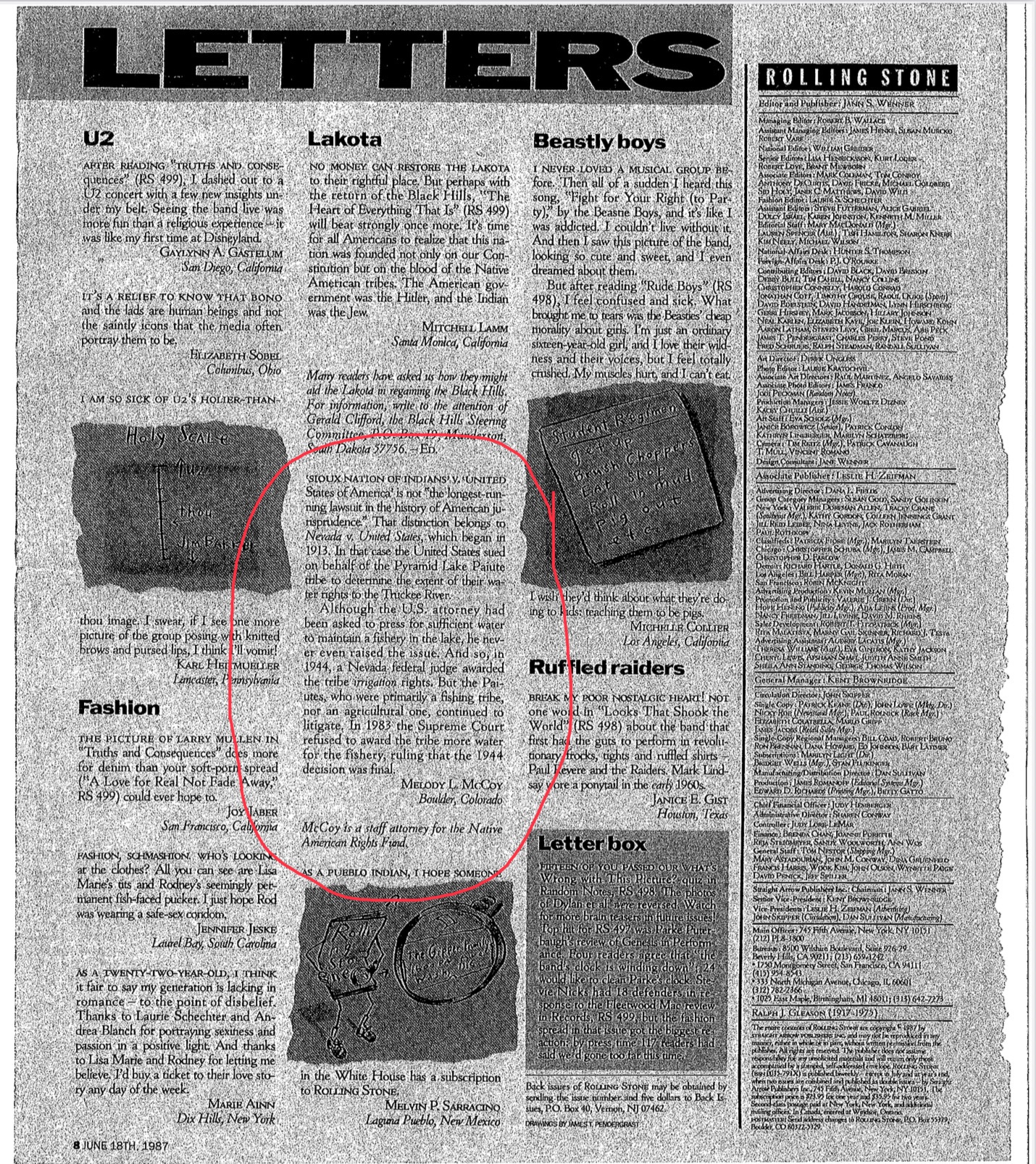

There was an error in that Rolling Stone article that led Melody McCoy to write a correction in 1987:
John LaVelle has published “Uses and Abuses of Johnson v. M’Intosh in Native American Land Rights Cases: Investigative Insights from the Indian Law Justice Files” in the Montana Law Review.
Here is the abstract:
The 200th anniversary of the foundational Indian law decision Johnson v. M’Intosh has come and gone, with many scholars contributing criticism and commentary. The dominant focus has been the case’s notorious embrace of the so-called “doctrine of discovery,” an odious theory for rationalizing European nations’ claims of superior rights to lands occupied by Indigenous Native American peoples. Commanding less attention, however, is the Johnson decision’s core protective legal feature, i.e., its reinforcing the United States government’s duty to guard against the alienation of Indian lands through private, unauthorized acquisitions.
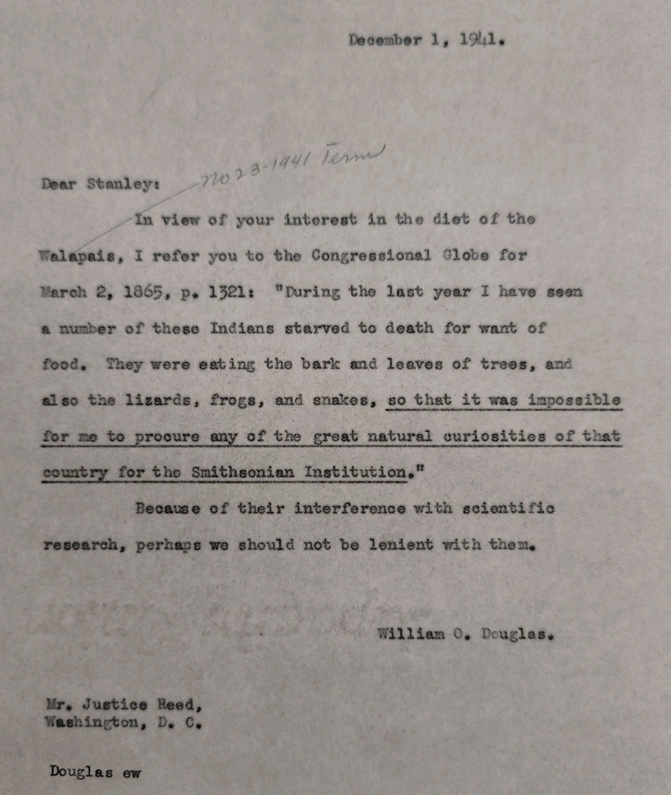
This Article offers a somewhat different appraisal of Johnson v. M’Intosh in the context of controversies over Indigenous rights. Notwithstanding the case’s offensive dicta, the unanimous Johnson opinion retains efficacy in safeguarding Native American land rights, provided certain infamous abuses of the decision as precedent can be identified and rectified. Accordingly, this Article examines instances of the modern Supreme Court’s distorting and misusing Johnson v. M’Intosh to damage, weaken, or deny Indian land rights. In centering attention on this abuse, the Article draws on eye‑opening, seldom‑viewed documents found among the papers of Supreme Court Justices archived at the Library of Congress and various universities across the country. The Article also discusses a series of modern‑era opinions by Supreme Court Justices that exemplify instructive conformity to and reliance upon Johnson’s protective features. Moreover, as a response to the joint call for papers issued by the Montana Law Review and the Public Land & Resources Law Review, the Article does not take merely a rear‑view‑mirror look at Johnson v. M’Intosh. Rather, this Article aspires to cast light on judicial distortions and misrepresentations of Johnson to help illuminate a “Vision for the Future” in legal battles over Indigenous property rights.
An accompanying Compendium of Exhibits from the Papers of Supreme Court Justices is available here.

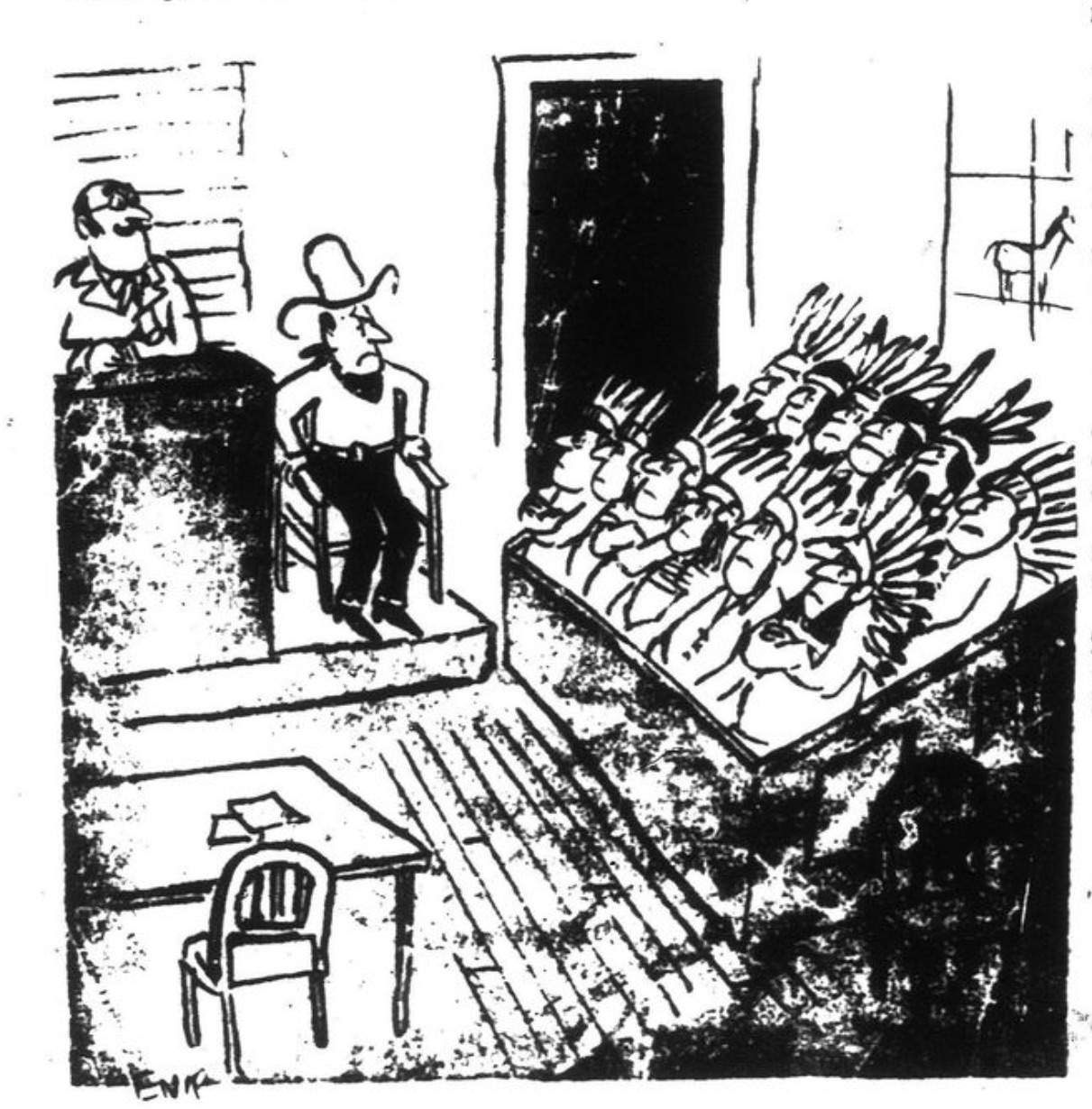
Tell us which Indian!

In honor of the land claims settlement at Akwesasne:

Akwesasne Notes, 1971:
Lauren van Schilfgaarde has posted “Civilized Enough to Tax: Natives as Federal Income Taxpayers,” forthcoming in the California Law Review, on SSRN.
Here is the abstract:
What does it mean to condition federal tax liability on the degree to which a Native American has assimilated? Federal Indian law has long assumed that Native Americans are subject to federal income taxation absent an express exemption. This presumption obscures the complicated history by which Native Americans were incorporated into the federal tax base. While U.S. citizenship alone is not ordinarily dispositive of federal income tax liability, courts have uniquely infused Native citizenship with doctrinal significance, intertwining questions of citizenship, assimilation, sovereignty, and taxation. In doing so, they have neglected the legal reality that Native Americans hold dual citizenship—as citizens of both the United States and their own Tribal nations.
This Article situates Native tax liability within the longer trajectory of federal Indian law. It traces how allotment policy, noncompetence determinations, and the Indian Citizenship Act of 1924 collectively transformed Native Americans from “Indians not taxed” into presumed taxpayers. Courts initially tethered liability to federal declarations of “competence,” using taxation as a tool of assimilation. Competence itself was understood to mark the extinguishment of Native identity: to be a competent citizen was, in law’s eyes, to cease being Indian. Courts relied on this framework in taxation cases well into the mid-twentieth century. Over time, however, competence gave way to citizenship as the doctrinal touchstone. The Supreme Court entrenched the presumption of Native taxability, narrowing exemptions to allotment-based income while disregarding the unresolved meaning of dual citizenship—the coexistence of U.S. citizenship with continued Tribal citizenship. The result is a jurisprudence that collapses political distinctiveness into presumptive assimilation, as if Native peoples could not simultaneously belong to two sovereigns.
By excavating this history, the Article demonstrates that Native income taxation is neither inevitable nor doctrinally coherent. It argues that courts have misapplied statutory canons by privileging the presumption of taxability over the Indian canons of construction, which require clear congressional intent before imposing taxation on Tribal citizens. More fundamentally, taxation doctrine has failed to account for the implications of Native dual citizenship, erasing the sovereign-to-sovereign relationship that the law otherwise recognizes. The Article concludes by advancing a structural reform: redirecting federal income tax paid by Tribal citizens to their Tribal governments. Modeled on existing provisions such as the foreign tax credit, this reform would affirm Native dual citizenship, strengthen Tribal fiscal capacity, and restore coherence to federal tax law. In reframing taxation not as an instrument of assimilation but as an expression of recognition, federal law can more accurately reflect contemporary commitments to Tribal self-determination.

The Native American Rights Fund has provided legal assistance to Tribes in Alaska since NARF’s founding in the early 1970s. In 1984, NARF opened an Alaska office so it could better serve Alaska Native Tribes and individuals. In the 40 years since NARF Alaska opened its doors, the office has litigated some of the most influential cases in the development of federal Indian law in Alaska. Below is an overview of the foundational work that NARF has done with and on behalf of Alaska Native Tribal governments and people.
Here:
John P. LaVelle, Compendium of Exhibits From the Papers of Supreme Court Justices, 88 Mont L. Rev. Online (2025).


 Turtle Talk
You must be logged in to post a comment.