Here:
Legislation
DOJ to consult with tribes on possible voting rights legislation
The DOJ is considering recommending that Congress pass legislation requiring state and local election administrators whose districts include Indian or Alaska Native lands to allow tribes to designate at least one polling place. Consultations are to begin shortly. It seems to me that such legislation would be very helpful in reducing the barriers to voting for Native persons who live on reservations and in similar communities.
The official notice is here: DOJ Consultation Announcement–Voting Rights (1). More information can also be found on the website for the Office of Tribal Justice.
Dale Kildee Claims MILCSA Not Intended to Create Off-Reservation Gaming Opportunities
From the Ann Arbor News, “Dale Kildee: Land for Soo tribe casinos in Lansing and SE Michigan not his legislation’s intent.”
California Appeals Court Finds Court Rules about Indian Children Inconsistent with Legislative Intent
Decision (a rare published ICWA decision for CA).
The children were eligible for membership at Cherokee Nation of Oklahoma. The trial court ordered DHHS to help enroll the children as active efforts. DHHS appealed. The appellate court found that both ICWA and California state law limited the definition of Indian child (member, or bio child of a member and eligible), and if the children did not fit in that definition, the laws did not apply. As such, the rules were beyond the scope of the Judicial Counsel to pass.
The rules:
Rule 5.482(c) states, “If after notice has been provided as required by federal and state law a tribe responds indicating that the child is eligible for membership if certain steps are followed, the court must proceed as if the child is an Indian child and direct the appropriate individual or agency to provide active efforts under rule 5.484(c) to secure tribal membership for the child.”
Rule 5.484(c) states, “In addition to any other required findings to place an Indian child with someone other than a parent or Indian custodian, or to terminate parental rights, the court must find that active efforts have been made, in any proceeding listed in rule 5.480, to provide remedial services and rehabilitative programs designed to prevent the breakup of the Indian family, and must find that these efforts were unsuccessful.
“(1) The court must consider whether active efforts were made in a manner consistent with the prevailing social and cultural conditions and way of life of the Indian child’s tribe.(2) Efforts to provide services must include pursuit of any steps necessary to secure tribal membership for a child if the child is eligible for membership in a given tribe, as well as attempts to use the available resources of extended family members, the tribe, tribal and other Indian social service agencies, and individual Indian caregivers.”
Guest Post, Postcript 2014: Indian Country Completely Shut Out of New Markets Tax Credits … Once Again
Guest Post by Gavin Clarkson (an update from last year’s post, here):
For the second time in as many years, NO NATIVE CDEs were selected for an award of New Markets Tax Credits. Despite strong objections from Native financial leaders, The CDFI Fund once again ignored the stark economic development needs of the Nation’s Tribal Communities and froze Native CDEs out of this important economic development financing program.
The case for a Native Carve Out for NMTCs is stronger than ever. The time for political action is NOW. Congress will be considering permanent financing of the NMTC Program as part of the Tax Extenders Act of 2014. Native political leaders should insist that a central component of permanent financing must be a mandatory Native American NMTC Carve Out.
Clinton White House Papers Release — Seminole Tribe v. Florida & Other Indian Matters
Pascua Yaqui Tribe set to prosecute first non-Indian under VAWA
News coverage includes an overview of the challenges Tribes have faced when non-Indian men batter Indian women on the reservation, a little about the battle to get the VAWA provisions passed, and information about the prosecutor, judge, and public defender who will be involved with this first case. Full article here.
Press Release from Pascua Yaqui regarding the VAWA pilot program here.
From the article:
Tribal police chief Michael Valenzuela drove through darkened desert streets, turned into a Circle K convenience store and pointed to the spot beyond the reservation line where his officers used to take the non-Indian men who battered Indian women.
“We would literally drive them to the end of the reservation and tell them to beat it,” Valenzuela said. “And hope they didn’t come back that night. They almost always did.”
About three weeks ago, at 2:45 a.m., the tribal police were called to the reservation home of an Indian woman who was allegedly being assaulted in front of her two children. They said her 36-year-old non-
Indian husband, Eloy Figueroa Lopez, had pushed her down on the couch and was violently choking her with both hands.This time, the Yaqui police were armed with a new law that allows Indian tribes, which have their own justice system, to prosecute non-Indians. Instead of driving Lopez to the Circle K and telling him to leave the reservation, they arrested him.
Inside a sand-colored tribal courthouse set here amid the saguaro-dotted land of the Pascua Yaqui people, the law backed by the Obama administration and passed by Congress last year is facing its first critical test. . . .
Some members of Congress had fought hard to derail the legislation, arguing that non-Indian men would be unfairly convicted without due process by sovereign nations whose unsophisticated tribal courts were not equal to the American criminal justice system.
“They thought that tribal courts wouldn’t give the non-Indians a fair shake,” said Pascua Yaqui Attorney General Amanda Lomayesva. “Congressmen all were asking, how are non-Indians going to be tried by a group of Indian jurors?”
Against that opposition last year, the Obama administration was able to push through only the narrowest version of a law to prosecute non-Indians. While it covers domestic and dating-violence cases involving Native Americans on the reservation, the law does not give tribes jurisdiction to prosecute child abuse or crimes, including sexual assault, that are committed by non-Indians who are “strangers” to their victims. In addition, the law does not extend to Native American women in Alaska.
“It was a compromise the tribes had to make,” Lomayesva said. “It only partially fixes the problem.”
Still, what will play out over the next months on the Pascua Yaqui reservation is being watched closely by the Justice Department and by all of Indian country. The tribe’s officials are facing intense scrutiny and thorny legal challenges as they prepare for their first prosecution of a non-Indian man.
“Everyone’s feeling pressure about these cases,” said Pascua Yaqui Chief Prosecutor Alfred Urbina. “They’re the first cases. No one wants to screw anything up.”
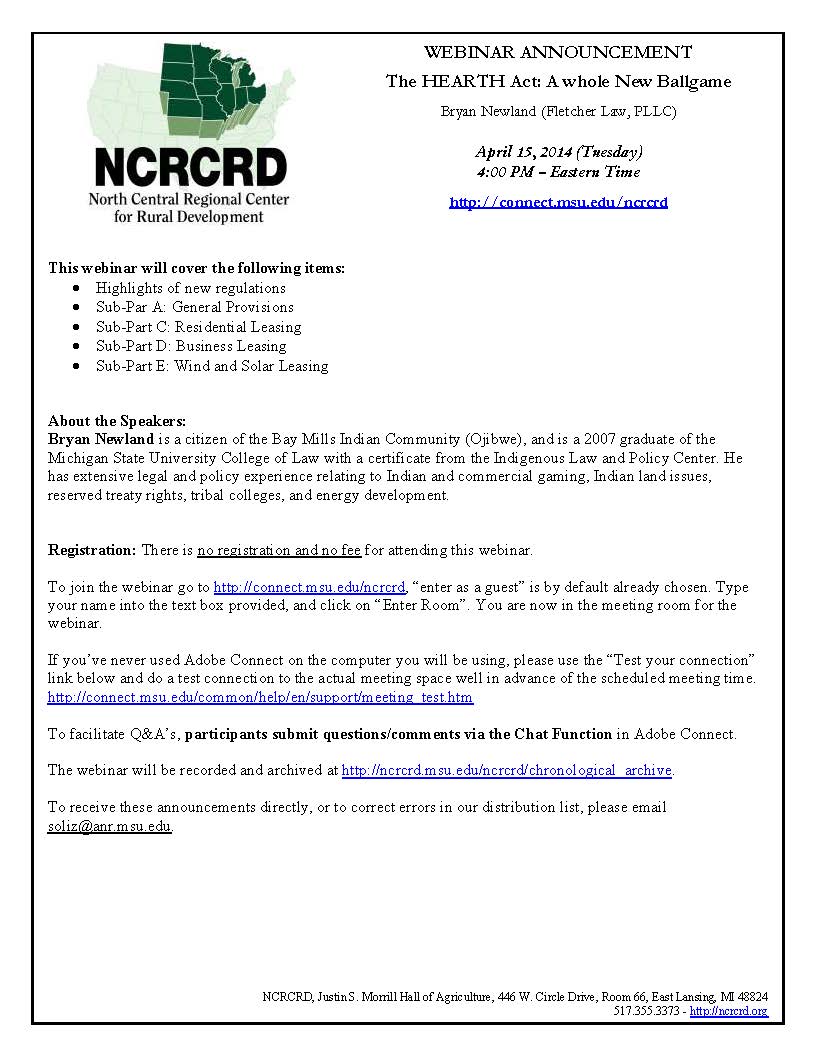
The HEARTH Act: A whole New Ballgame — April 15, 2014, 4 PM
Details here (PDF):
Interior Approves Four HEARTH Act Applications
Assistant Secretary Washburn Approves Four HEARTH Act Applications
to Help Spur Economic Development in Tribal Communities (PDF)
Dry Creek Rancheria, Jamestown S’Klallam, Mohegan, and Wichita and Affiliated Tribes join eight others already cleared to process economic development leases without BIA approval
WASHINGTON, D.C. — Assistant Secretary – Indian Affairs Kevin K. Washburn today approved leasing regulations submitted by four federally recognized tribes, restoring their authority to control the leasing of their trust lands and promoting their self-determination and economic development. This streamlined process for restoring tribal leasing authority is consistent with the objectives of the Helping Expedite and Advance Responsible Tribal Homeownership Act, or HEARTH Act.
“Thanks to the HEARTH Act, more tribes have been empowered to take over leasing on their lands,” Assistant Secretary Washburn said. “Tribal governments are the drivers of economic self-sufficiency and prosperity on their reservations and in their communities. The HEARTH Act restores their ability to directly control how their lands can and should be used for the good of their people, now and in the future.”
The four tribes, submitted requests for Secretarial approval of their leasing regulations, are: Dry Creek Rancheria Band of Pomo Indians in California, Jamestown S’Klallam Tribe in Washington State, Mohegan Indian Tribe of Connecticut, and Wichita and Affiliated Tribes in Oklahoma. Each tribe plans to authorize leases for general economic development.
The HEARTH Act was signed by President Obama in July 2012. It restores the authority of federally recognized tribes to develop and implement their own laws governing long-term leasing of federal Indian trust lands for residential, business, renewable energy and other purposes, which greatly expedites the approval of leases for homes and small businesses in Indian Country. Upon one-time approval of its regulations by the Department of the Interior, a tribe may process land leases without having to first gain approval from the Bureau of Indian Affairs (BIA).
The Assistant Secretary’s action brings to 12 the number of tribes who have had their tribal leasing regulations approved under the Act. The others are: Federated Indians of Graton Rancheria, California (Feb. 1, 2013); Pueblo of Sandia, New Mexico (March 14, 2013); Pokagon Band of Potawatomi Indians, Michigan (April 11, 2013); Ak-Chin Indian Community; California (Nov. 10, 2013); Santa Rosa Band of Cahuilla Indians, California (Nov. 10, 2013); Citizen Potawatomi Nation, Oklahoma (Nov. 25, 2013); Ewiiaapaayp Band of Kumeyaay Indians, California (Dec. 10, 2013); and Kaw Nation, Oklahoma (Dec. 13, 2013).
In November 2012, the Department announced new regulations resulting from a comprehensive reform of the BIA’s antiquated regulations governing its process for approving surface leases on lands held in trust by the Federal Government for Indian tribes and individuals. As trustee, Interior manages about 56 million surface acres in Indian Country.
The new regulations streamlined the leasing approval process on Indian land, spurring increased homeownership and expediting business and commercial development, including renewable energy projects.
The Assistant Secretary – Indian Affairs oversees the BIA, which is headed by a director who is responsible for managing day-to-day operations through four offices – Indian Services, Justice Services, Trust Services and Field Operations. These offices directly administer or fund tribally based infrastructure, law enforcement, social services, tribal governance, natural and energy resources, and trust management programs for the nation’s federally recognized American Indian and Alaska Native tribes and villages through 12 regional offices and 85 agencies.

N. Arapaho Tribe Fights Draft Federal Legislation to Terminate the Wind River Reservation
Here is the press release:
 Turtle Talk
You must be logged in to post a comment.