Harbor Springs Area Historical Society Receives Grant To Portray Native Perspectives of War of 1812

Here.

The exhibit, called Turning Point: The War of 1812 from the Native American Perspective, will focus only in part on the actual events of the 1812 war.

“It’s not your typical bicentennial commemoration of a conflict, where we’re showing battles and people involved in the battles,” said Mary Cummings, who is the executive director of the historical society. “That’s just part of the story.”

Rather, said Cummings and Eric Hemenway, the exhibit will look at the events leading up to the war, and how that war affected the Odawa people of Little Traverse Bay — as well as Little Traverse Bay itself.

“There’s going to be emphasis on the men who participated in the battle — who they were,” said Hemenway, who sits on the board of trustees for the historical society and is the director of repatriation, archives and records for the Little Traverse Bay Bands of Odawa Indians. His work revolves around retrieving human remains and sacred objects under the Native American Graves Protection and Repatriation Act.

The exhibit will feature the biographies of three Odawa leaders: Assiginac, Mokomanish and Shabanai.

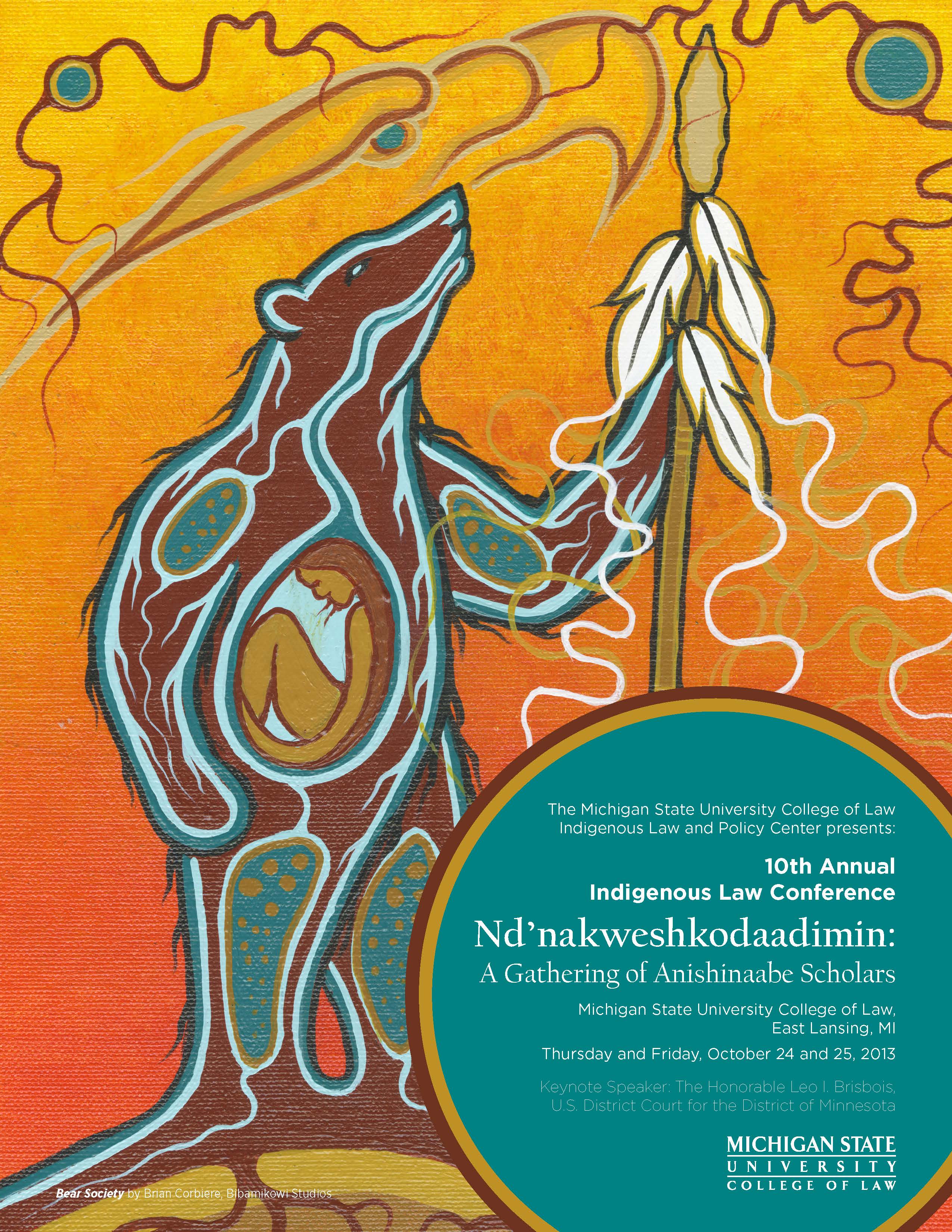
2013 MSU Indigenous Law and Policy Center Annual Conference Announcement

Here (PDF):

13-I&P-34 Indigenous Conference 2013

Freep’s Mike Thompson on Michigan Mascot Issue

Here. With accompanying comic:

Michigan schools-American Indians-education

Unpublished Michigan ICWA Notice Case

Michigan’s practice of automatically proceeding as if the child is NOT an Indian child unless told otherwise by a tribe will eventually cause problems.

In re Vanostran(pdf)

For our current purpose, what is important
from this Court’s prior decision is that we ultimately conditionally reversed the trial court order terminating respondents’ parental rights to SKV and remanded the case to the trial court only for “resolution of the ICWA-notice issue.” Id.at page 4. On remand, the trial court held several administrative review hearings. The trial court submitted an order dated March 8, 2013, indicating that at the review hearing held on January 23, 2013, the Department of Human Services complied with the statutory notice requirements tothe four Native American Indian tribes mentioned as a possible connection to the biological father of SKV who was later adopted by respondent father. As of February 19, 2013, one of the tribes had responded that there was no evidence to support that SKV was a descendent of that tribe. The order further stated that on February 14, 2013, another of the tribes responded that SKV was neither registered nor eligible to registeras a member of that tribe. The other tribes had not responded. As a result, the trial court ordered that none of the Native American Indian tribes identified as having a possible connection to SKV have responded that the child is eligible for membership in their tribe and/or that they wish to intervene in this matter. The trial court thus ordered, “The Court having previously made findings that there was clear and convincing evidence of statutory grounds to terminate the parental rights of [respondents], and that it was in the best interest of the minor child to terminate their parental rights, reinstates the Order Following hearing to terminate Parental Rights of the parents to [SKV].”

OSG Recommends Denial of Michigan’s Cert Petition in Vanderbilt Casino Dispute

Here is the brief:

12-515 Michigan v Bay Mills

Tim Garrison Review of “The Eagle Returns”

Published in the Michigan Historical Review:

Michigan Historical Review of TER

It is a great honor to have The Eagle Returns reviewed by Professor Garrison. Migwetch!

WaPo on Same Sex Marriage in Indian Country

Here. H/T How Appealing.

Tribes and the Michigan Wolf Hunt

The Michigan Natural Resources Commission has approved a wolf hunting season here in Michigan, just one day after Governor Snyder signed legislation authorizing the Commission to determine whether to allow such hunting.

In recent years, Anishnaabe tribes (Ojibwe, Potawatomi, and Odawa) in MichiganWisconsin, and Minnesota have opposed state-sanctioned wolf-hunting.  Wolves are important in the religious teachings of Anishnaabe people, and it is often said that the Ma’iingun (wolf) and the Anishnaabe are brothers whose fates are linked.

Senator Casperson of Escanaba,  the primary sponsor of the legislation, dismissed tribal religious concerns during the process, stating:

“I don’t know how you negotiate that, because that’s a personal belief they have. But at the end of the day, I do think many people don’t hold that same belief, so what do we do. Do we hold fast to it because the tribes say it’s sensitive to them, when many of my citizens don’t hold that same value?”

Aside from the Senator’s ironic statement, some Michigan tribes have also based their objections on the legal relationship between the tribes, the state, and the United States.  The 1836 Treaty of Washington reserved the hunting, fishing, and gathering rights of what are now five of Michigan’s Ojibwe and Odawa tribes throughout much of the State of Michigan.  In 2007, those five tribes and the State entered into a court-approved agreement to clarify tribal rights on lands ceded under that treaty.

Section 22 of the 2007 Agreement addresses tribal “activities designed to restore, reclaim, or enhance fish, wildlife or other natural resources within the inland portion of the 1836 Ceded Territory through stocking, rearing, habitat improvement, or other methods.”

Section 23 of the 2007 Agreement addresses consultation between the tribes and the State.  In particular, Section 23.4 provides:

“23.4 The State and the Tribes shall notify each other at least annually of proposed regulatory changes (including changes in management units or methodologies for determining the allowable harvest of any species) before they take effect (except where, due to an emergency or other matter beyond the control of the Parties it is not possible to provide advance notice) and seek to resolve any concerns arising from such changes before implementing them. Upon request, the State and the Tribes shall share information regarding the rationale for such changes and their anticipated effects (e.g., changes in species abundance, distribution, or age or sex ratios). Upon request, the State and the Tribes shall provide similar information for any existing regulation, management unit or allowable-harvest methodology. The information provided shall be sufficiently detailed to enable the other Parties to fully understand the regulation, management unit or allowable-harvest methodology at issue and any underlying data associated with it, and to enable them to make constructive suggestions for improvements to such regulation, management unit or harvestable surplus methodology.”

I am citing these provisions to highlight one basis of tribal opposition to the State’s proposed authorized wolf hunt.  I am not privy to information regarding the level of consultation between the tribes and the State, and whether the State has satisfied its obligations under the 2007 Agreement.  That issue may well be decided in the near future.

I can say that merely including tribes in a general public comment process does not fulfill tribal consultation requirements at either the state or the federal level.  That is not the legally appropriate forum in which to address tribal treaty rights.  If that is the extent to what occurred with the wolf hunt, I’m not sure that all of the tribes that were parties to the 2007 Agreement would believe that the State has fulfilled its obligations.

Lastly, the rights reserved in the 1836 Treaty necessarily include the right to protect habitats and ecosystems that would support hunting, fishing, and gathering.

It is well-documented that wolves are considered a “keystone” species in their natural habitat (which includes most of northern Michigan).  This means that their existence and well-being affects the health and well-being of many other species of plants and animals in their ecosystem.

To the extent that Michigan’s state-sanctioned wolf-hunt impacts tribal rights to hunt, fish, and gather other species, then those tribes may have a valid basis for challenging the size and scope of the hunt.

*Any views expressed in this post are solely those of the author, and not representative of any tribes or other organizations. 
Colorado COA Affirms Refusal to Transfer ICWA Case to Tribal Court (Sault Tribe)

Here is the opinion in In re T.E.R.

An excerpt:

In July 2012, mother moved to transfer jurisdiction to tribal court. The Department and the guardian ad litem (GAL) opposed the motion, arguing that good cause existed to deny the transfer because the case was at an advanced stage, and the case could not  be adequately presented in the tribal court without undue hardship to the parties or the witnesses. The Tribe took no position.

Michigan Radio on ICWA, Baby Veronica, and MIFPA

Here. Judge Allie Maldonado, Judge Tim Connors, and our own Kate Fort are interviewed. [Everyone’s name is spelled wrong, but there’s no spelling on radio….]

An excerpt:

The state law is called the Michigan Indian Family Preservation Act. People in the know shorten it to MIFPA.

As State Court Judge Tim Connors sees it, the law could be a model for the whole state. He get’s really passionate about the law, going so far as to call it “salvation” and “a tremendous gift.” Connors  sees MIFPA’s approach as an alternative to breaking apart families when the state takes children away from their parents. Connors is not afraid to say what he thinks about that approach. “The truth of the matter is that what we do in our state courts and (sic) family courts is very destructive to families, to individuals, to children,” he says.

The tribes want families kept out of this system. Their history and a ton of statistics tell them it takes kids a long time to get out, and it can be pretty damaging.

Tribes would rather parents get the help they need to be better parents and keep a family together.

Of course that isn’t always possible. Abusive and neglectful parents should not get to keep their kids under MIFPA or any other law.

But for many other families who have problems, MIFPA says the state needs to work a little harder to connect Indian families to the resources that can make a difference for them and their children. It’s called an “active efforts” requirement. Judge Connors explains it to himself as “following through” and “walking the talk.”  Connors also says he thinks the active efforts requirement should be the law for all kids in the state.

Judge Connors highlights something that always gets lost in discussions about the Indian Child Welfare Act — ICWA and MIFPA really are best practices statutes, and when someone asks why Indians should get a “special” statute, the answer is that every child should have these legal rights.