National Judicial Institute on Domestic Child Sex Trafficking – September 9-11, 2019 at Talking Stick Resort

The National Council of Juvenile and Family Court Judges is pleased to share the dates and location for the next National Judicial Institute on Domestic Child Sex Trafficking (NJIDCST): September 9-11, 2019 in Scottsdale, Arizona. The NJIDCST is an interactive workshop that seeks to increase the judiciary’s understanding of child sex trafficking in the U.S. and improve the justice system’s response to victims and those at risk for sex trafficking. The program begins on Monday at 8 a.m. and concludes on Wednesday at 11:30 a.m.

Registration and other information on the institute can be found here.

Nooksack Federal/State Litigation Update

Tageant v. Ashby (state court tort suit removed to federal court)

1-0.-7-12-19-notice-of-removal-to-federal-court.pdf

1-1.-7-12-19-complaint.pdf

6.-7-17-19-defendant-michael-ashbys-motion-for-certification-of-employment.pdf

11.-7-23-19-plaintiffs-response-in-opposition-to-defendant-ashbys-motion-for-certification-of-employment.pdf

14.-8-5-19-united-states-opposition-to-defendants-motion-for-certification-of-federal-employment.pdf

16.-8-9-19-defendant-mike-ashbys-reply-in-support-of-motion-for-certification-of-employment.pdf

Adams v. Elfo (federal court habeas corpus suit)

6.-8-13-19-amended-petition-for-writ-of-habeas-corpus.pdf

Adams v. Dodge (state court tort suit)

8-13-19-first-amended-complaint.pdf

Doucette v. Zinke (federal APA suit)

41.-8-13-19-order-on-summary-judgment.pdf

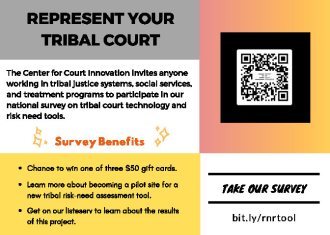
Survey for Tribal Justice Practioners

Tribal Justice Tools Flyer.jpg

The Center for Court Innovation is conducting a national survey of risk-need assessment tools and data management technologies being used by tribal courts.

The best person to fill out this survey is someone who works in a tribal court, or who has clients who are involved in a tribal justice system. Judges, court staff, prosecutor and defense attorneys, treatment providers, social service providers, case workers, probation officers, etc.

The results of the survey will be used to help develop new risk-need assessment tools and court-based data management technologies designed specifically for tribal courts.

Visit https://www.courtinnovation.org/areas-of-focus/tribal-justice

Questions? TribalJustice@courtinnovation.org

Indigenous Law Journal 2019 Call for Submissions

ILJ

Indigenous Law Journal – Call For Submissions!

Please download our Call for Submissions!

Deadline: September 13, 2019

Please contact the Submissions Manager prior to making an oral submission, or to submit written work: submissions.ilj@utoronto.ca

If someone you know would like to receive future calls for submissions, please signup here! You may unsubscribe from our list using the link at the bottom of this email.

Sincerely,

Olivia Hodson and Daniel Diamond
Editors-in-Chief
The Indigenous Law Journal

American Indian Law Journal: Call for Submissions to Fall 2019 Issue

AILJ

The American Indian Law Journal, published by the Seattle University School of Law, serves as a vital online resource providing high quality articles on issues relevant to Indian law practitioners and scholars across the country. The American Indian Law Journal accepts articles and abstracts on Indian Law for consideration from students, practitioners, tribal members, and law school faculty members.

The American Indian Law Journal is currently
accepting submissions for potential publication
in the fall 2019 issue.

Submission Deadline:

Fall issue September 15, 2019

Article submissions are accepted through Scholastica, BePress, and AILJ@seattleu.edu. The editing process for publication begins soon after these deadlines for each respective issue. The American Indian Law Journal respectfully requests that authors please use footnotes rather than endnotes. All footnotes must conform to the 20th edition of The Bluebook.

For more information or to submit an article, please contact Phoebe Millsap, Content Editor, millsapp@seattleu.edu.

MGM Sues Interior over Off-Rez Gaming in Connecticut

Here is the complaint in MGM Resorts Global Development LLC v. Dept. of Interior (D.D.C.):

1-complaint

Native Village of Eklutna Sues Interior over Gaming-Related Denial

Here is the complaint in Native Village of Eklutna v. Dept. of Interior (D.D.C.):

1 Complaint

Federal Court Refuses to Allow Law Firm to Intervene in Trust Breach Suit to Collect Fees against Tribe

Here are the materials in Yankton Sioux Tribe v. Bernhardt (D.D.C.):

69 Herman Law Motion to Intervene

72 Yankton Response

74 Reply

88 Yankton Supplemental Brief

90 Herman Law Supplemental Brief

110 DCT Order

Fifth Circuit: ICWA is Constitutional on All Counts

Here.

The Fifth Circuit overturned the Northern District of Texas today with strong language supporting ICWA. The Court found that the plaintiffs did have standing, but found against them on all other counts. There is a dissent forthcoming from Judge Owens.

Equal Protection:

We begin by determining whether ICWA’s definition of “Indian child” is a race-based or political classification and, consequently, which level of scrutiny applies. The district court concluded that ICWA’s “Indian Child” definition was a race-based classification. We conclude that this was error.

We disagree with the district court’s reasoning and conclude that Mancari controls here. As to the district court’s first distinction, Mancari’s holding does not rise or fall with the geographical location of the Indians receiving “special treatment.”

Anti-Commandeering:

We examine the constitutionality of the challenged provisions of ICWA below and conclude that they preempt conflicting state law and do not violate the anticommandeering doctrine.

Non-Delegation:

We find this argument unpersuasive. It is well established that tribes have “sovereignty over both their members and their territory.” See Mazurie, 419 U.S. at 557 (emphasis added)”

For a tribe to exercise its authority to determine tribal membership and to regulate domestic relations among its members, it must necessarily be able to regulate all Indian children, irrespective of their location.

Authority to Issue Regulations

Here, section 1952’s text is substantially similar to the language in Mourning, and the Final Rule’s binding standards for Indian child custody proceedings are reasonably related to ICWA’s purpose of establishing minimum federal standards in child custody proceedings involving Indian children. See 25 U.S.C. § 1902. Thus, the Final Rule is a reasonable exercise of the broad authority granted to the BIA by Congress in ICWA section 1952.

Conclusion:

For these reasons, we conclude that Plaintiffs had standing to bring all claims and that ICWA and the Final Rule are constitutional because they are based on a political classification that is rationally related to the fulfillment of Congress’s unique obligation toward Indians; ICWA preempts conflicting state laws and does not violate the Tenth Amendment anticommandeering doctrine; and ICWA and the Final Rule do not violate the nondelegation doctrine. We also conclude that the Final Rule implementing the ICWA is valid because the ICWA is constitutional, the BIA did not exceed its authority when it issued the Final Rule, and the agency’s interpretation of ICWA section 1915 is reasonable.

D.C. Circuit Decides United Keetoowah Band of Cherokee Indians v. FCC

Here is the opinion.

An excerpt:

We grant in part the petitions for review because the Order does not justify the Commission’s determination that it was not in the public interest to require review of small cell deployments. In particular, the Commission failed to justify its confidence that small cell deployments pose little to no cognizable religious, cultural, or environmental risk, particularly given the vast number of proposed deployments and the reality that the Order will principally affect small cells that require new construction. The Commission accordingly did not, pursuant to its public interest authority, 47 U.S.C. § 319(d), adequately address possible harms of deregulation and benefits of environmental and historic-preservation review. The Order’s deregulation of small cells is thus arbitrary and capricious. We do not reach the alternative objections to the elimination of review on small cell construction. We deny the petitions for review on the remaining grounds.

Prior post here.