Here are new materials in Metlakatla Indian Community v. Dunleavy (D. Alaska):
Prior post here.

Here is today’s order list, with an opinion by Justice Gorsuch (joined by Justice Thomas) dissenting from the denial of certiorari in Veneno v. United States:
Briefs:
Petition for Certiorari – Veneno
This is hardly a surprise given that both judges were critical of the Kagama decision. One presumes they come at this issue with a far different eye toward the outcome. Justice Thomas dissented in Brackeen because he found little constitutional text authorizing Congress’ Indian affairs powers. Thomas has seemingly sought an endgame to Indian affairs by attacking Congressional powers and tribal sovereignty. Justice Gorsuch found plenty of Congressional Indian affairs power in the text and structure of the Constitution, but not “plenary power” as described by the Kagama Court. His views are seemingly more in line with scholars like Bob Clinton, who saw no Congressional power to regulate the internal governance of tribal nations.
Certainly on a superficial level, who can really like Kagama? After all, the Court’s characterization of Indian people is unbelievably racist. It’s formalistic reading of the Constitution is also pretty . . . well, formalistic. There are important things in Kagama though, such as the notion that Congress possesses at least some powers by virtue of the duty of protection. Kagama is largely a dead letter anyway, since the Court has essentially already adopted Justice Gorsuch’s view of Congressional powers (e.g., Negonsott v. Samuels and U.S. v. Lara).
If these judges get their way and the Court eventually accepts a vehicle to review Kagama, for judges like Gorsuch, it might be merely housecleaning, but for judges like Thomas, it’s a potential revolution. There is ever-present the conflict between a formalist (Thomas) and a functionalist (Gorsuch) reading of the Constitutional text. I will continue to worry if the Court decides it needs to address Kagama if that’s the framing. It would be odd if the Court decided it needed a case to clean up its jurisprudential mess — full employment for Indian law profs!!! — where the law is settled.
More worryingly (perhaps?), the vehicle to reassess Kagama can only really be a federal criminal case. A vehicle like that will not be a good one to set the boundaries of Congressional authority over tribal nations, but instead a vehicle for revisiting Brackeen’s Congressional powers holding.
In the end, it’s just these two, so don’t hold your breath.
Here is the order in Tarabochia v. Quinault Indian Nation:
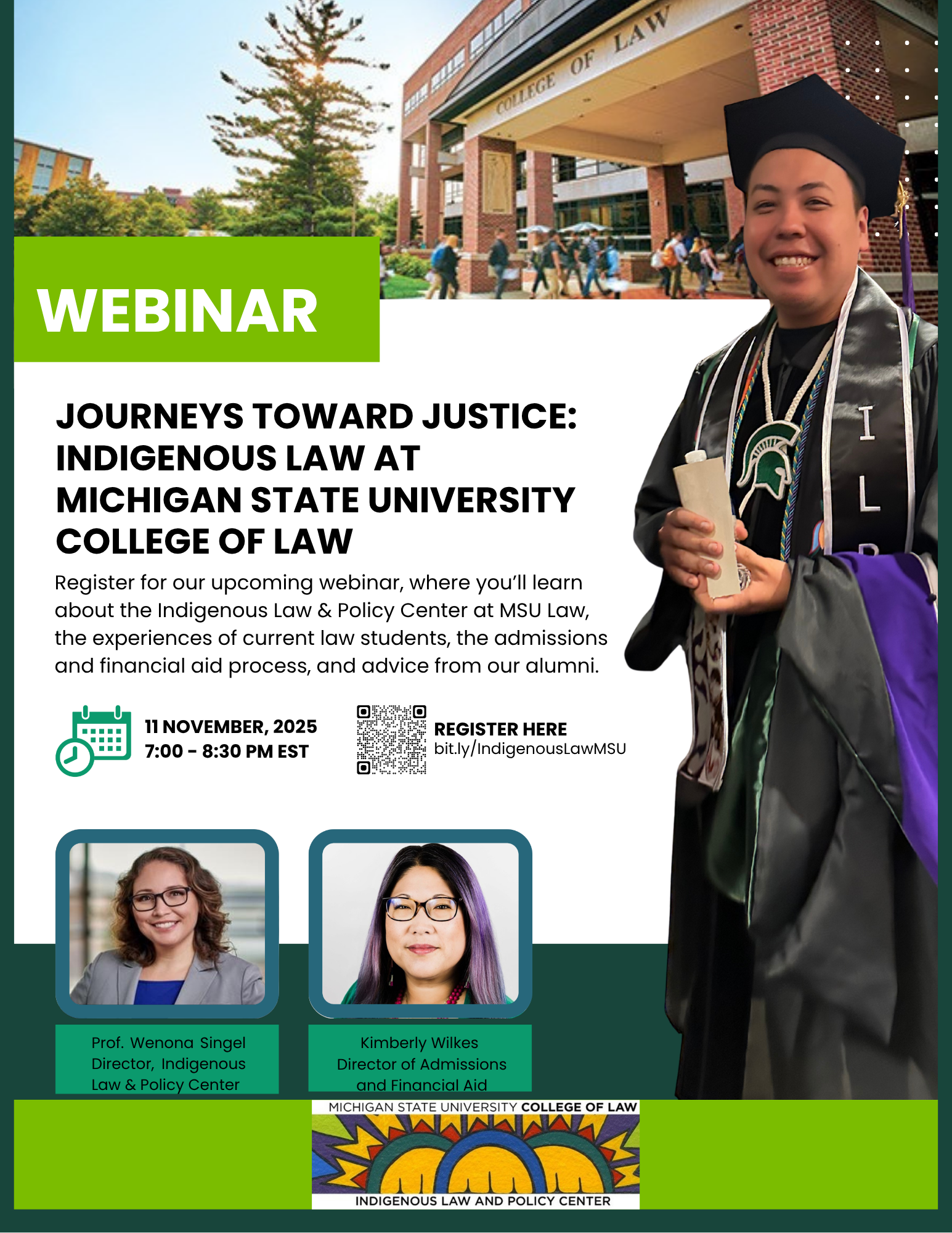
Do you know any students considering law school? Send them our way! The Indigenous Law & Policy Center at Michigan State University, in collaboration with the MSU College of Law Admissions & Financial Aid office are hosting a webinar on Tuesday, November 11 at 7PM EST.
The webinar, JOURNEYS TOWARD JUSTICE: INDIGENOUS LAW AT MICHIGAN STATE UNIVERSITY COLLEGE OF LAW will discuss the Indigenous Law & Policy Center at MSU Law. Featuring Prof. Wenona Singel, Director of the ILPC, and Kimberly Wilkes, Director of Admissions & Financial Aid. Additionally, hear from current students and recent graduates to hear about their experiences at MSU.
Please register at https://bit.ly/IndigenousLawMSU
Hope to see you there!
The Indigenous Law & Policy Center at MSU College of Law hosted the Michigan Tribal State Federal Judicial Forum on October 27-28, 2025. The forum was formally established in 2014 by the MichiganSupreme Court and consists of tribal judges from each of Michigan’s 12 federally-recognized tribes, 12 state court judges, as well as federal judges and officials. Michigan, which is home of 12 federally recognized Indian tribes and tribal court systems, has also enjoyed a long history of collaboration between state and tribal courts.
The meeting began with a welcome by MSU College of Law Dean Michael Sant’Ambrogio, followed by Co-Chair Reports, and a report from Chief Justice Cavanaugh. The next session was the forum business meeting where we heard about the DEI Commission Update from Hon. Melissa Pope, New Forum Member On-Boarding – Communications Committee from Hon. Carol Bealor, and Tribal Child Support Order Enforcement in State Courts.
Over lunch, the keynote was delivered by Jeff Davis, Partner, Barnes & Thornburg (Turtle Mountain Band of Chippewa Indians). Jeff is the former Executive Director of the Indian Law & Order Commission established by Congress. The Commission held public hearings throughout Indian Country to gather information from Native peoples directly on the state of justice in Indian Country and the judicial, law enforcement, and other systems that affect justice in these communities. The Commission ultimately published a report called “A Roadmap for Making Native America Safer,” which was presented to the President and Congress. Jeff’s keynote was called Views of an ‘Old’ Native AUSA: From Prosecutor to Policy—An Insider’s Look at Justice in Indian Country.
The afternoon session was geared toward the law students. Hon. Jeff Nellis, Hon. Michael Petoskey, and Hon. Angela Sherigan talked about how the tribal, state, and federal courts work together, while Hon. Allie Greenleaf-Maldonado discussed career and clerkship opportunities. In the following session, Hon. Carol Bealor talked to the students about ICWA and MIFPA, and Emilie Tarsin (SCAO) talked about Legal Deserts.
Day two was all business as the justices met in their assigned committee groups and offered report out from those committees. Lasty, plenty of action planning took place as the form worked to draft near-term deliverables; finalize action items, assign leads, confirm follow-ups; discuss Peacemaking Conference and make plans for the next Forum meeting.
The forum was attended by several justices including:
Hon. Carol Montavon Bealor – Cass County Probate Court, Family Division,
Hon. Stuart Black Isabella – County Probate Court
Hon. Patrick Conlin – 22nd Circuit Court Family Division – Peacemaking Court
Hon. Kelley R. Kostin – 52nd District Court – Division 2
Hon. Jeffrey Nellis – Mason County Probate Court
Hon. Steven Paciorka – Leelanau Count Probate Court
Hon. Valerie Snyder – 7th Probate Court, Emmet County/33rd Circuit Court – Family Division (Juvenile)
Hon. Jennifer Whitten – Grand Traverse Probate Court
Hon. Hannah Bobee – Lac Vieux Desert Band of Lake Superior Chippewa Indians
Hon. Michael Petoskey – Match-E-Be-Nash-She-Wish Band of Potawatomi Indians ( Gun Lake Tribe)
Hon. Melissa Pope – Nottawaseppi Huron Band of the Potawatomi
Hon. Angela Sherigan – Little River Band of Ottawa Indians
Hon. Wenona Singel – Little Traverse Bay Bands of Odawa Indians
Hon. Maarten Vermaat – US District Court
Hon. Megan K. Cavanagh – Chief Justice – Michigan Supreme Court
Hon. Allie Maldonado – Michigan Court of Appeals
Hon. Bob Butts – Sault Ste. Marie Appellate Judge (retired)
Hon. Sue Dobrich – Cass County Probate Court (retired)
Below are a few photos from the event.

Hon. Michael Petoskey, Hon. Jeffrey Nellis and Jeff Davis

Hon. Allie Maldonado and Hon. Bob Butts talking to NALSA students.

Hon. Melissa Pope listening intently.

Hon. Megan K. Cavanagh, Chief Justice of the Michigan Supreme Court
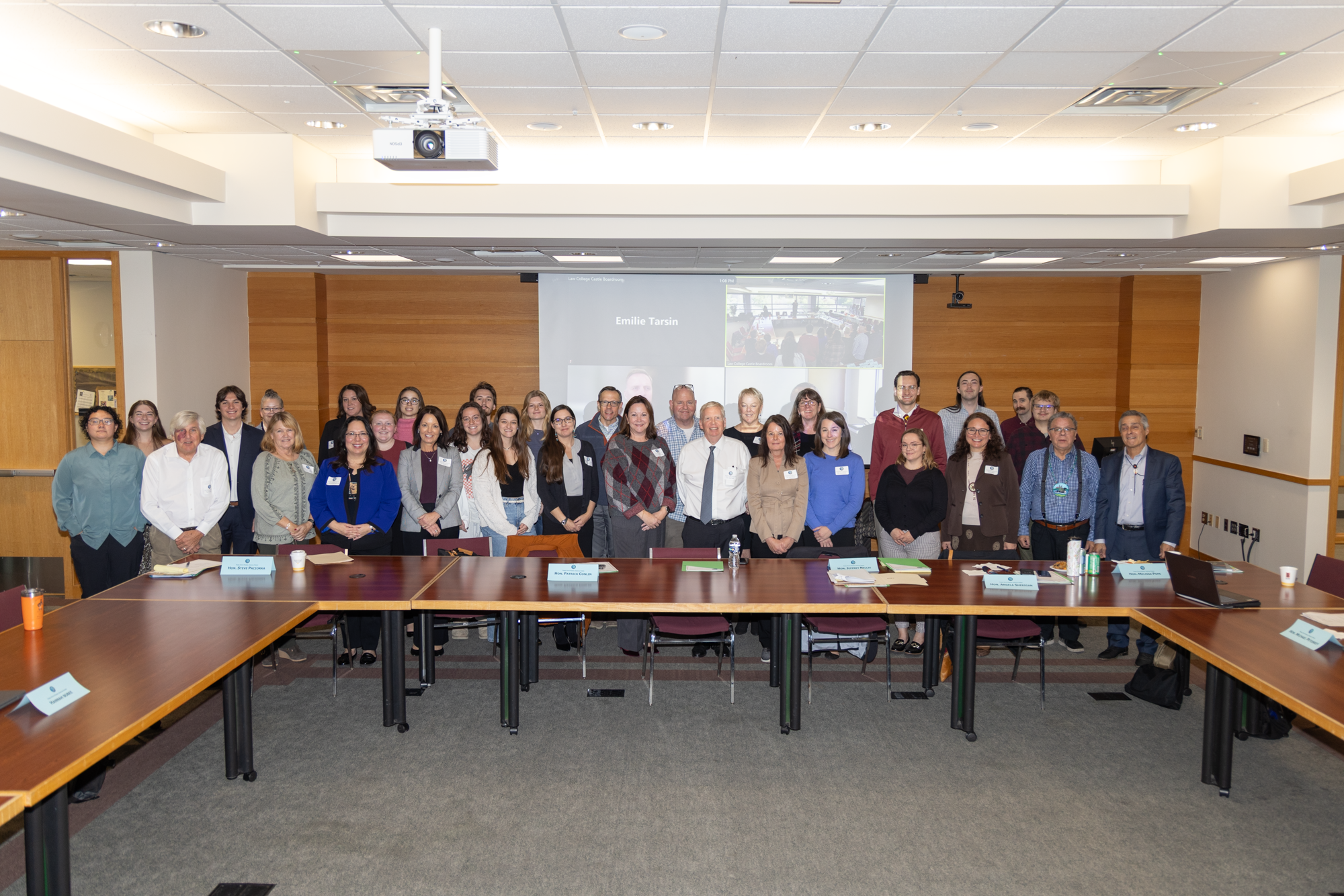
Group photo.
If you have a new announcement, please share it with us by uploading the information requested on this Google Form. If you have any questions, please email the MSU College of Law Indigenous Law & Policy Center at indigenous@law.msu.edu.
Lac Courte Oreilles Band of Lake Superior Chippewa, Hayward, WI
• Represent the Tribe in all Tribal Court proceedings and before quasi-judicial or administrative agencies.
• Serve as the Tribal Prosecutor for all tribal matters, including but not limited to: employment appeals, traffic, conservation, truancy, Indian Child Welfare, housing, election appeals, child support conflict cases as assigned, and other legal matters on behalf of the Tribe.
• Prepare legal documents, including not limited to: pleadings, legal opinions, motions, and proposedorders.
• Draft, review, and revise Tribal law, codes, ordinances, and legislative documents for various tribal entities or tribal enterprises as directed by the Attorney General.” “•Must have a Juris Doctorate from an accredited Law School.
•Must be a member in good standing of the State Bar of Wisconsin, any other Bar, or must become licensed following the next available bar exam (WI Bar Admission may be required at the discretion of the Attorney General).
•General knowledge of Federal Indian law with emphasis on applicable current federal and state law, P.L.280, statutes and regulations relating to Indian tribes.
•Working knowledge of Federal, State and Tribal court systems. Individuals with experience in Federal Indian and Tribal law and litigation strongly preferred.
•Excellent oral and written communication skills; must work effectively with other people at a variety of ages and levels, competency in various computer programs, and able to work independently to get projects completed.
•Proficiency in legal research.
•Ability to work with representatives of governmental units, including other Tribes, federal government, state government and local governmental entities.
•Ability to identify and analyze legal issues and present legal theories.
•Independent, organized, multi-tasker whom is able to manage a significant number of matters simultaneously.
•Demonstrate the ability to meet deadlines in a fast paced environment.
•Well-developed interpersonal skills and ability to work in a supportive and professional manner with other attorneys, support staff and client agencies.
•Knowledge of and commitment to professional ethics.
Salary TBD w/Qualifications https://lco-nsn.gov/wp-content/uploads/2025/09/TribalProsecutor.pdf
Columbia River Inter-Tribal Fish Commission, Portland, Oregon
CRITFC seeks a highly skilled attorney and strategic leader to serve as Manager of the Policy Development and Litigation Support Department (PDLSD). This department plays a pivotal role in advancing the treaty rights, tribal sovereignty, and natural resource priorities of CRITFC’s four member tribes: the Nez Perce Tribe, the Confederated Tribes of the Umatilla Indian Reservation, Warm Springs tribe, and the Yakama Nation.
• Juris Doctorate from an accredited law school, active bar membership in WA, OR, or ID (or ability to obtain within one year). Special consideration will be given to practice in other states accompanied by the ability to acquire a license to practice in any of the three states listed.
• Certificate, special training, and/or experience in Expertise in Indian law, tribal sovereignty, environmental and natural resource law, and federal litigation procedures.
• Experience working with Native American Tribes in any capacity.
• Minimum of 10 years’ experience as a practicing attorney.
• Minimum 5 years’ experience in a supervisory position.
• Strong strategic planning, organizational leadership, and communication skills.
• Ability to work in a dynamic environment, adapt to changing priorities, and effectively manage multiple tasks or projects concurrently.
• Excellent inter-personal and cross-culture communication skills.
• Knowledge and experience with tribal fishing treaty rights, customs, and regulations, especially those of the Warm Springs, Umatilla, Yakama, and Nez Perce tribes, is helpful.
Salary $ 156k to $ 180k Open until filled https://workforcenow.adp.com/mascsr/default/mdf/recruitment/recruitment.html?cid=7de56b96-15a5-4660-8c81-782450fbe9ae&ccId=19000101_000001&type=JS&lang=en_US&selectedMenuKey=CareerCenter&jobId=522137
Gila River Indian Community – Office of the Prosecutor, Sacaton, AZ
The Legal Assistant I under supervision perform work of moderate difficulty in supporting and assisting criminal and civil attorney; performs related work as assigned. High school diploma or GED and four (4) years’ experience as a legal secretary or secretarial experience in a legal environment, which included working with legal procedures and preparing legal documents. $18.61 – $29.01 / Hour Open until 11/25/2025 https://selfservice.gric.nsn.us/ess/employmentopportunities/default.aspx
Gila River Indian Community – Office of the Prosecutor, Sacaton, AZ
The Prosecutor I – Deputy Community Prosecutor is responsible for representing the Gila River Indian Community in the litigation of criminal complaints, civil petitions, and juvenile offender matters in Community Courts as plaintiff or petitioner, which may include legal research and writing. The incumbent must be familiar with professional responsibilities as an Attorney, which include ethically prosecuting criminal cases for the Office of the Prosecutor. Juris Doctorate degree from an accredited school of law by the American Bar Association and current membership in good standing with the State Bar of Arizona.
Salary $82,522.50 – $144,522.50 Open until 11/25/2025 https://selfservice.gric.nsn.us/ess/employmentopportunities/default.aspx
California Indian Legal Services, Sacramento, CA
POSITION DESCRIPTION
This is a full-time exempt position reporting directly to the Directing Attorney of the Central Office. The Senior Staff Attorneys has substantial knowledge of and experience with issues related to client eligible Native American individuals, Indian Tribes, and Indian organizations and groups that are in the service area for the program. They bring a strong, demonstrated expertise in federal Indian law and/or public interest law, and/or a specialized area of law required by the program (e.g. Domestic Violence, Indian Child Welfare Act, etc.). The Senior Staff Attorney will be expected to maintain a caseload involving complex Indian law issues, engage with tribal clients on government work that requires experience in land, environmental, cultural resources, and economic matters. They will provide individual Native
American clients with advice and representation on critical issues that are unique to Native Americans such as allotments, Indian probate, taxation, and benefits.
Essential Functions:
• Collaborates with the Directing Attorney and the Director of Legal Programs on mentoring staff attorneys on issues of federal Indian law.
• Conducts client development, including developing and maintaining effective relationships with Tribes and Indian organizations in the service territory and ensuring that the office pursues and secures meaningful opportunities to work with Tribes, Indian organizations and Indian individuals throughout the service territory.
• Manages an appropriately sized caseload concurrent with other duties and responsibilities.” “Minimum Qualifications:
• J.D. degree and California Bar membership in good standing or eligible for admittance and willing to sit for the next available California State Bar exam;
• Minimum of seven years’ experience practicing law with low-income Native Americans, substantial experience in federal Indian law, or significant legal services practice. Equivalent general practice may be acceptable;
• Substantial experience and knowledge of civil litigation;
• Commitment to high quality legal services for Native American people.
• Excellent communication, writing and organizational skills.• Strong work ethic and able to work nights and weekends when manyTribal councils meet.
• Ability to travel overnight and a valid driver’s license.
• Solid understanding of Native Americans and Tribes in California.
• A commitment to providing high-quality legal services for Native Americans.
• Ability to work independently, as part of a team and to take initiative.
• Deep connection and commitment to the CILS mission and Tribal communities.
Preferred Qualifications:
• Prior management and supervisory experience
Salary $93,978 – $107,376 https://recruiting.paylocity.com/recruiting/jobs/Details/3613286/California-Indian-Legal-Services-Inc/Senior-Staff-Attorney
Executive & Communications Manager
California Indian Legal Services, Sacramento, CA
The Executive & Communications Manager at California Indian Legal Services (CILS) plays a critical role in advancing the mission of the organization by providing direct support to the Executive Director and Board of Trustees. This position manages organizational communications — including social media, press releases, newsletters, the Annual Report, and website content — while upholding brand standards and strengthening CILS’s visibility. The Executive & Communications Manager also supports CILS’s Capitol Presence by organizing, coordinating, and promoting legislative and policy initiatives, advocacy events, trainings, and Tribal engagement activities. This dynamic role requires strategic thinking, exceptional organizational skills, and the ability to independently lead projects and priorities with professionalism and impact.
As the Executive & Communications Manager at CILS, you will:
• Support Executive Projects: Serve as a trusted partner to the Executive Director by managing and leading delegated tasks, projects, and priorities with independence and accuracy.
• Coordinate Governance: Lead the quarterly meeting preparation and execution of the Board of Trustees and its Committees, ensuring smooth meetings, accurate records and clear communication of actions and decisions.
• Lead Communications: Manage CILS’s external communications through social media, press releases, newsletters, website updates, the Annual Report, and branding.
• Advance Advocacy: Support CILS’s Capitol Presence by organizing, coordinating, and promoting legislative and policy initiatives, advocacy events, trainings, Tribal Roundtables, and other key Capitol-based activities.
• Strengthen Organization: Maintain internal communication tools, resources, and processes that keep staff informed and aligned with the strategic plan.
Required Qualifications
Education & Experience
o Bachelor’s degree (communications, public policy, nonprofit management, Native American studies or related field preferred).
o Minimum of three years’ experience in a nonprofit, Tribal organization/government, or legal setting.
o Demonstrated programmatic or project management experience (minimum three years).
Knowledge & Cultural Competency
o Solid understanding of Native Americans and Tribes in California.
o Experience working directly with Tribal communities in any capacity.
Communications & Media
o Proven experience creating and managing organizational social media platforms.
o Exceptional written and verbal communication skills, with ability to draft clear, compelling content for diverse audiences.
o Experience drafting press releases, newsletters, or public-facing organizational communications.
Professional Skills
o High attention to detail and strong organizational/time management skills.
o Ability to balance multiple projects and work independently while meeting deadlines.
o Excellent judgment, discretion, and ability to maintain confidentiality.
o Strong interpersonal skills with a professional, reliable, and collaborative approach.
o Potential to supervise administrative support staff as organize grows
Technology Skills
o Expertise in Microsoft 365 (Outlook, Teams, PowerPoint, Word, Excel).
o Proficiency with communications and design tools including Canva, Constant Contact, and Hootsuite (or similar social media scheduling platforms).
o Experience Familiarity updating and maintaining websites using WordPress (or comparable CMS).
o Proficient with Zoom and PDF editors for professional collaboration and document management.
o Ability to quickly learn and adapt to new platforms and digital tools.
Salary $69,159 – $82,141 annually https://recruiting.paylocity.com/recruiting/jobs/Details/3681754/California-Indian-Legal-Services-Inc/Executive-Communications-Manager

 Turtle Talk
You must be logged in to post a comment.