Here are the materials available in Lomeli v. Kelly (Nooksack Tribal Court):
Order Denying Motion for Preliminary Injunction
Defendants Response Brief in Opposition to Plaintiffs Emergency Motion for T
Here are the materials available in Lomeli v. Kelly (Nooksack Tribal Court):
Order Denying Motion for Preliminary Injunction
Defendants Response Brief in Opposition to Plaintiffs Emergency Motion for T
Here is the opinion.
The court’s syllabus:
Civil case – Indian law. Because the district court had adjudicated the issue of subject matter jurisdiction in the Sandy Lake Band’s previous suit, and Sandy Lake did not appeal from that decision or exhaust its administrative remedies, the court is bound by the district court’s original determination that it lacked subject matter jurisdiction; the district court’s dismissal order is affirmed, but modified to be without prejudice.
Briefs:
Lower court materials here.
Sorry about the “quasi-banishment.” It’s a made up word, I know. 🙂
Mr. Mitchell contended that the Council’s action imposing certain restrictions on him (following a federal indictment charging him with fraudulent acts in connection with his position with a Nation gaming enterprise) subjected him to custody for purposes of ICRA, and sought habeas corpus relief. The Court held that Mr. Mitchell is not subject to custody or detention, and did not reach the question of exhausting tribal court remedies.
Here are the materials in Mitchell v. Seneca Nation of Indians (W.D. N.Y.):
15-1 Memorandum in Support of Motion to Dismiss Under Rule 12(B)(1)
18 Mitchell Opposition Motion Dismiss 1
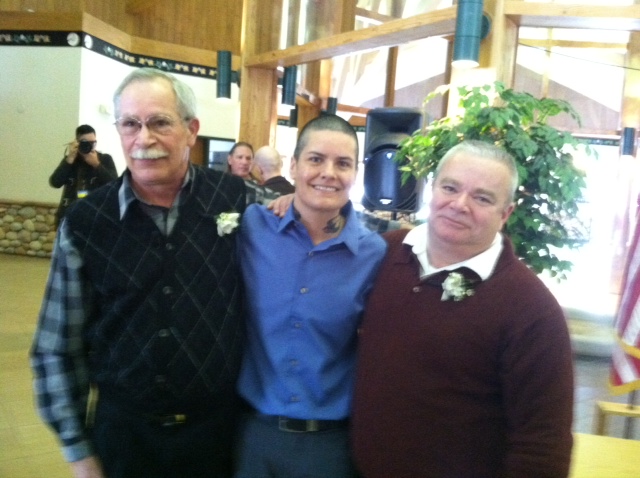
AP Article here features a quote from Cherie Dominic, who is pictured below today (on her birthday!) with the newly married couple. Congratulations to Mr. Barfield and Mr. LaCroix!
Here.
From his email to the tribal employees and news outlets:
Our constitution under ARTICLE II ” INDIVIDUAL RIGHT ” reads, The Little Traverse Bay Bands of Odawa Indians, in exercising powers of self governance, shall NOT deny to any person within its jurisdiction the equal protection of its laws or deprive any person of liberty or property without due process of law.
Also in our Constitution under ARTICLE VI. ORGANIZATION OF THE GOVERNMENT A. PURPOSE, FUNDAMENTAL RIGHTS. We, the Little Traverese Bay Bands of Odawa Indians, speak through this document to assert that we are a distinct nation of Anishinaabek of North America that possess the right to : self-determination; freely determine our political status; freely pursue our economic, social, religious and cultural development, and determine our membership, without external interference. These same rights and principles the Little Traverse Bay Bands of Odawa Indians acknowledge to be inherent among other peoples, nations and governments throughout the world. We recognize their sovereignty and pledge to maintain relations with those peoples, nations and governments who acknowledge those same fundamental human rights and principles, and who recognize the sovereighty of the Little Traverese Bay Bands of Odawa Indians.
As the Chairman of the Little Traverse Bay Bands of Odawa Indians I will sign the Same Sex Marriage Statute on Friday March 15, 2013 @ 10:00 A.M. in the Chairmans office.
I believe that Tribal Citizens who wish to choose same sex marriage should be treated and just as importantly as any other Tribal Citizen who are Man and Woman. This is about people being happy. This is a real Issue. We are private people and we need to recognize on how we wish to live our lives. I have heard from Tribal Citizens, and not once have I heard that this could bring injury to our Nation, and that was the biggest issue that I had concerns of. There should not be a dividing line and we should all be able to seek a good life.
Migwech…
Chairman McNamara has said he intends to sign the bill approving same-sex marriage. This information is from an email forwarded to me by a tribal member.
The previous post is here.
Here are the materials in Anglen v. Cherokee Nation Council:
Here.
Fascinating. My favorite part:
By 1862, Ross had become disillusioned with the Confederate government. The first major military engagements in Indian Territory proved disastrous for both the Confederacy and the Cherokees. Retreating from Indian Territory, the Confederacy left the Cherokees open to Union advances and without supplies for Cherokee troops and destitute civilians. Although Ross believed the Confederacy was shirking its treaty promises, the Confederate colonel Douglas H. Cooper called upon Ross to fulfill his obligations by ordering all Cherokee men of fighting age to “take up arms to repel invasion.”
Union Capt. Harris S. Greeno was aware of Ross’s dissatisfaction with the Confederacy, and he ordered the arrest of Ross and his family at their plantation home, Rose Cottage, in present-day eastern Oklahoma. They were quickly paroled and escorted to Union territory, and they retreated to his wife’s family home in Philadelphia. Ross would spend the remainder of the war attempting to convince the Lincoln administration of the Cherokee’s loyalty and commitment to the Union cause.
 Turtle Talk
You must be logged in to post a comment.