Here:
CA5 panel materials are here.
Here is today’s order list.
Cert petition was here.
Here is the complaint in GlaxoSmithKline LLC v. Cherokee Nation (D. Mass.):
An excerpt:
By filing suit in the Tribal Court for conduct relating to the marketing, sale and promotion of Avandia, the Cherokee Nation breached the Avandia Settlement Agreement in three ways. First, the Avandia Settlement Agreement clearly specifies that the exclusive jurisdiction and venue over disputes under the Avandia Settlement Agreement are vested in the United States District Court for the District of Massachusetts. Filing suit in the Tribal Court was a breach of this exclusive jurisdiction and venue provision. Second, the Cherokee Nation’s suit runs afoul of the Avandia Settlement Agreement because it asserts claims that were released under the Avandia Settlement Agreement. Third, the suit purports to seek relief under the “statutory, common, and decisional laws of the Cherokee Nation,” notwithstanding that disputes under the Settlement Agreement are “governed under the laws of the United States.”
Here are the updated materials in St. Germaine v. Kelly (Nooksack Tribal Court):
St Germain v. Kelly TRO Motion
St Germain v. Kelly Declaration of Michelle Roberts
St Germain v. Kelly Declaration of Rudy St. Germain
St Germain v. Kelly Order on Motion for Temporary Restraining ORder
The complaint is here.
Here is the complaint:
Rudy St Germain v Kelly Complaint For Prospective Equitable Relief
And a press release:
Nooksack 306 Deprived Of Christmas Support
Deming, WA – Today the Nooksack 306 were forced to file yet another Tribal Court lawsuit, after it became public that on December 3, the Nooksack Tribal Council Faction led by Chairman Bob Kelly voted via secret “poll” to exclude the 306 families from $250 in Christmas support.
The families have asked the Nooksack Tribal Court to stop the Kelly Faction from excluding 306 families from the distribution, which they intend to make starting this Thursday, December 12.
“We are disgusted but not surprised that Bob Kelly and his followers would now deprive our families from Christmas support,” said Nooksack 306 family spokesperson Moreno Peralta. “The holidays are a struggle for many of us, and they know that. This is just pure insult that is being added to the deep injury we’ve already suffered this year.”
Tribal member comments on the Tribe’s Facebook page confirm that Nooksack “families in need” could really use the Christmas monies.
The lawsuit alleges violation of the equal protection clauses in the Nooksack Constitution and federal Indian Civil Rights Act, as well as the Indian Gaming Regulatory Act (IGRA), which prevents tribes from distributing gaming revenues on a per capita basis without a federally-approved revenue allocation plan and/or in discriminatory fashion.
The Nooksack Tribe does not have any such revenue allocation plan. The resulting violations of IGRA could result in the National Indian Gaming Commission levying civil fines against the Tribe up to $25,000 per distribution and/or closing the Tribe’s two gaming facilities.
I visited the Santee Sioux Nation Reservation for the Nation Supreme Court’s first oral argument yesterday.
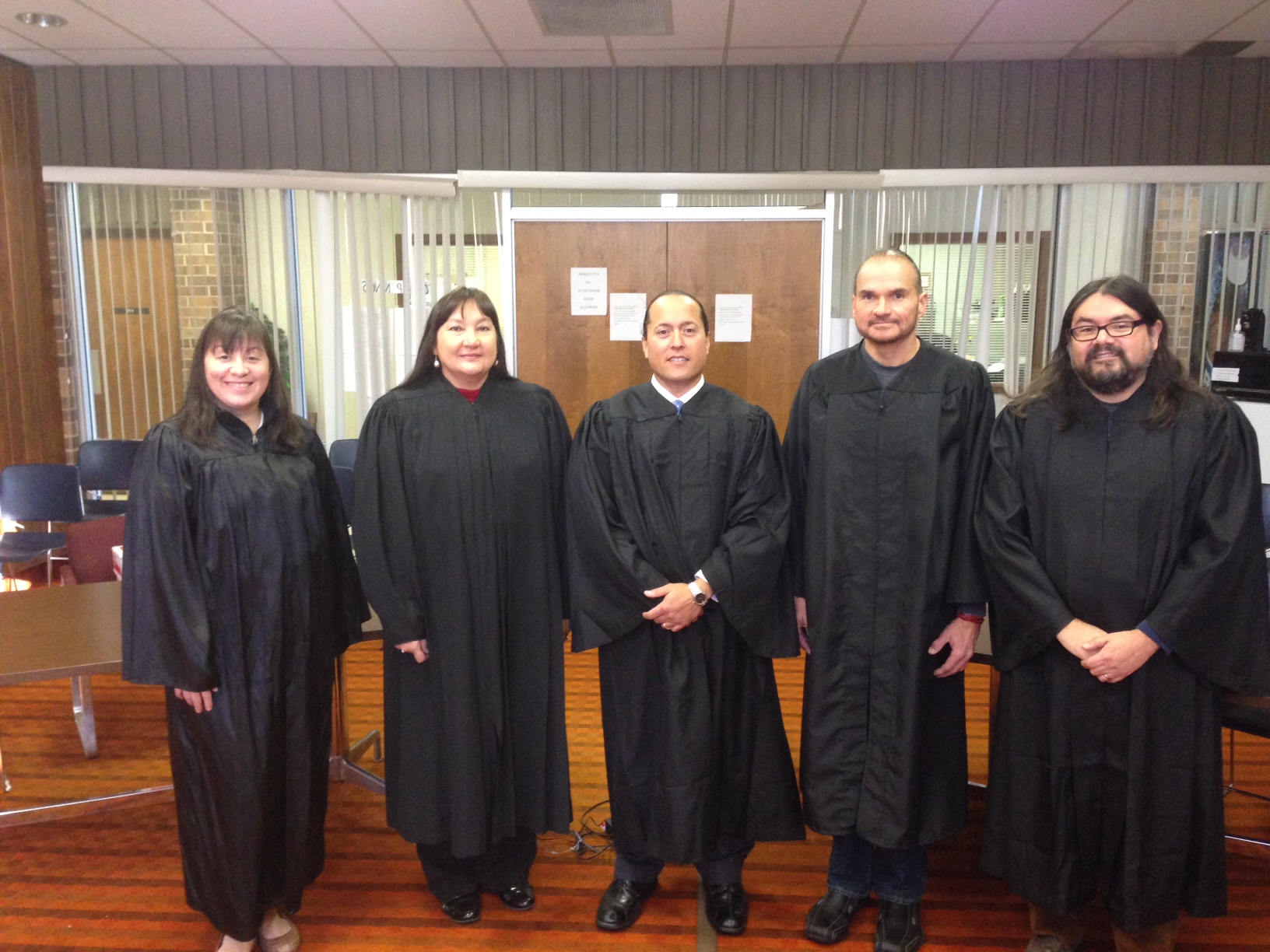
Here is the court: Amanda WhiteEagle (Ho-Chunk Nation); Terri Mason Moore (Osage Nation); Andrew Adams III (Muscogee Nation); John LaVelle (Santee Sioux Nation); and me (GTB)
Sunrise at the Ohiya Casino (negative 2 degrees Fahrenheit): Continue reading
Here.
Here is the opinion in Evans v. Shoshone-Bannock Land Use Policy Commission. The court’s syllabus:
Reversing in the district court’s denial of a motion for preliminary injunction and dismissal of an action seeking to enjoin tribal court proceedings, the panel held that the Shoshone-Bannock Tribes lacked the power to regulate the land use of the plaintiff, a nonmember who owned land in fee simple within the Fort Hall Reservation.
The panel held that the plaintiff was not required to exhaust tribal remedies before bringing suit in federal court because the tribal court plainly lacked jurisdiction. The panel held that because the plaintiff was an owner of non-Indian fee land, the Tribes’ efforts to regulate him were presumptively invalid under Montana v. United States, 450 U.S. 544 (1981), and an exception for the regulation of nonmember activity that directly affects a tribe’s political integrity, economic security, health, or welfare did not apply. The panel reversed the judgment of the district court and remanded the case for further proceedings.
Briefs and lower court materials are here.
Minnesota Supreme Court decision here.
The Director argues that Michael’s e-mail questioning the tribal court’s impartiality violated Rule 8.4(d). Michael counters that her accusation regarding the tribal court’s impartiality was well founded and, therefore, was not a violation of Rule 8.4(d). Similar to the misconduct in Getty, the conclusion that Michael’s conduct constitutes a violation of Rule 8.4(d) rests on the manner in which she raised her concerns about the tribal court’s alleged unfairness. Even if Michael could establish that her concerns were well founded, Michael’s flippant rhetorical question at the end of the e-mail that she addressed to the presiding tribal court judge and sent to opposing counsel was unprofessional and disrespectful. Michael’s conduct demonstrates a failure to “show . . . restraint and . . . respect for the judicial system even while disagreeing strongly with it or its decisions.” In re Getty, 401 N.W.2d at 671; cf. In re Snyder, 472 U.S. 634, 645-47 (1985)
You must be logged in to post a comment.