ABA SCOTUS Indian Law Cases Webinar (August 29, 2023)

Date: Tuesday, August 29, 2023

Time: 3:00 p.m. – 4:30 p.m. ET

Format: Free non-CLE Webinar

Sponsor: ABA Section of Civil Rights and Social Justice

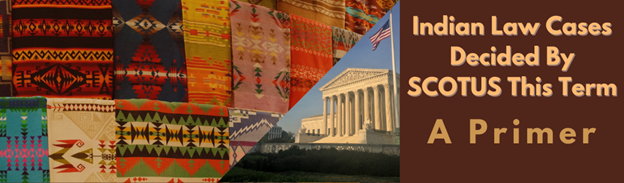
The United States Supreme Court decided several Indian law cases this term that touch on fundamental concepts at the core of federal Indian law.  This panel, made up, in part, of lawyers who were directly involved in each of these cases on behalf of Indian Tribes, and other lawyers and scholars who will offer a broader perspective, will discuss each of these cases and their impact on broader federal Indian law principles.

Speakers:

  • Erin C. Dougherty Lynch – Senior Staff Attorney and Managing Attorney, Native American Rights Fund
  • Shay Dvoretzky – Partner, Supreme Court and Appellate Litigation, Skadden, Arps, Slate, Meagher & Flom LLP and Affiliates
  • Matthew L.M. Fletcher – Harry Burns Hutchins Collegiate Professor of Law, University of Michigan Law School
  • Leonard R. Powell – Associate, Jenner & Block
  • Pratik A. Shah – Partner, Akin Gump Strauss Hauer & Feld LLP

Moderator:

  • Patty Ferguson Bohnee – Director, Indian Legal Clinic, Arizona State University Sandra Day O’Connor College of Law; Attorney, Sacks Tierney


Register HERE: https://americanbar.zoom.us/webinar/register/WN_lbFcLRxERZqV6JrqtYYOWw

The Section of Civil Rights and Social Justice is the only ABA membership entity solely dedicated to the advancement of human rights, civil rights, civil liberties, and social justice. We invite you to become involved with critical legal and public policy issues by joining one or more Section committees. You may want to become part of a committee to learn more about developments in a particular issue area. Or you may choose to take a more active role by participating in or organizing specific activities. Whatever your area of interest or specialization, we have a home for you.  To get involved, join us here.

Eighth Circuit Holds Parental Kidnapping Prevention Act Does Not Apply to Tribes

Decision

It is true that Indian reservations are “physically within the territory of the United States.” United States v. Wheeler, 435 U.S. 313, 322 (1978) (emphasis added). The PKPA’s definition of “State,” however, includes “a territory . . . of the United States,” 28 U.S.C. § 1738A(b)(8) (emphasis added), which is most naturally understood to mean a political entity that is not a state but is still “[a] part of the United States . . . with a separate legislature (such as Guam and the U.S. Virgin Islands).” Territory, Black’s Law Dictionary (11th ed. 2019); see, e.g., 48 U.S.C. § 1541(a) (“The Virgin Islands . . . are declared an unincorporated territory of the United States of America.”). And the Supreme Court has made clear that within our constitutional order, such “territories” are distinct from Indian tribes.

***

Our conclusion that the PKPA does not apply to Indian tribes is further supported by the fact that when Congress intends for tribes to be subject to statutory full-faith-and-credit requirements, it expressly says so.

***

For the reasons explained above, we conclude that the PKPA does not apply to Indian tribes. As a result, the Cheyenne River Sioux Tribal Court is not obligated under that statute to enforce the North Dakota court orders awarding custody of C.S.N. to Nygaard. The district court properly granted summary judgment to the Tribal Court.

UDub 36th Annual Indian Law Conference

Boldt at 50 — Law, Policy and the State of Cascadian Fisheries

Co-sponsored by the Washington Law Review and the UW School of Law Native American Law Center.

Please join us in person at UW Law on September 7 and 8, 2023, for our 36th Annual Indian Law Symposium, hosted and presented by the Native American Law Center. We’ll also be streaming the event live if you are unable to attend on-site.

We’re thrilled to welcome you back for this year’s program, with the theme:

Setting the Stage for Boldt at 50: Law, Policy, and the Current State of Cascadian Fisheries

The program features keynote addresses from Jennifer Quan, Regional Administrator, NOAA Fisheries Pacific Northwest Region, and Robert T. Anderson, Solicitor, Department of the Interior, along with a number of engaging panels featuring expert biologists, attorneys, advocates, and policymakers. The full agenda is available online and we have requested 10.25 CLE credits (including 9.00 Law and Legal Procedure credits and 1.25 Ethics credits) for the entire program.

Looking forward to it — hope you can join us!

Monte Mills & Eric Eberhard

Note: We will be requesting 10.25 CLE credits, including 9.00 Law & Legal and 1.25 Ethics, from the Washington State Bar Association.

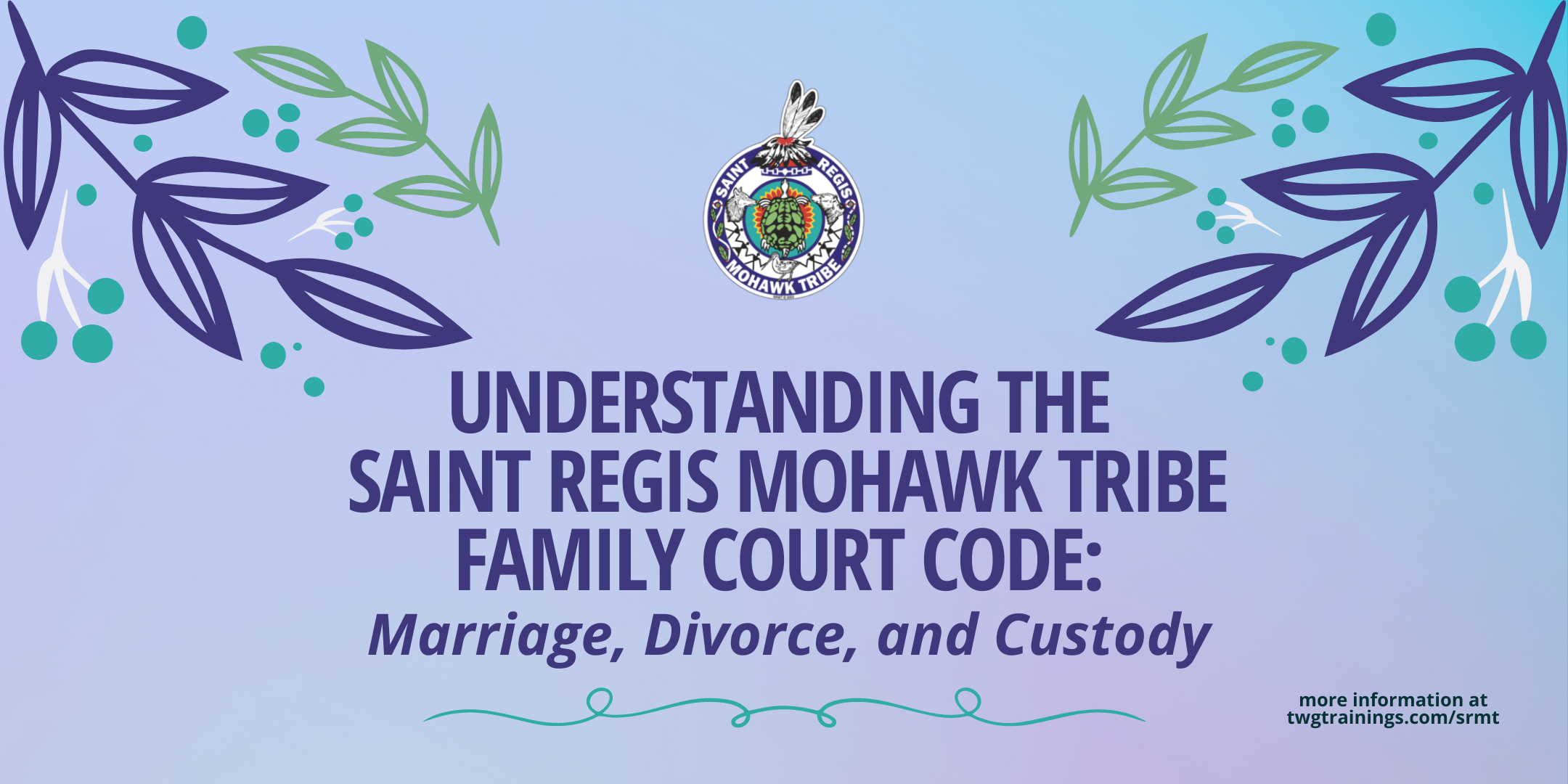
Free CLE on Saint Regis Mohawk Custody and Marriage Code on Aug. 30

Understanding the SRMT Family Court Code CLE (2160 × 1080 px))updated

Training is August 30 at 12pm. Kate Fort and Ron Whitener are presenting. Registration is here:

Event Registration

Information at Training Link

The CLE is hosted by the Saint Regis Mohawk Tribe and sponsored by the New York State Child Welfare Court Improvement Project. This program is pending approval by the NYS Unified Court System, Office for Justice Initiatives, Division of Policy and Planning in accordance with the requirements of the NYS Continuing Legal Education Board. This training is free of charge and is appropriate for both newly admitted and experienced attorneys.

Amended Complaint in Ysleta del Sur Pueblo v. City of El Paso

Here:

Prior posts here.

New Scholarship on the Canons, Proposing a New Canon

Evan D. Bernice has posted “Canon Against Conquest” on SSRN. Here is the abstract:

The interpretive rules that require judges to read treaties, statutes, and other legal texts in favor of Native nations and people have always been contested. But seldom has the future of the “Indian canon” seemed so uncertain. Several sitting Supreme Court Justices have questioned the legitimacy of the Indian canon, expressing skepticism about the roots of the specific rules that constitute it and raising doubts about whether “Congress has always framed statutes in a way that are favorable to Indian tribes.” Other Justices have written or joined opinions that have narrowed and diluted it.

This Article traces the origins of the Indian canon and defends it on originalist and textualist grounds. It then contends that the canon should be codified to ensure its survival. This codification should be expressly grounded in a constitutional commitment to tribal sovereignty. Tribal sovereignty was part of the law of nations at the Founding; it was built into the original meaning and structure of the Constitution; and it persists today, in spite of state and federal efforts to extinguish it.

Codification is necessary because it is not enough to answer criticisms of the Indian canon from the standpoint of originalism, textualism, or any other methodology that holds sway on the Supreme Court. The canon has been diminished, disparaged, and nearly discarded by judges of a variety of methodological persuasions. Codification will increase the likelihood that the canon will be deployed to protect Native lands, governance, and culture. As an act of legislative constitutionalism, it will be at once entitled to respect and tailored to receive it.

Tenth Circuit Denies Certificate of Appealability to Prisoner Attempting to Invoke McGirt Jurisdictional Defense

Here are the materials in Williams v. Harpe:

Application for Certificate of Appealability

CA10 Order

Utah District Court Dismisses Utah and Individual Challenges to Bears Ears National Monument

On Friday, August 11, 2023, United States District Judge David Nuffer of the United States District Court of the District of Utah granted motions to dismiss the cases challenging the Bears Ears National Monument designation.

Here is the Order:

Previous post with briefs here and here.

Bears Ears at Sunset. Photo credit: Tim Peterson.

California Federal Court Orders Arbitration in Dispute in Tribal Sovereign Lending Case

Here are the materials in Huntley v. Rosebud Economic Development Corp. (S.D. Cal.):

1 Complaint

8-1 Motion to Compel Arbitration

9-1 Motion to Dismiss

13 Response to Motion to Compel

14 Response to Motion to Dismiss

17 Reply ISO Motion to Compel

18 Reply ISO Motion to Dismiss

22-1 Second Motion to Compel

28 Response

33 Reply ISO Motion to Compel

35 DCT Order