Maine Law Review Indian Law Symposium Issue

Here:

Articles

Symposium Keynote: “Isolation and Restraint: Maine’s Unique Status Outside Federal Indian Law”
Michael-Corey Francis Hinton

One Nation, Under Fraud: A Remonstrance
Hon. Donna M. Loring, Hon. Eric M. Mehnert, and Joseph G.E. Gousse Esq.

The Dark Matter of Federal Indian Law: The Duty of Protection
Matthew L.M. Fletcher

The Growing List of Reasons to Amend The Maine Indian Jurisdictional Agreement
Nicole Friederichs

Case Notes

Five Times More Likely: Haaland v. Brackeen and What It Could Mean for Maine Tribes
Eloise Melcher

Solemn Vow: Solum’s Originalism, Treaties, and Tribal Sovereignty in Castro-Huerta
Liam T. Sheridan

Split Tenth Circuit Panel Affirms Sanctions Award Against Ute Tribe

Here is the order in Becker v. Ute Indian Tribe.

Lower court materials here.

Job Posting — AUSA (Indian Country) for the Western District of Michigan

Assistant United States Attorney (Indian Country)

Grand Rapids, MI

Closing date: 8/11/2023

The United States Attorney’s Office for the Western District of Michigan is seeking applications for an Assistant U.S. Attorney (Indian Country) in the Criminal Division of the Grand Rapids Office, with occasional travel to its Marquette Office. The AUSA will work with federal, state, local, and tribal law enforcement agencies to investigate and prosecute primarily crimes occurring on property owned by, or held in trust for, Native American Tribes. This is an important position in our District, which has eleven federally-recognized tribes within its borders-together comprising the largest Native American population in any district east of the Mississippi River. The AUSA who fills this role will prosecute a variety of cases, many involving vulnerable victims, including crimes against children and disproportionately affecting Native women. The AUSA may also prosecute other offenses, such as crimes involving firearms and explosives, drug-trafficking offenses, and financial frauds. The AUSA will also provide training and coordination in connection with legal issues affecting tribes in the District.

Link to apply: https://www.usajobs.gov/job/740035200

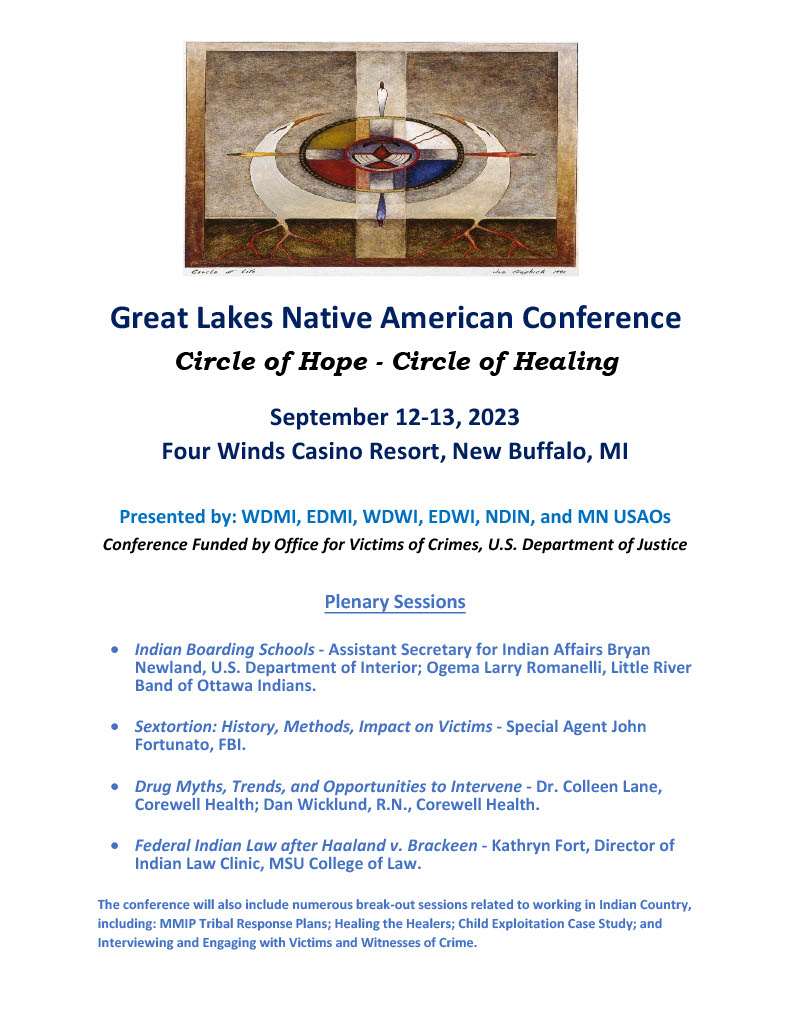
DOJ Great Lakes Native American Conference @ Four Winds, Sept. 12-13, 2023

Register here.

Tenth Circuit Briefs in Wichita and Affiliated Tribes v. Stitt

Here:

Reply TK

Lower court materials here.

Tenth Circuit Affirms Post-McGirt Federal Conviction Where Jury Might Could Have Acquitted Defendant Under Oklahoma Self-Defense Law

Here is the opinion in United States v. Budder.

Briefs:

Utah Federal Court Allows Employment Claim against Skull Valley Tribal Officials to Proceed

Here are the materials in Skull Valley Health Care LLC v. NorStar Consultants (D. Utah):

City of Tulsa v Hooper Stay Application Materials

Here:

Lower court materials here.

WaPo Article on Diversity in OSG Office and Letter to the Editor in Response

Recently the Washington Post published a long article on the issues in the Office of Solicitor General regarding their lack of diversity in hiring. This conversation is a constant one in federal Indian law circles (as in, we really do talk about this ALL THE TIME), but the article failed to mention that OSG is all up in the Indian law cases but has no Native lawyers now or ever. Today, the Post published a letter to the editor in response stating this far more eloquently:
Justice For and By Native Americans:

The July 25 front-page article “A defense of diversity fell to an office that lacks it” brought much-needed attention to the lack of diversity at the Office of the Solicitor General (OSG). The article failed to mention, however, the OSG’s lack of Native American lawyers. Both omissions of Native Americans — from the article and from the OSG — merit correction.

Erasures such as these are a persistent problem for Native Americans; the resulting harm is particularly acute here. The United States owes treaty-based, trust obligations to Indian tribes, and federal law governs life in Indian country to a degree matched in few other areas. Federal law determines the bounds of tribal sovereignty, the scope of treaty rights and the rules that apply to individual tribal members in spheres such as child welfare, taxation and criminal law.

In just its past five terms, the Supreme Court decided more than 10 cases involving Indian tribes. The OSG — which is charged with fulfilling the United States’ trust obligations at the Supreme Court — plays an outsize role in these cases. The United States is often a party, and even when it is not, the OSG typically participates at oral argument. Indeed, the OSG presented oral argument in every Indian law case from the past five terms. Yet despite the OSG’s central role, the OSG has never hired a Native American lawyer, per University of Michigan professor Matthew L.M. Fletcher.

As The Post article noted, many maintain that the OSG “has a special responsibility to reflect the country it serves.” That moral imperative is especially pronounced in the case of Native Americans.

Lenny Powell, Washington