Here is the order in State of Oklahoma v. Dept. of the Interior (W.D. Okla.):
Briefs here.
Here is the order in State of Oklahoma v. Dept. of the Interior (W.D. Okla.):
Briefs here.
Posted an earlier draft of this before, but here is the all-but-final version, now available on SSRN here.
Here is “Preemption, Commandeering, and the Indian Child Welfare Act,” published in the Wisconsin Law Review.

Foreword
Eric D. Eberhard

Bringing Congress and Indians Back into Federal Indian Law: The Restatement of the Law of American Indians
Kirsten Matoy Carlson
Tribal Sovereignty and Economic Efficiency Versus the Courts
Robert J. Miller
Off-Reservation Treaty Hunting Rights, the Restatement, and the Stevens Treaties
Ann E. Tweedy
Reflections on the Restatement of the Law of American Indians
Matthew L.M. Fletcher
Protection for Indian Sacred Sites
William A. Fletcher
Why Our Stories Matter: A Perspective on the Restatement from the State Bench
Raquel Montoya-Lewis


“ICWA doesn’t prevent an individualized assessment of the best placement for each child,” says Kathryn Fort, director of the Indian Law Clinic at Michigan State University. State courts do this type of assessment “every day,” she says, adding, “I personally don’t know a state court judge who would be comfortable being told that they weren’t allowed to do an individualized assessment.”
But for an Indian child, Fort says, that individualized assessment includes consideration of the child’s relationship with her relatives, her language, her religion, and her tribal tradition.
“A child isn’t separate from her tribe,” she adds. “That child is sacred to that tribe.”
WaPo (check out Fred Urbina’s picture!)
Oral arguments in the case are tomorrow (11/9) at 10am. Live audio can be streamed here.
Gregory Ablavsky has posted “Further Thoughts on the Constitutional History of Federal Power Over Indian Affairs” on SSRN.
The abstract:
This short piece builds on my earlier response to Robert Natelson’s purported “cite check” of my 2015 Yale Law Journal article by addressing some of the arguments in his new Federalist Society Review article. It argues 1) that Natelson misinterprets Federalist 42, 2) that colonial-era regulations of Indian trade support a quite broad scope for the law merchant, and 3) that Natelson mischaracterized my methodology while making some odd methodological choices of his own. It also briefly offers some new evidence on the historical scope of federal authority in Indian affairs that further supports an interpretation of the meaning of “commerce with the Indian tribes” that encompasses intercourse.
Please join the Indigenous Law and Policy Center this Wednesday, November 9, at 6:00 p.m. ET for a post-oral argument discussion of Brackeen over Zoom. Wenona Singel will be moderating this conversation with speakers Matthew L.M. Fletcher, Melody McCoy and April Youpee-Roll.
The link to register is here. Please see the below flyer for more information.
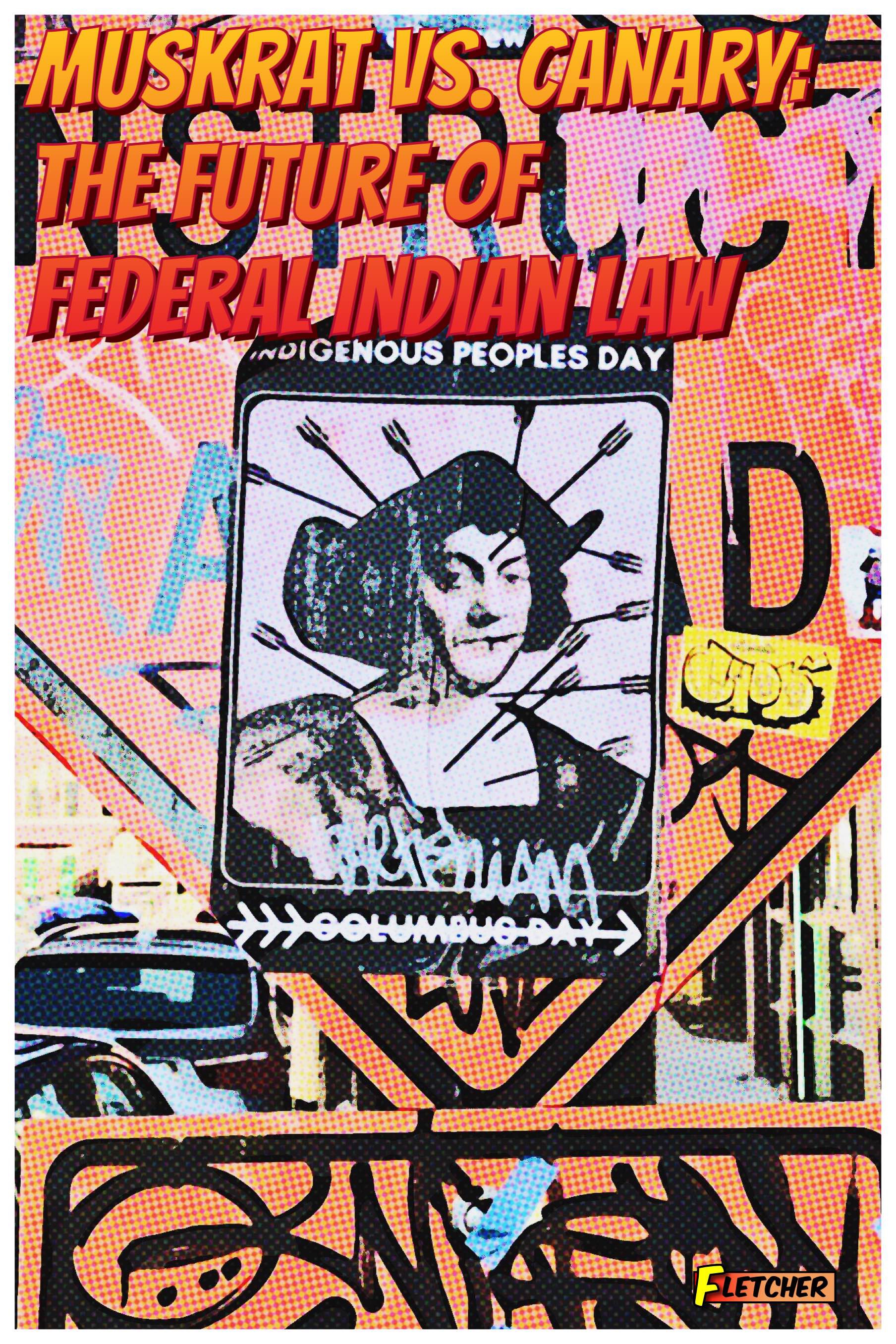
This Thursday @ 7PM it’ll be time to unveil the new book project (now just have to write it).
Federal Indian law is marked by dramatic confrontations between paradigms such as George Washington’s “Savage as the Wolf” policy or Felix Cohen’s “Miner’s Canary” parable. These metaphors reflect the reality that federal Indian law and policy was imposed on tribal nations. Even today, five decades after the beginning of the tribal self-determination era, the Miner’s Canary parable remains the most used metaphorical shorthand to describe Indigenous affairs in the United States, but those metaphors are no longer useful. Tribal nations now possess political and economic power. Congress and the executive branch have largely embraced tribal self-determination. The Supreme Court has not. Or has it? Tribal nations have fared better in the Supreme Court since 2014 than in any other period of American history. Even so, the Court is paradigmatically split. The Anishinaabe creation is a story about the lowly, but heroic, Muskrat as a metaphor to describe modern tribal nations. The Supreme Court is poised to either accept the new paradigm of tribal self-determination or eradicate it in favor of keeping tribal nations weak. It is a paradigmatic battle of the Muskrat versus the Canary.
Miigwetch to John Low at THE school that shall not be named on this blog for the invitation to present!
Here are the materials in Grant v. Norton (D. Mont.):

Here was yesterday’s order.
Prior post here.

 Turtle Talk
You must be logged in to post a comment.