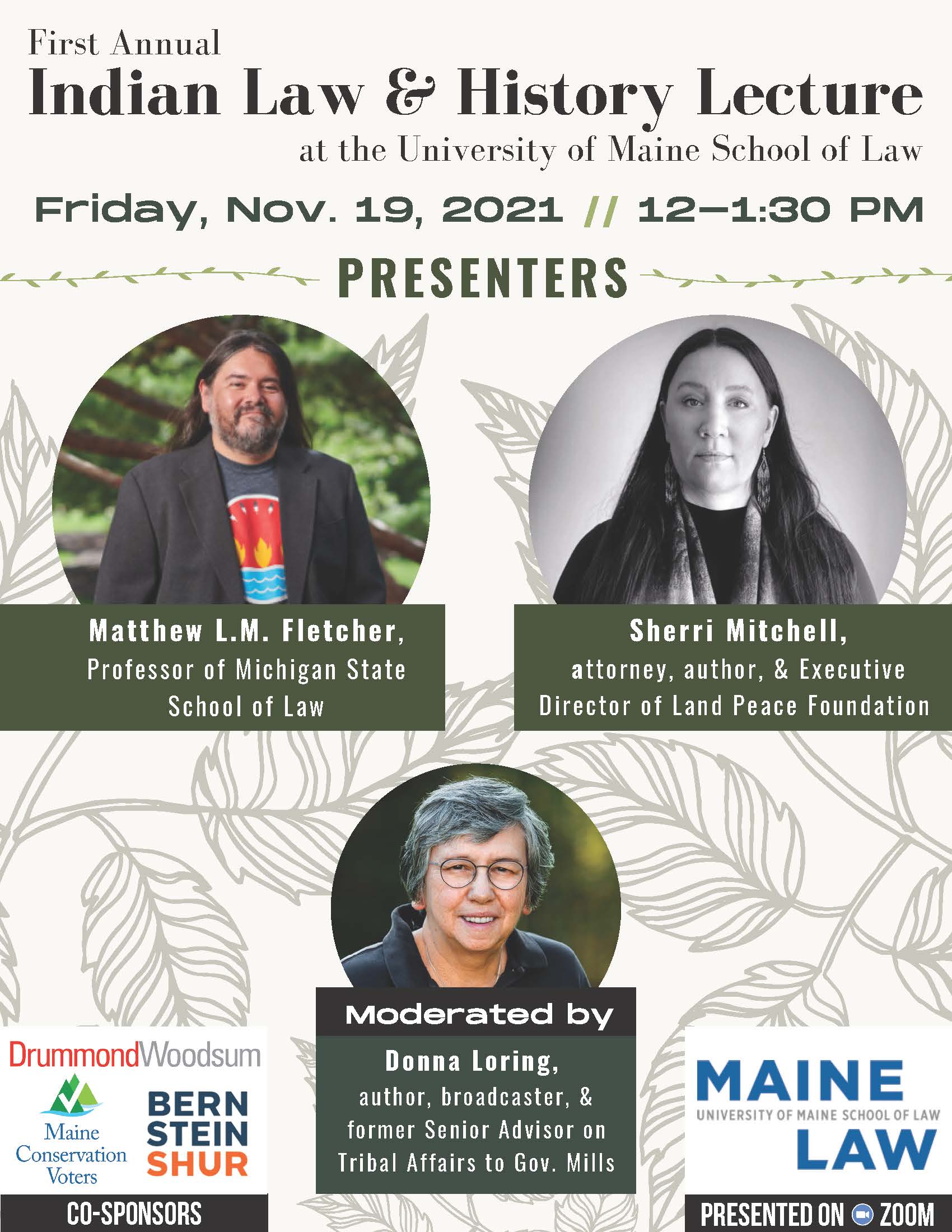
First Annual Indian Law & History Lecture @ Maine Law School
Here is the opinion in West Flagler Associates Ltd. v. DeSantis (N.D. Fla.):
Briefs are here.

Lansing State Journal: Anishinaabemowin class aims to save Michigan’s first language
NPR: The National Park Service could soon have its first Native American director

WaPo: The nomination of Chuck Sams to lead the Park Service is already changing history
Casino.org: US Supreme Court to Hear Texas Tribal Gaming Case, Could Impact Claims in Rhode Island, Maine, Massachusetts
Times Higher Education: US universities ponder massive debt to Native Americans: In year since land-grant institutions learned they were funded by theft, serious conversations have barely begun
KLCC: Ancient Native American forest practices demonstrated in burn near Eugene
Green Entrepreneur: Native Americans Jump Way Ahead in Selling Legal Cannabis
Here are the materials in Treasure v. Bureau of Indian Affairs (D. Mont.):
For those committed to increasing diversity in the legal profession, Texas A&M University School of Law announces the Accountability, Climate, Equity, and Scholarship (ACES) Fellows Program at Texas A&M University School of Law.
The ACES program is a two-year fellowship designed to help early career legal scholars get the training and mentoring necessary to become successful members of the legal academy. Funded by Texas A&M’s Office of the Provost and administered by the University’s Office for Diversity, the fellowship is designed to help early career scholars who are strongly committed to diversity.
The position has a light teaching load (one class per year) to enable the Fellow to focus on advancing their research agenda, scholarship (including at least one published article), and other necessary skills in anticipation of seeking a tenure-track, faculty position on the law school teaching market. Faculty are committed to providing the mentoring necessary to help the Fellow to succeed on the legal academic job market and in the legal academy.
Details:
–24-month term, starting between July 1- August 10, 2022.
–Teach one class per year
–$60,000 annual salary plus benefits
–$4,500 annual travel and development fund
–Reimbursement of moving expenses
–Eligibility: Must have earned JD or PhD degree between January 1, 2012 and July 1, 2022
Thomas Mitchell, Brendan Maher, and Huyen Pham are on the appointments committee for this fellowship. Please feel free to reach out to any of them with questions.

November 4th, 2021 | 12:45pm-2:00pm ET | 1.25 CLE
Tribal consultation laws, whether at the federal, state, or county level, allow Indigenous people to directly participate in decisions that impact their daily lives from health to education and beyond. The presentation explains the variety of tribal consultation laws across US jurisdictions and policies that tribes can use to best suit their communities.
Joe Sarcinella: Attorney, Drummond Woodsum
Wenona Singel: Associate Director & Professor, Indigenous Law & Policy Center, Michigan State University College of Law
Tehani M. Louis-Perkins: University of Hawai’i
Moderator – Ian F. Tapu: Law Clerk, Hawaii State Judiciary
US Customs and Border Patrol: Prairie Band Potawatomi Nation to Issue Enhanced Tribal Card Through Agreement with CBP
PBS News Hour (8 min. video): Why Native Americans are buying back land that was stolen from them (Part 1 of 2)
PBS News Hour (7:22 min. video): Native American tribe land buybacks start a commercial approach to social justice (Part 2 of 2)
Time: The Fight to Save the Salmon
Grist: North Carolina tribes fear pipeline will damage waterways, burial grounds
E&E News: EPA unveils plan to address tribal water woes
Time: MIT Reckons with Early Leader’s Role in Forced Removal of Native American Tribes
Traverse City Record Eagle: Journalist unearths family history while reporting on boarding school trauma, family, cultural destrution
Christian Science Monitor: Untaming a river: The stakes behind America’s largest dam removal
MLive: Dozens of Michigan schools still use Native American slurs, imagery
Daily Beast: Native American Group Calls on Fox News to Fire Hosts Over ‘Racist’ Comments
WaPo: Beyond blunt truths about Columbus Day, Biden presses for real progress for Indigenous people


Kim Teehee wrote a heartfelt tribute to Dale Kildee and agreed to allow us to post it here:
I knew the day would come but still I wasn’t prepared to hear that Dale Kildee had passed away. He passed on October 13th, which is also my birthday. My mind is flooded with precious memories. I worked for Dale for 11 ½ years as the first senior advisor to the bipartisan Congressional Native American Caucus. Dale founded the Caucus after anti-Indian measures started passing the House only to be stopped in the Senate. He knew a bipartisan Caucus was necessary to educate Members about Indian country issues. What began as a Caucus of 15 members had grown to over 100 members. My job was to work across partisan divides with House leaders, Caucus members, Committees, and with tribal leaders. As Co-chair of the Caucus, Dale successfully advanced legislation on myriad topics from education, health care, transportation, appropriations to housing. Under his leadership, the Caucus had a 100% success rate that included defeating every anti-Indian proposal. He also enjoyed giving speeches to tribal organizations where he became famous for pulling out his pocket U.S. Constitution and reminding the audience that tribes are sovereign and that sovereignty must be protected. He was a great defender of tribal sovereignty.
Dale had no tribes in his congressional district and people would often ask why he cared so much about the Indians. His commitment began when as a kid his Dad took him to the land in Michigan where a tribe’s village once stood but was burned to ashes when the people refused to leave. He never forgot that story or the other injustices that Native people endured. He had a passion for education too having served as a Latin teacher. When he served in the Michigan state legislature he led the way for the passage of the Michigan Indian Tuition Waiver Act, which waived the college tuition of any Michigan Indian who attended a public college. He took his passion for Indians and education to Congress where in the Education and Labor Committee he began slipping “Indian tribes” in every education bill that listed “states” to ensure tribes were expressly included. He also had a special affinity for the Michigan tribes and a deep appreciation of their unique histories. I also enjoyed working with these tribes.
Dale was a devout Catholic and loved his work family as if we were his real family. I am eternally grateful for his unconditional support. When I was tapped for a White House appointment in the Obama Administration, he galvanized congressional support and helped secure my historic position. He was a gentle soul with a warrior’s spirit. He believed in civil discourse. He despised unkindness.
Dale lived a blessed life. He did not fear the inevitable of life. He was comforting to me that way. I last saw Dale two years ago at lunch for his 90th birthday just before the pandemic hit. Something in me knew that would be my last time with him. As we said goodbye, he hugged me and kissed my cheek telling me that he loved me. I love you too, Dale. Rest In Peace.
Cert Petition of Merle Denezpi
Question Presented:
Is the Court of Indian Offenses of Ute Mountain Ute Agency a federal agency such that Merle Denezpi’s conviction in that court barred his subsequent prosecution in a United States District Court for a crime arising out of the same incident?
Ysleta Del Sur Pueblo’s Cert Petition
Question Presented:
Whether the [Ysleta del Sur Pueblo and Alabama-Coushatta Indian Tribes of Texas] Restoration Act provides the Pueblo with sovereign authority to regulate non-prohibited gaming activities on its lands (including bingo), as set forth in the plain language of Section 107(b), the Act’s legislative history, and this Court’s holding in California v. Cabazon Band of Mission Indians, 480 U.S. 202 (1987), or whether the Fifth Circuit’s decision affirming Ysleta I correctly subjects the Pueblo to all Texas gaming regulations.
Reply of petitioners Ysleta del Sur Pueblo
Brief amicus curiae of United States in favor of SCOTUS review
Texas v Ysleta del Sur Pueblo 5th Circuit Opinion
 Turtle Talk
You must be logged in to post a comment.