Here.
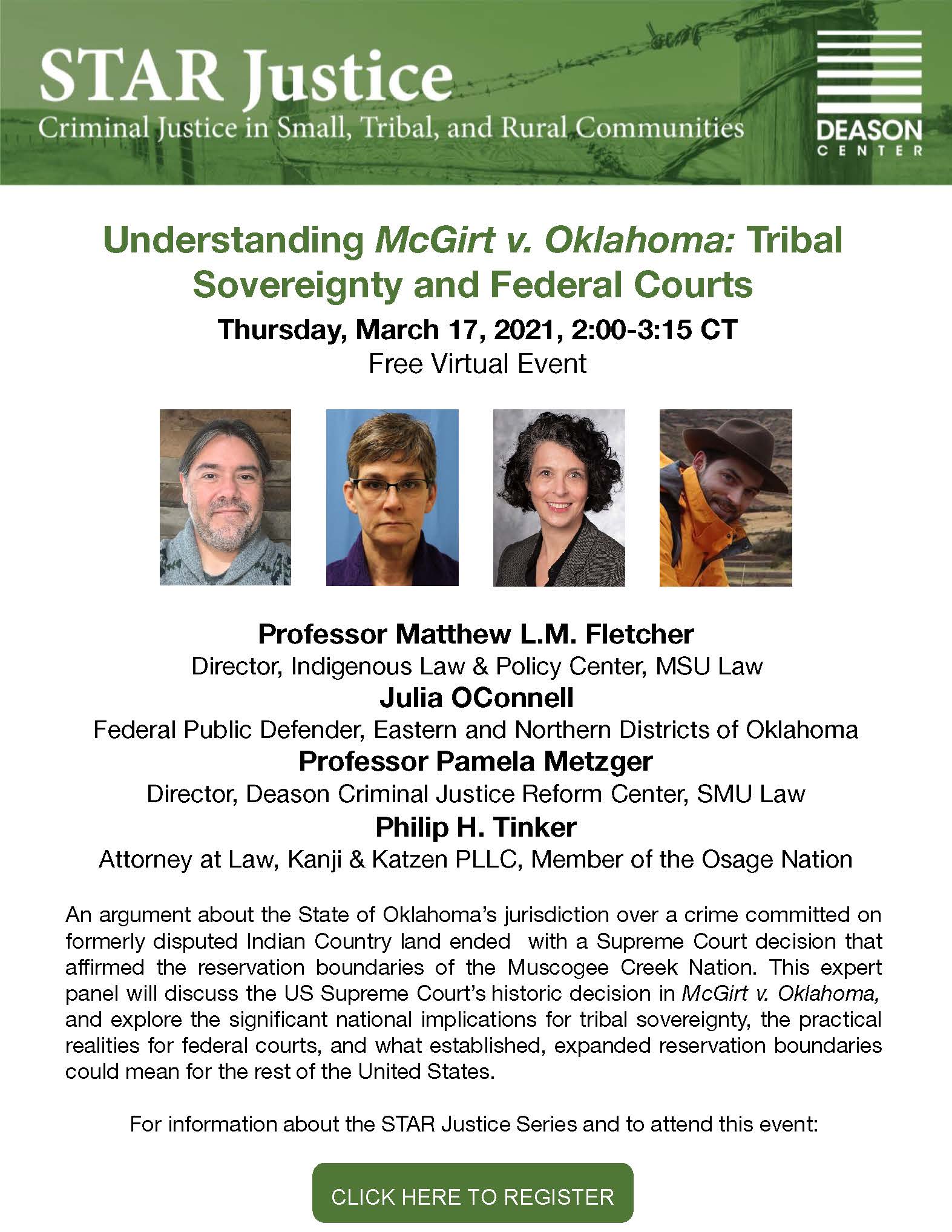
This panel will explore the U.S. Supreme Court’s decision in McGirt v. Oklahoma, including how the decision could affect future cases involving tribal rights as well as the ruling’s on-the-ground impacts on environmental regulatory authority within the recently reaffirmed reservation boundaries in eastern Oklahoma.
The U.S. Supreme Court’s July 2020 opinion in McGirt v. Oklahoma affirmed the historic reservation boundaries of the Muscogee (Creek) Nation in eastern Oklahoma, ruling that Congress’s lack of any clear action or intent to diminish that reservation’s boundaries left them intact. Hailed by some Indian law scholars and practitioners as the most significant Indian law case of the twenty-first century, the U.S. Supreme Court’s July 2020 ruling in McGirt v. Oklahoma has potentially wide-ranging impacts for future litigation involving tribal rights and Indian reservation boundaries throughout the United States. Although the McGirt case itself focused on one reservation in eastern Oklahoma, the Supreme Court’s adoption of a strong, textualist-based approach in the McGirt opinion could signal a new era in federal Indian law that has ramifications for treaty rights and reservation-diminishment cases far beyond Oklahoma’s borders. Meanwhile, despite the Court’s reaffirmation of Indian reservation boundaries in eastern Oklahoma, the U.S. Environmental Protection Agency (EPA) recently approved Oklahoma Governor Kevin Stitt’s request to grant the State, not Native Nations, authority over environmental issues within their reservations, raising new jurisdictional questions for Oklahoma Tribes.
Our esteemed panel will offer attendees an understanding of the potentially wide-ranging nature of the McGirt decision, as well information about the ruling’s on-the-ground impacts in eastern Oklahoma. Native American law scholar Matthew L. M. Fletcher (Michigan State University) will provide crucial perspective that places McGirt within the broader framework of federal Indian law, while Riyaz Kanji (Kanji & Katzen) will offer insight into the arguments that led to the McGirt decision, as well as commenting on how Tribes outside of Oklahoma might rely on the ruling in future cases involving tribal rights and reservation boundaries. Finally, Cherokee Nation Attorney General Sara Hill will share her perspective about the post-McGirt regulatory landscape, following the EPA’s October 2020 decision to grant the State of Oklahoma environmental authority within the Indian reservations in eastern Oklahoma.
 Turtle Talk
You must be logged in to post a comment.