The County filed a petition for relief in Humboldt county superior court and attached the investigative subpoena on the Humboldt County Department of Health and Human Services from the California DOJ. The subpoena includes a request for all internal communications relating to tribes and children who are eligible for enrollment or enrolled in any tribes, among a fair number of other ICWA-related inquiries.
SCOTUS Denies Cert in Alaska v. Organized Village of Kake (Roadless Rule)
Jim Harrison Walks On
Here.
Harrison was a long time resident of Michigan, including Leelanau County, where he knew many Anishinaabe people. He wrote a compelling introduction to the history of the Grand Traverse Band of Ottawa and Chippewa Indians, Mem-ka-Weh: The Dawning of the Grand Traverse Band of Ottawa and Chippewa Indians.
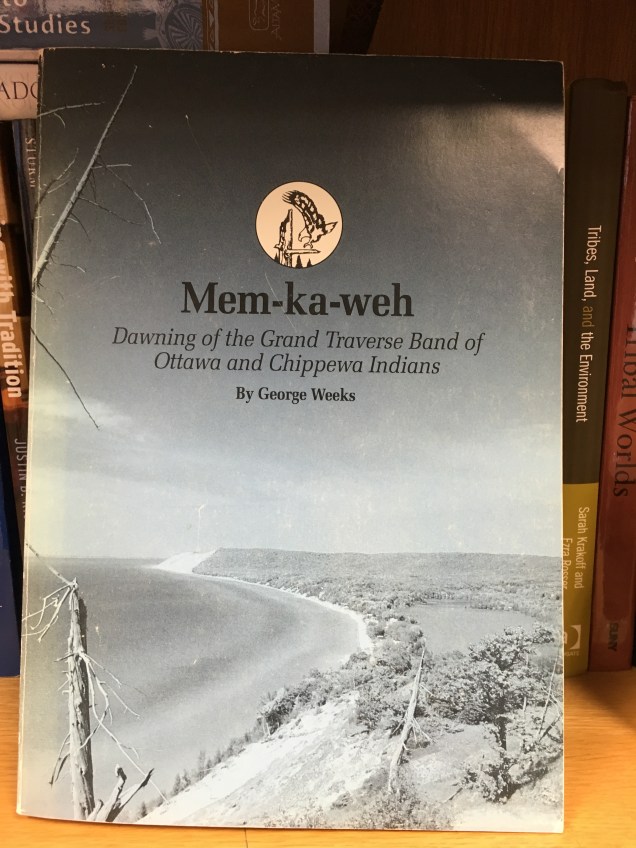
He also wrote many Indian characters into his books. He wrote them as human beings, with all their flaws and strengths, and not as exotic others like so many writers do.
Patty Ferguson-Bohnee on Indian Voting Rights in Arizona
Patty Ferguson-Bohnee has posted “The History of Indian Voting Rights in Arizona: Overcoming Decades of Voter Suppression,” which she published in the Arizona State Law Journal. Here is the abstract:
Native Americans “have experienced a long history of disenfranchisement as a matter of law and of practice.” This comes from a complicated and contradictory history of laws and policy that has recognized tribes as separate sovereigns, reduced tribal status to that of domestic dependent nations, sought to remove, relocate, or assimilate tribal citizens, terminated numerous indigenous nations, and has now moved to a policy of tribal self-government. Unfortunately, the right to vote for Arizona’s first people has only recently been achieved, and there are continuing threats to the electoral franchise.
Voter suppression has been used to discourage or prevent Indian people from voting in Arizona. Voter qualifications such as literacy tests were used to prevent Indians from participating in elections for approximately fifty years. Once Native Americans started voting, redistricting and vote dilution were used to reduce the effectiveness of the Native vote.
This article will review the history of Indian voting rights in Arizona. The author begins by reviewing the history of Native American voting rights and the history of voting discrimination against Native Americans in Arizona. The Voting Rights Act turned the corner for Native people to participate in the state and federal election processes. The article then discusses the current challenges faced by Native American voters and specifically discuss the voter ID law passed in 2004. The voter ID law is a roadblock that impedes full participation by all Arizona Indians. The last part of the article focuses on strategies to protect Indian voting rights. Notwithstanding the Supreme Court’s invalidation of the Section 5 coverage formula in Shelby County, tribes should consider proactive measures to ensure that tribal citizens can participate in elections.
Highly recommended.
Galanda Broadman Lawyers Sue to Challenge Disbarment in Tribal Court
Here are the materials in Galanda v. Bernard (Nooksack Tribal Court):
Galanda v. Bernard Motion for Injunction and Declaratory Relief
Alaska SCT Recognizes Inherent Authority of Tribal Court to Enforce Child Support Orders Against Non-Member Parents
From Justice Fabe’s opinion:
This case, in contrast, requires that we decide whether tribal courts’ inherent, non-territorial subject matter jurisdiction does in fact extend to the adjudication of the child support rights and obligations of nonmember parents of children who are members or eligible for membership. We hold that because tribes’ inherent authority over child support stems from their power over family law matters concerning the welfare of Indian children — an area of law that is integral to tribal self-governance — the basis and limits of that authority are tied to the child rather than the parent.
Two Justices joined in a separate concurring opinion, which reads more like a dissent:
Today the court affirms those legal rulings and the associated injunctive relief, and I join that part of its decision. But the court unnecessarily moves further and reaches out to provide an advisory opinion on yet another legal issue: whether a tribal court with non-territorial based inherent sovereign authority to adjudicate matters involving tribal children necessarily has adjudicatory authority (subject to some unstated personal jurisdiction limitations) over non-tribal-member parents. This issue is not necessary to the decision before us, there is no specific controversy in this case necessitating a decision on the issue, there is no party in this case truly advocating for the interests of non-member parents on the issue, and neither the Tribe nor the United States considered the issue worthy of significant briefing; I therefore do not join the court’s advisory opinion.
Opinion is here.
Briefs here.
NIGC Job Postings: Auditor and IT Specialist
National Indian Gaming Commission
About the Agency
The Commission’s primary mission is to work within the framework created by the Indian Gaming Regulatory Act (IGRA) for the regulation of gaming activities conducted by tribes on Indian lands to fully realize IGRA’s goals: (1) promoting tribal economic development, self-sufficiency and strong tribal governments; (2) maintaining the integrity of the Indian gaming industry; and (3) ensuring that tribes are the primary beneficiaries of their gaming activities.
How to Apply
Your complete application, including required documents, must be received by 11:59 p.m. Eastern Time (ET) on the closing date of this announcement. To apply on-line, you must complete and submit an application by accessing the USAJOBS website at http://www.usajobs.gov. To begin, click the Apply Online button near the bottom of this screen and follow the prompts to register into your USAJOBS account, answer the questions, and submit all required documents. To return to your saved application, log in to your USAJOBS account at http://www.usajobs.gov and click on “Application Status.” Click on the position title, and then select Apply Online to continue.
Job Title: Auditor
Job Announcement Number: NIGC-8000-16-EW-010(EXC)
Salary Range: $62,531.00 to $115,867.00 / Per Year
Duty Locations: Portland, OR
Open Period: Tuesday, March 29, 2016 to Tuesday, April 5, 2016
Duties
Major duties at the full performance level include, but are not limited to the following:
- Performs audits of class II and class III gaming operation to ensure compliance with the Indian Gaming Regulatory Act of 1988 (IGRA), the regulation of the NIGC, and the provisions of the tribal gaming ordinance/resolution.
- Serves as the NIGC’s representative with tribal government with respect to gaming matters
- Provides training and technical assistance to tribal governments, tribal regulatory authorities, gaming operation personnel and contract managers to ensure compliance with the IGRA and NIGC regulations.
- Conducts audits to investigate known or alleged violations of the IGRA and NIGC regulations, prepares reports and testifies in administrative hearings or other proceedings as designated by the Commission to hear such matters.
- Coordinates with responsible management officials; and evaluates the validity of tentative findings and recommendations that have been identified.
For details, go to this link: https://www.usajobs.gov/GetJob/ViewDetails/433866700
Job Title: It Specialist (NETWORK)
Job Announcement Number: NIGC-8000-16-EW-008(EXC)
Salary Range: $77,490.00 to $119,794.00/Per Year
Duty Locations: Washington, DC
Open Period: Tuesday, March 29, 2016 to Tuesday, April 5, 2016
Duties
Major duties at the full performance level include but are not limited to:
Duties include analyzing and defining network requirements; defining and maintaining physical network architecture and infrastructure; configuring and optimizing network servers, hubs, routers switches and other network components including desktop workstation O/S and application configuration; analyzing network workload, monitoring network capacity and performance; diagnosing and resolving connectivity problems, making adjustments to ensure proper load balancing; installing, testing, maintaining, and upgrading network operating systems software; and ensuring the rigorous application of information security/information assurance policies, principles, and practices including disaster recovery and continuity of operations policies; documenting network topology and procedures; assisting the NIGC Help Desk with direct user contact and support as needed.
- Completes applications development lifecycle by performing troubleshooting and solving production problems. Supports users by developing documentation and assistance tools.
- Provides network services support to the entire NIGC IT network enterprise assuming operational responsibility for NIGC network management, problem diagnosis and troubleshooting LAN/WAN hardware and software communication issues. Exercises a high degree of technical judgment in NIGC network design, configuration, security and maintenance as well as establishing, interpreting and applying NIGC policy for the Commission’s IT systems.
- Performs routine maintenance and monitoring of network infrastructure. Ensures that the network’s hardware, software and data resources remain safe from digital attacks through vigilant application of DMZ’s, firewalls and anti-virus software. Ensures that data backup procedures are in place for recovery from loss or destruction of program and data files. Develops and implements standard operating procedures to periodically test data recovery procedures for integrity.
Assignments will be specifically designed to prepare you for advancement to the next higher level without further competition. Advancement to the next higher level is not guaranteed, and does depend on: (1) a demonstrated ability to successfully perform at the next higher level, to the satisfaction of the immediate supervisor; (2) the availability of sufficient work at the next higher level to warrant advancement; and (3) having satisfied all legal and regulatory requirements for advancement.
For details, go to this link: https://www.usajobs.gov/GetJob/ViewDetails/433296500.
Request for Proposals – Court Assessments in Alaska-AVCP & California
As a courtesy notice, the below Request for Proposals are available on the Federal Business Opportunities website. Please note, they are advertised as 100% Indian Small Business Economic Enterprise Set-aside in accordance with the Buy Indian Act.
- RFQ No. A16PS00308, closes 4/25/2016, BIA Office of Justice Services District IX (California) Tribal Court Assessments
- RFQ No. A16PS00309, closes 4/25/2016, BIA Office of Justice Services District IX (California) Tribal Court Assessments
- RFQ No. A16PS00310, closes 4/25/2016, BIA Office of Justice Services District IX (Alaska – AVCP) Tribal Court Assessment
Please direct all questions to the Contracting Officer listed on the solicitation.
National Indian Law Library Bulletin 3/24/16
Here:
| The National Indian Law Library added new content to the Indian Law Bulletins on 3/24/16.
U.S. Supreme Court Bulletin U.S. Federal Trial Courts Bulletin State Courts Bulletin News Bulletin U.S. Legislation Bulletin U.S. Regulatory Bulletin Law Review & Bar Journal Bulletin |
Eleventh Circuit Rejects Miccosukee Members’ Federal Tax Challenge
Here is the opinion in Cypress v. United States:
An excerpt:
This appeal arises out of a dispute between sixteen members of the Miccosukee Tribe of Florida (the “Tribe members”) and the United States, the U.S. Department of the Interior, the U.S. Department of the Treasury, and the Secretaries of the Treasury and of the Interior (collectively, “the Government”). The Tribe members seek declaratory relief to avoid paying federal income taxes on distributions, including gaming proceeds, paid out of the Tribe’s trust account. The district court dismissed the complaint for lack of subject matter jurisdiction, finding that the United States had not waived sovereign immunity for suits brought by individual Tribe members. The Tribe members now appeal the dismissal.
We agree with the district court that the Government did not waive sovereign immunity. Accordingly, we affirm the district court’s dismissal of this matter.
Briefs here.
 Turtle Talk
You must be logged in to post a comment.