As widely reported here, here, and here, California is now the first state in the nation to enact legislation forbidding all public schools from using the term Redskins for school or team names, mascots, or nicknames.
From the L.A. Times:
As of Jan. 1, 2017, all public schools will be barred from using the term “Redskin,” which many Native Americans consider a racial slur. The measure by Assemblyman Luis Alejo (D-Watsonville) will allow schools that use materials that contain the term, such as uniforms, to phase out their use to alleviate cost concerns. The new law will affect four California high schools in Merced, Calaveras, Tulare and Madera counties.
The legislation, called the California Racial Mascots Act, was approved by the Governor on October 11. It includes the following findings:
(a) The use of racially derogatory or discriminatory school or athletic team names, mascots, or nicknames in California public schools is antithetical to the California school mission of providing an equal education to all.
(b) Certain athletic team names, mascots, and nicknames that have been used and remain in use by other teams, including school teams, in other parts of the nation are discriminatory in singling out the Native American community for the derision to which mascots or nicknames are often subjected.
(c) Many individuals and organizations interested and experienced in human relations, including the United States Commission on Civil Rights, have concluded that the use of Native American images and names in school sports is a barrier to equality and understanding, and that all residents of the United States would benefit from the discontinuance of their use.
(d) No individual or school has a cognizable interest in retaining a racially derogatory or discriminatory school or athletic team name, mascot, or nickname.
The legislation provides that, “[B]eginning January 1, 2017, all public schools are prohibited from using the term Redskins for school or athletic team names, mascots, or nicknames.” It also includes provisions that ameliorate the financial impact that this new law might otherwise cause for schools that use the term Redskins. It allow schools to continue to use uniforms or materials bearing the term Redskins after January 1, 2017 as long as the school selects a new school or athletic team name, mascot, or nickname, and the school does not purchase new uniforms or other materials such as yearbooks, newspapers, marquees, signs or other fixtures that bear the term. The targeted schools will essentially be able to slowly progress toward elimination of the use of word Redskins on team uniforms and materials as they purchase new uniforms and equipment in the ordinary course of replacing these items.
Although California is the first state to use legislation to ban public school use of Redskins, it is not the first state to adopt a state-wide measure that phases out use of the term. In 2012, the Oregon State Board of Education adopted a resolution and final rule that prohibits the use of any Native American mascot by a public school on or after July 1, 2017. For those interested in the findings and sources relied upon the Oregon Board of Education in reaching its decision to adopt the rule, the Board’s final report on the use of Native American mascots is available here. Some may also be interested in a 2014 report on Native American mascots in schools produced by the Center for American Progress, which is available here.
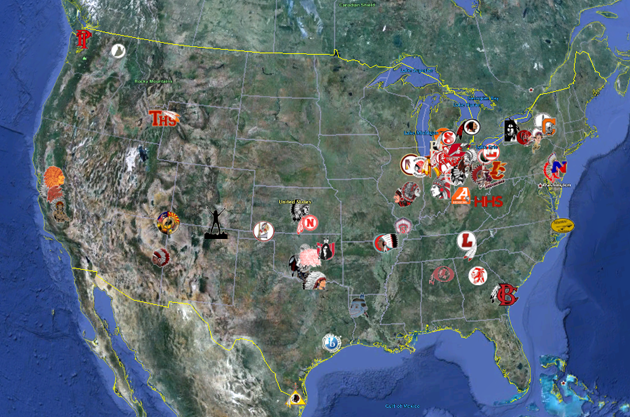
California and Oregon aside, there remain 21 states representing 58 high schools in the U.S. that use Redskins as a team name or mascot. These schools are marked on the map below. Many more schools throughout the U.S. use other Indian mascots, such as Indians, Warriors, Braves, and Chieftans.
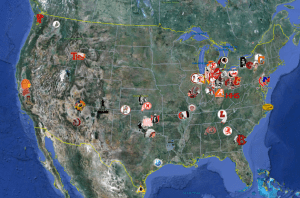
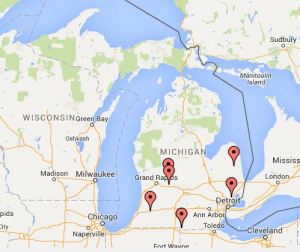
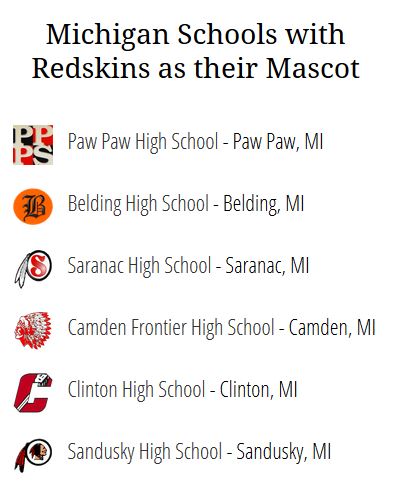
Interestingly, the area of lower Michigan, Indiana, Ohio, and Pennsylvania have the highest concentration public high schools using the name Redskins, constituting nearly half of the schools on the map. This “Redskins Belt” includes six Michigan high schools, identified on the list and map below.

Past efforts to ban the use of Native American mascots throughout the state of Michigan have been unsuccessful. In 2013, the Michigan Department of Civil Rights filed a complaint with the U.S. Department of Education Office for Civil Rights on behalf of all present and future students who self-identify as American Indians, alleging that thirty-five schools in Michigan engage in the continued use of American Indian mascots, names, nicknames, logos, and other imagery, creating a hostile environment and denying equal rights to all current and future American Indian students. The complaint was dismissed because, in an effort to protect students from a possible backlash at their schools, the Michigan Dept. of Civil Rights offered empirical studies that supported the psychological harm experienced by American Indian students in lieu of specific examples of race-based incidents and the identity of students and individuals who suffered specific harm because of the alleged discrimination. The US Dept. of Education Office for Civil Rights concluded that these omissions rendered the complaint insufficient to support an inference that racial discrimination had occurred or was occurring.
For states like Michigan with public schools that continue to use Indian mascots, the strategies pursued in California and Oregon provide new examples of pathways to successfully banning Indian mascots. One thing is clear, however. Any state that takes seriously 1) its commitment to ensure that students are not subjected to unlawful discrimination in public schools on the basis of race or color and 2) its obligation to provide an educational environment that is not hostile and that promotes educational attainment for all, should closely examine the effect of and potential prohibition of the use of Indian mascots in schools.


 Turtle Talk
You must be logged in to post a comment.