Jason Robison on Arizona v. Navajo Nation

Jason Robison has published “Relational River: Arizona v. Navajo Nation & the Colorado” in the UCLA Law Review.

Here is the abstract:

It is not every day the U.S. Supreme Court adjudicates a case about the water needs and rights of one of the Colorado River Basin’s thirty tribal nations and the trust relationship shared by that sovereign with the United States. Yet just that happened in Arizona v. Navajo Nation in June 2023. As explored in this Article, the Colorado is a relational river relied upon by roughly forty million people, reeling from climate change for nearly a quarter century, and subject to management rules expiring and requiring extensive, politically charged renegotiation by 2027. Along this relational river, Arizona v. Navajo Nation was a milestone, illuminating water colonialism and environmental injustice on the country’s largest Native American reservation, and posing pressing questions about what exactly the trust relationship entails vis-à-vis the essence of life. Placing Arizona v. Navajo Nation in historical context, the Article synthesizes the case with an eye toward the future. Moving forward along the relational river, the trust relationship should be understood and honored for what it is, a sovereign trust, and fulfilled within the policy sphere through a host of measures tied, directly and indirectly, to the post-2026 management rules. Further, if judicial enforcement of the trust relationship is necessary, tribal sovereigns in the basin (and elsewhere) should not view the Court’s 5–4 decision as the death knell for water-related breach of trust claims, but rather as a guide for bringing cognizable future claims and reorienting breach of trust analysis.

Fletcher on the Sovereignty Problem in Federal Indian Law

Check out “The Sovereignty Problem in Federal Indian Law” on SSRN.

Here is the abstract:

There is a sovereignty problem in federal Indian law, namely, that the federal government’s sovereign defenses prevent tribal nations and individual Indian people from realizing justice in the courts. Often, compelling tribal and Indian claims go nowhere as the judiciary defers to the interests of the United States, even where Congress has expressly stated its support for tribal interests. Conversely, tribal judiciaries allow claims to proceed to the merits, invoking customary and traditional law to hold tribal governments accountable.
Sovereignty theory helps to explain why justice can be done in one court system but not another. But federal, state, and tribal courts are all American courts than can and should learn from one another. This paper is an effort to show that federal sovereign defenses are not inevitable, nor are they even necessary.

Data good.

Robin Kundis Craig on Sackett + Navajo + Montana

Robin Kundis Craig has posted “Tribes and Water in the Wake of Navajo Nation and Sackett: Treaties, Winters, Montana, and Rights of Nature,” forthcoming in the William & Mary Environmental Law and Policy Review, on SSRN.

Here is the abstract:

As headlines over the last decade have made clear, people in the United States can no longer afford to take fresh water for granted. In the midst of increasing issues regarding both water quality and water quantity (allocation), Tribes are playing an ever-more-active role in the Nation’s water management. This Article provides an overview of the contemporary legal landscape governing tribal authority over water, emphasizing two recent Supreme Court decisions: Sackett v. Environmental Protection Agency (May 2023), in which the Supreme Court cut back on the Clean Water Act’s jurisdictional reach, and Arizona v. Navajo Nation, in which the Court held that the federal government has no trust duty to help Tribes get water.

HIGHLY RECOMMENDED!

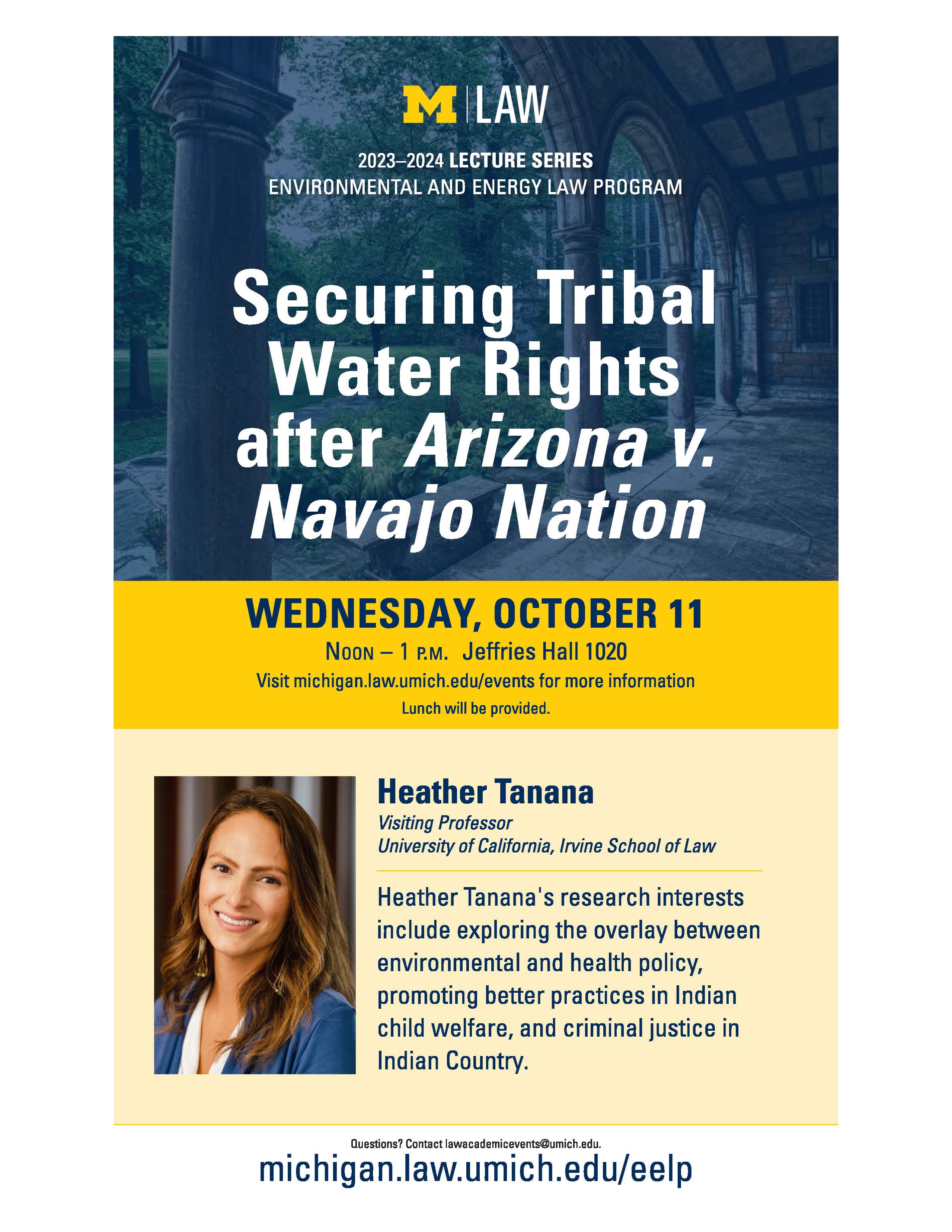
Heather Tanana to Speak at UMLS Next Week

SCOTUSBlog Recap of Arizona v. Navajo Opinion

Here.

Opinion and stuff here.

SCOTUS Rejects Navajo Nation’s Water Rights Trust Claim 5-4

Here is the opinion in Arizona v. Navajo Nation.

Background materials here.

ABA SEER “Community Conversation” re: Arizona v. Navajo Nation Supreme Court Argument

Here.

Title: Arizona v. Navajo Nation, U.S. Supreme Court Oral Argument Debrief

Date/Time: April 20, 2023, 12–1 pm Mountain Time.

Registration link: https://americanbar.zoom.us/meeting/register/tJIqf-uprDgtHNJdop7wBRttqIpyu3j9-Xw2#/registration

Description: Last month, the U.S. Supreme Court held oral arguments in Arizona v. Navajo Nation, a case that pertains to the Navajo Nation’s claims to water rights in the mainstem of the Colorado River and the United States’ trust obligation to assess and assert those rights under the Court’s more-than-century-old Winters doctrine. Although this current case ostensibly relates to one Tribe’s rights to one specific water source, the forthcoming Supreme Court ruling could have ripple effects for Native Nations across the United States as they seek to assert, quantify, and settle their water rights in ongoing adjudications nationwide. Join law professors Heather Whiteman Runs Him (University of Arizona), Derrick Beetso (Arizona State University), and Heather Tanana (University of Utah) for a discussion about the Arizona v. Navajo Nation oral arguments, the potentially wide-ranging implications of the case, and their work on the amicus briefs they coauthored and submitted to the Court, during this free virtual event sponsored by the ABA Section of Environment, Energy, and Resources’ (SEER) Native American Resources Committee and Water Resources Committee.

SCOTUS Asks for Supplemental Briefing in Brackeen and Navajo on the Pope’s Repudiation of the Doctrine of Discovery

Here.

SCOTUSBlog Recap of Arizona v. Navajo Nation Oral Argument

Here is “Justices appear divided over Navajo Nation’s water rights.”

Background materials on the case are here.

According to the U.S., this area is entitled only to the water that the Navajos can find there.

UCLA Debrief of Oral Argument in Arizona v. Navajo Nation

Transcript of the argument is here.

Audio is here.