Kekek Stark on Tribal Law Interpretations of the Indian Civil Rights Act

Kekek Stark has posted “The Utmost Rights and Interests of the Indians: Tribal Law Interpretations of the Indian Civil Rights Act” on SSRN.

Highly recommended.

Here is the abstract:

It has been more than fifty years since Congress enacted the Indian Civil Right Act (hereinafter “ICRA”) and more than forty years since the United States Supreme Court in Martinez articulated that the tribal courts are the proper forum for the adjudication of ICRA claims. In the decades since, tribal courts have developed a rich body of intertribal common law pertaining to the implementation of the ICRA. This comes after over a century of assimilative policies in which the federal government attempted to eradicate native culture and traditions and subjected Indians to the deprivation of individual rights by federal and state judicial systems.So how are tribes doing in the implementation of the ICRA? Specifically, how are tribal courts balancing the promotion of tribal sovereignty with the protection of individual rights? Does the ICRA establish a mandate to tribal governments to assume and require judicial review of any allegedly illegal action by a tribal government? Can a Tribe accused of violating these primary rights also be the judge of its own actions and at same the time comply with federal law? This article will examine these questions in detail. In doing so, Part I provides a brief introduction. Part II details the implementation of individual rights protections prior to the enactment of the ICRA. Part III provides an overview of the passage of the ICRA. Part IV examines federal court encroachment into tribal court determinations of individual rights protections. Part V provides an overview of the ruling in Martinez. Part VI details tribal court interpretations of the ICRA associated with tribal sovereign immunity, tribal council actions, equal protection, due process, and criminal protections. Part VII concludes by offering recommendations for tribal courts in their ongoing review of the ICRA. 
New Student Scholarship on Oklahoma Choctaw Constitutional Interpretation

Crispin South has posted “Transplanted Rights in the Choctaw Nation: Threats to Sovereignty and Potential Solutions,” forthcoming in the Texas Journal on Civil Liberties & Civil Rights, on SSRN.

Here is the abstract:

The constitutions of Federally Recognized Indian Tribes are varied, but nearly all contain a bill of rights. The Choctaw Nation’s Constitution, like that of several other Tribes, rather than specifically enumerating rights, instead contains a single catch-all provision, protecting the same rights available to citizens of the State of Oklahoma. Recently, the Choctaw Nation’s Constitutional Court adopted a broad interpretation of this provision, potentially allowing non-Tribal sovereigns, like the State of Oklahoma, to indirectly control the laws and public policy of the Tribe. This is a serious threat to the Tribe’s sovereignty, touching on issues of transplanted law raised by Indian Law scholars Elmer Rusco and Wenona Singel. To address this threat, the Choctaw Nation, and other Tribal Nations with similar constitutional provisions, ought to adopt a practice of selectively incorporating rights. Under this approach, only those rights fundamental to the Tribal structure of liberty and democracy would be incorporated, thus preserving the Tribe’s right to be different from the State, and the United States. Little has been written regarding these “transplanted rights” provisions in Tribal constitutions, and nearly nothing has been published proposing judicial and legislative solutions to the problems raised by these provisions. This note fills this gap in the literature by proposing judicially focused solutions, legislative solutions, and solutions involving constitutional reform.

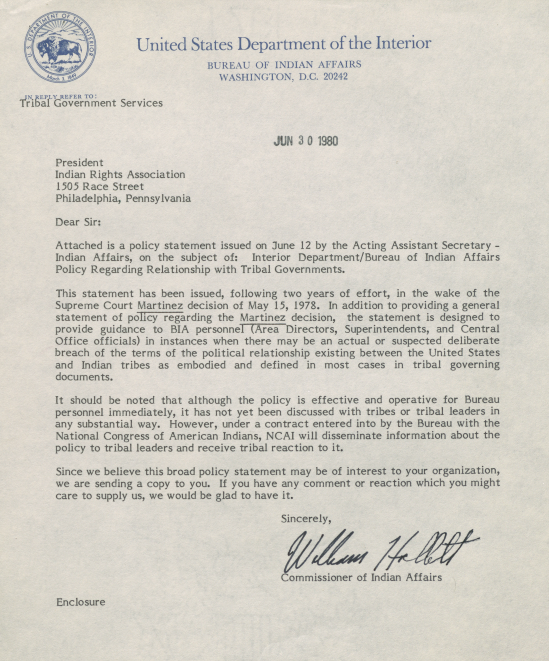
Blast from the Past: 1980 Interior Guidance to BIA Officials re: ICRA Enforcement Post-Martinez

Here:

1980 Interior Guidance on ICRA

Interesting list of “sanctions” BIA would impose on tribal governments that violate ICRA (considered by the Commissioner to be a violation of the political relationship between the tribe and the feds):

Montana Federal Court Allows Habeas Petition against Blackfeet to Move Forward

Here are the materials in Arocha v. Blackman (D. Mont.):

Jeanne Smith

Student Note on the Exclusionary Rule and the Indian Civil Rights Act

Seth E. Montgomery has published “ICRA’s Exclusionary Rule” in the Boston University Law Review.

The abstract:

The Fourth Amendment does not limit the actions of the 574 federally recognized Indian tribes. In an affront to tribal sovereignty, Congress enacted the Indian Civil Rights Act (“ICRA”) in 1968. The ICRA provides limitations on tribal governments that parallel the Bill of Rights. For example, the ICRA provides that no Indian tribe shall “violate the right of the people to be secure . . . against unreasonable search and seizures.”
But the ICRA—like the Fourth Amendment—does not state what happens when police obtain evidence from an unreasonable search or seizure and prosecutors seek to introduce that evidence in a criminal trial. Federal courts have developed an exclusionary rule for evidence obtained in violation of the Fourth Amendment: subject to myriad exceptions, if police obtain evidence unconstitutionally, then that evidence may not be introduced in a criminal trial. This Note asks whether the ICRA’s search-and-seizure provision incorporates such an exclusionary rule.
This Note advances an interpretation of the ICRA based on the statute’s 1968 meaning: the ICRA’s text compels an exclusionary rule, conditioned on deterring tribal police misconduct, but not subject to the myriad exceptions that apply in the Fourth Amendment context. And, with important qualifications, this Note explains why a court applying this interpretation should turn to tribal law. A deterrence-based exclusionary rule requires courts to consider whether exclusion deters police misconduct, how to measure the benefits of deterrence against the harms of excluding probative evidence, and how much deterrence is necessary for exclusion. Comity, self-determination, and federalism all compel deference to tribal law in answering these questions. Thus, tribal law can and should guide the application of the ICRA’s search-and-seizure provision in a criminal prosecution.
This Note contributes to the legal and academic landscape in three ways. First, it adds to an ever-growing body of literature advocating for federal and state deference to tribal law. Second, this Note fills a gap in the literature by addressing a remedy that the ICRA does not expressly provide—namely, exclusion. Most academics and courts describe federal habeas review as the ICRA’s only available remedy outside of tribal courts. Finally, this Note provides a roadmap for litigants arguing for or against a suppression motion based on an ICRA violation. Only a limited number of reported cases address whether the ICRA incorporates an exclusionary rule, and even fewer provide a full analysis. This Note thus answers an open question in a way that harmonizes constitutional criminal procedure with deference to tribal legal precedent.

Muscogee SCT Issues Opinion in Criminal Law Matter [speedy trial; duress defense]

Here is the opinion in Casey v. Muscogee (Creek) Nation:

Eighth Circuit (again) Rejects Challenge to Oglala Tribal Police Traffic Ticket

Here is the opinion in Stanko v. Oglala Sioux Tribal Police:

Memorandum

Only one brief was filed:

Stanko Brief

Lower court materials here.

Minnesota Federal Court Declines to Suppress Red Lake Tribal Criminal Defendant’s Uncounseled Statements to FBI and Uncounseled Tribal Court Plea

Here are the materials in United States v. Begay (D. Minn.):

South Dakota Federal Court Dismisses ICRA Claims (again) against Oglala Tribal

Here are the materials in Stanko v. Oglala Sioux Tribal Public Safety Division (D.S.D.):

1 Complaint

7-2 Tribal Exclusion Order

8 Motion for PI

8-1 Tribal Bench Warrant

11 DCT Order

Prior suit here.

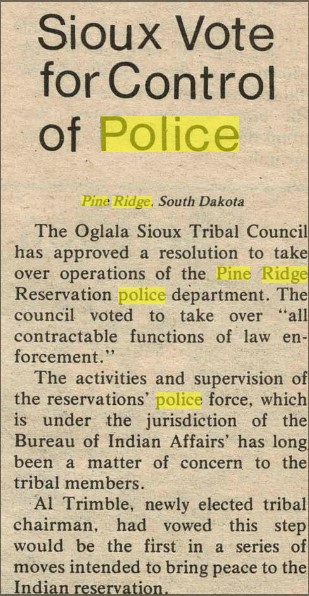
Wassaja, Aug. 1976

Eighth Circuit Rejects MHA Nation Citizens’ Voting Rights Suit

Here is the opinion in Cross v. Fox.

Briefs:

Lower court materials here.

Fort Berthold Agency