Here.
Boston Globe on Mashpee Compact Revenue Sharing Provisions
Here.
Here.
Here is the press release:
Gun Lake Revenue Sharing Announcement 6.4.12
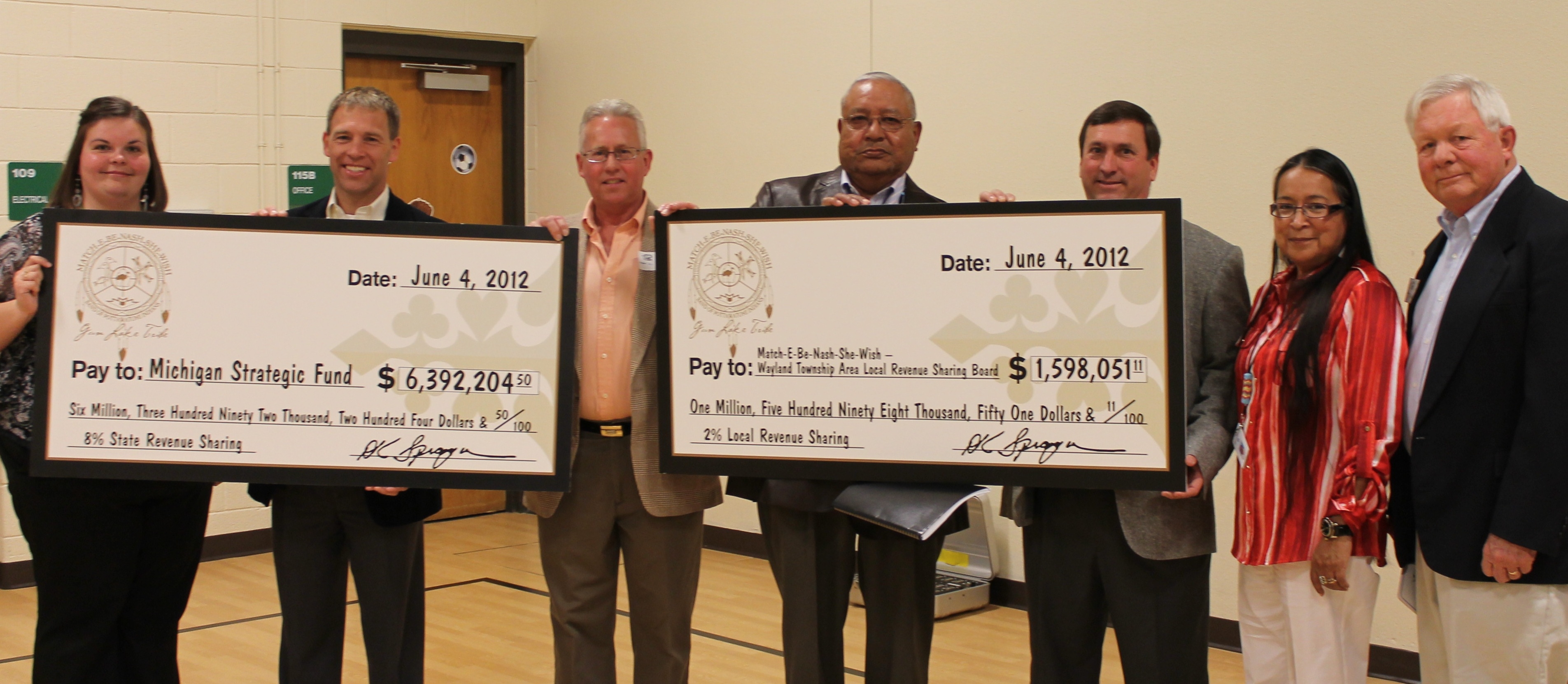
Photo courtesy Gun Lake Tribe.
Here, from Indianz.

Left to Right: Lindsay Vogelsberg (Rep. Bob Genetski’s Office on behalf of State of Michigan); Punkin Shananaquet (Tribal Council); D.K. Sprague (Tribal Chairman); Mark DeYoung (Chairman, Allegan County Board of Commissioners); Norm Taylor (Superintendent Wayland Union Schools); Phyllis Davis (Tribal Council); Linden Anderson (Local Revenue Sharing Board). Photo courtesy Gun Lake Tribe.
Thomas Jensen’s article in ICT (available here) identifying a possible “silver lining for tribal sovereignty” in the context of shrinking federal and state budgets seems, on first glance, to be counterintuitive, but the thinking is dead-on.
All around Michigan, anyway, tribes and local governments have become more and more interconnected and interdependent. Since 1993, when the first Class III compacts came into being, and where the tribes agreed to share two percent of their net win the local units of government, local governments have grown used to (and even dependent upon) tribal revenue sharing. The two percent payments fill needs in local government budgets, and generate more and more cooperation between governments.
Similarly, and on a broader scale, the settlement of a major reservation boundaries case at Saginaw Chippewa has provided models on how tribes and local governments can cooperate on everything from tax collection to hot pursuits to environmental protection.
The theme for the 21st century in Indian country should be about exercising good governance (in Angela Riley’s words), or Native Nation building or just plain intergovernmental cooperation. Local governments need Indian country, and vice versa.
Jensen’s point is well taken. State and local governments are losing the capacity to govern. Tribal capacity to govern is growing. Helping local (and even state) governments fill needs is an important way to help tribes grow into mature sovereigns.
Indian gaming is heading for bad news, if it isn’t already there. Indian tribes defending their share of big gaming markets are paying off states, lobbyists (and the federal Reps and Senators linked to them), and big time lawyers (hopefully someone who went to PLSI, so at least they have some soul), sometimes to the tune of millions of dollars.
It kinda works one of two ways, although they overlap. The first way, the oldest way, is political — Tribe A pays hundreds of thousands of dollars to a lawyer for advice. Big time lawyer says spend hundreds of thousands on campaign contributions to whomever in D.C. is in power, and perhaps the state elected officials, too, if gaming compacts negotiations are needed, to keep Tribe B from getting into Tribe A’s market. Meanwhile, Tribe B is paying another big time lawyer for advice on how to get into Tribe A’s market (of course, they don’t agree it’s Tribe A’s market; to them, it’s Tribe B’s market). Tribe B’s lawyers recommending spending hundreds of thousands more on the same political entities. Tribe A and B pay tons of dough really for nothing, since the political entities are getting a windfall.
Option two isn’t much better (and must less used so far), with the bigger gaming tribe using the gaming compacting process to pay more money to the state to protect a gaming share. The smaller gaming tribes who want into the bigger gaming tribes wheelhouse will naturally agreed to pay even more to the state. State gets more and more.
Option three is litigation, losers all around.
Why not negotiate among tribes first? Who says political entities in the federal government and states are good at gatekeeping or keeping their word? If Tribe A wants Tribe B out, why don’t they approach each other and at least ask what’s it is worth to keep the status quo? Why should politicians and states ever get anything from an Indian tribe?
Yeah, some tribes need gaming compacts. This might not help them, though after Rincon, states can’t just ask for revenue sharing in exchange for a compact.
Intertribal revenue sharing has to be the future, or else all the intertribal conflict will destroy most of the good things about Indian gaming.
Currently pending in district court is a motion for summary judgment by the Pauma Band in their long-running dispute with the State of California over revenue sharing and their compact terms.
Here are the most recent materials:
Pauma Band Motion for Summary J
This case is on remand from the Ninth Circuit (materials here).
Article here, from Uplivenorth.
TV coverage here, from channels 9 & 10.
Big news.
Here: TribeUpperLake081710
Here is the opinion in Cachil Dehe Band of Wintun Indians of the Colusa Indian Community v. State of California.
Here are the briefs.
Here is the press release: 2% first half 2010 press release 07-30-10
 Turtle Talk
You must be logged in to post a comment.