NARF Press Release on Parks v. Simmonds

Here:

Friday, July 18, 2014

Alaska Supreme Court affirms full faith and credit to tribal court orders in Simmonds v. Parks decision

This morning, the Alaska Supreme Court issued its opinion in Simmonds v. Parks. The Court ruled the Minto Tribal Court’s order terminating Mr. Parks’ parental rights was entitled to full faith and credit and remanded the matter back to the superior court to be dismissed. Today’s decision ends the long-running case and reaffirms the respect owed to tribal courts when deciding issues that concern tribal children.

Background:

In June 2008, the Minto Tribal Court took emergency custody of an infant girl. After numerous hearings in which the parents participated, the Minto Tribal Court terminated the parental rights of the girl’s mother and father, Mr. Parks, and granted permanent custody of the child to the Simmonds who are relatives of the child’s mother. Mr. Parks did not appeal the decision in the Minto Tribal Court, but instead filed a series of lawsuits in federal and state court claiming, among other things, that the tribal court has no jurisdiction over him and that the Minto Tribal Court’s traditional practices and procedures violated his right to due process. Based on these arguments, Mr. Parks claimed that the tribal court termination order was not entitled to full faith and credit under the Indian Child Welfare Act (ICWA). The Simmonds argued that the termination order is entitled to full faith and credit, and they moved to dismiss the state court action, but this motion was denied by the superior court in November 2010.

The Simmonds petitioned the Alaska Supreme Court for review. The petition was granted, and the case was remanded to the superior court for it to make specific factual findings and legal conclusions. The superior court issued findings and concluded in part that tribal courts may not have jurisdiction over nonmembers and also suggested that the Minto Tribal Court’s traditional practices and procedures violated Mr. Parks’s right to due process. The Simmonds filed another petition for review with the Alaska Supreme Court asking that numerous aspects of this decision be reversed.

The State of Alaska intervened in the case and argued vigorously against the Minto Tribal Court’s jurisdiction and the use of the Tribal Court’s traditional law and processes. Attorney General Geraghty himself published an opinion piece on the case. These actions are consistent with the State’s 2004 Renkes Opinion and subsequent lawsuits in which the State has refused to recognize the authority of tribal courts over member children, including State v. Native Village of Tanana, Kaltag Tribal Council v. Jackson, and the ongoing State v. Central Council of Tlingit & Haida Indian Tribes of Alaska.

The Alaska Supreme Court’s Decision:

In its opinion today, the Alaska Supreme Court affirmed that the Minto Tribal Court’s decision is entitled to full faith and credit by Alaska courts. The Court affirmed that the Minto Tribal Court’s judgment on the custody of the child implicates interests that are at the core of tribal sovereignty and self-determination, and the Court rejected the State’s jurisdictional arguments to the contrary. In addition, the Court’s opinion is notable because it adopts the longstanding exhaustion of tribal remedies doctrine, which requires litigants to make use of tribal appellate courts before challenging tribal court decisions in federal or state courts.

NARF Staff Attorney Erin Dougherty described the Court’s analysis of full faith and credit and the tribal exhaustion doctrine as “a direct rebuke of the State of Alaska’s arguments, which sought to treat the decisions of tribal courts differently simply because they are Tribes. These arguments have no foundation in federal law and do a great disservice to the relationships between Tribes and the State of Alaska.” NARF Staff Attorney Natalie Landreth agreed, noting that “the Court’s decision today is entirely consistent with federal and state law.”

In this case, the Native Village of Minto did what it and the 228 other Tribes in Alaska have done since time immemorial—protect and care for their member children in times of need. The Native American Rights Fund calls on Governor Sean Parnell and Attorney General Geraghty to cease the State’s repeated efforts to oppose tribal courts and instead, work with Tribes to better protect all of Alaska’s children.

NARF Press Release re: Hunter Cox

Meet Hunter Cox – Siletz Grant Recipient from the Native American Rights Fund!

Each summer NARF hosts the summer clerkship program, a ten to twelve week program clerkfor second year law students.  Unlike most law clerk projects that consist mainly of legal research and writing, NARF’s projects are extremely challenging because NARF practices before federal, state, and tribal forums, and because most of its cases – whether at the administrative, trial, or appellate level – are complex and involve novel legal issues.

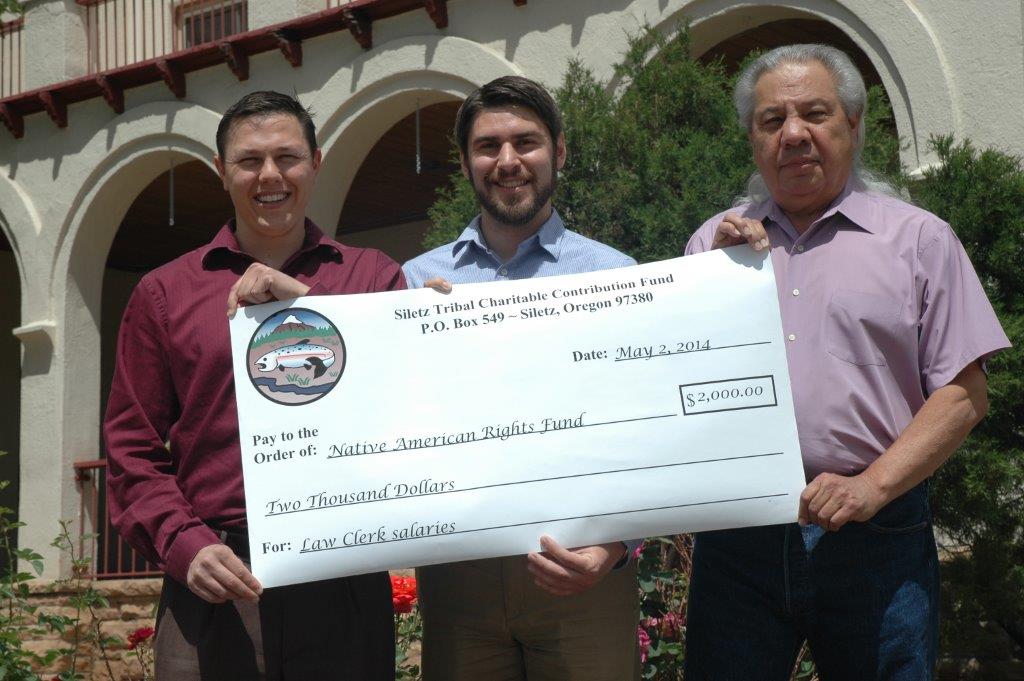
This summer the law clerk program was supported by a grant from the Confederated Tribes of Siletz Indians through the Siletz Tribal Charitable Contribution Fund.  This summer NARF has six law clerks – two in the Alaska office, one in the D.C. office, and three in the Boulder office. Law Clerk Hunter Cox (Prairie Band of Potawatomi Nation), was chosen to be the recipient of this grant due to his recent and impactful work collaborating with NARF attorney Steve Moore to protect the rights of Native high school students to wear their eagle feathers during their graduation ceremony.

Earlier this month, NARF, California Indian Legal Services (CILS), and the American Civil Liberties Union (ACLU) of Northern California advocated on behalf of Native students in Lemoore, California, who wanted to wear eagle feathers at their graduation ceremony.  The gift of an eagle feather is a great honor and is typically given to recognize an important transition in a young person’s life.  Many graduates are given eagle feathers in recognition of their educational journey and the honor the graduate brings to his or her family, community, and tribe.  Hunter, along with Steve, CILS, and ACLU, sent a letter on the students’ behalf requesting the school district to allow the students to wear their eagle feathers during graduation.  After initially denying the students requests, the school district relented once receiving the letter, and allowed the students to wear their feathers despite originally denying the students request.

To read the letter sent on the students’ behalf, click here.  And, to read the press about the students wearing their feathers, click here.

NARF thanks the Confederated Tribes of Siletz Indians and the Siletz Tribal Charitable Contribution Fund for its grant to further the NARF law clerk program, which allows Native law students to make an impact on Indian law and to Native people during their term at NARF.

CONTACT: For questions regarding eagle feathers – Steve Moore, Native American Rights Fund – 303-447-8760
For questions about NARF’s Law Clerk Program – Matthew Campbell, Native American Rights Fund – 303.447.8760

Native American Rights Fund on Humetewa Confirmation

Today the United States Senate unanimously confirmed Diane Humetewa as a United States District Court Judge for the District of Arizona.  Humetewa is a member of the Hopi Tribe and is now the first American Indian woman federal judge.  She was the U.S. Attorney for the District of Arizona from 2006 to 2009.

NARF Executive Director John E. Echohawk congratulated Judge Humetewa on her confirmation:  “She is well-qualified for this position and the Federal Judicial Selection Project, staffed by NARF and NCAI attorneys, has long-supported her nomination and confirmation.  With today’s historic vote, she will be the only Native American federal judge currently sitting and the first Native American woman in the federal judiciary. With this important milestone, we acknowledge that there are still a lot of judicial vacancies and accomplished, well-qualified Native American attorneys who are ready to serve.  We look forward to supporting more nominees like Judge Humetewa in the future.”


Guest Post — Keeping a Close Eye on Michigan v. Bay Mills Indian Community (Jefferson Keel and John Echohawk)

Keeping a Close Eye on Michigan v. Bay Mills Indian Community (Jefferson Keel and John Echohawk):

Since it was established in 2001, the National Congress of American Indians and the Native American Rights Fund have jointly coordinated the work of the Tribal Supreme Court Project.  The Project was established by tribal leaders in response to a series of devastating losses for Indian tribes before the Supreme Court of the United States.  As you may recall, tribes were losing 3 out of every 4 Indian law cases argued before the Court and resulted in decisions significantly eroding the doctrine of inherent tribal sovereignty.  Our work has focused on coordinating tribal resources throughout Indian country and bringing the best legal minds to the table to develop litigation strategies to put forward the strongest legal arguments when litigation could not be avoided.  But our message to tribes became and remains:  “Stay away from the Supreme Court!”

During its early years, the Project experienced relative success with tribes increasing their winning percentage to greater than 50%—winning 4, losing 3, and 2 draws in the 9 Indian law cases heard by the Rehnquist Court.  But since 2005, with the installment of John Roberts as Chief Justice, the retirement of Justices O’Connor, Souter and Stevens, the tribes winning percentage has plummeted to 10%—with 1 win and 9 losses in the 10 Indian law cases heard by the Roberts Court.  And neither Chief Justice Roberts nor Justice Alito has voted in favor of tribal interests in a single case!

With this background, we recently read the State of Michigan’s opening brief in Michigan v. Bay Mills Indian Community–a case granted review by the Court even though the United States had filed a brief recommending that cert be denied.  Although this litigation should be about the merits of Bay Mills’ claims under the Michigan Indian Land Claims Settlement Act to conduct gaming on lands acquired with settlement funds—it is not.   In its current posture before the Court, the State of Michigan is using this case to mount a full frontal attack on tribal sovereign immunity and the authority of states to regulate “gaming activity” under the Indian Gaming Regulatory Act (IGRA).

First, Michigan asks the Court to examine “IGRA as a whole” to find Congressional intent to  waive of tribal sovereign immunity or, in the alternative, to overrule Santa Clara Pueblo and apply a “less strict standard” when considering whether legislation such as IGRA abrogates tribal sovereign immunity.  Second, if the statutory arguments are not successful, Michigan asks the Court to recognize that tribal sovereign immunity “is a federal common law doctrine” created by this Court and subject to adjustment by this Court.  Thus, according to Michigan, the Court should narrowly read Kiowa as a “contract-based ruling” and (at the extreme) hold that a tribe’s immunity is limited to its on-reservation governmental functions.

With the doctrine of tribal sovereign immunity and the authority of states under IGRA on the table, this case has become high-stakes litigation for Indian tribes across the country.  Although Bay Mills and other tribes have solid legal arguments to make to the Court, the optics and politics of this case do not bode well for a good outcome.  The last time the doctrine of tribal sovereign immunity was before the Court was in Madison County v. Oneida Indian Nation of New York back in 2010.  Madison County, the State of New York and other local governments had filed briefs taking aggressive approaches similar to the State of Michigan. Their positions were supported by a number of other states, local governments and non-Indian property rights organizations as amicus parties.  In response to similar concerns expressed here, the Oneida Indian Nation passed a resolution which irrevocably waived its sovereign immunity and resulted in the Court vacating and remanding the case to the lower courts for further proceedings on the merits.  Although that result may be difficult to replicate, our hope is that the on-going efforts by the Bay Mills Indian Community to find an alternative resolution to this case, or at least change the posture of this case before the Court, will bear fruit.

To repeat our message to all tribes:  “Stay away from the Supreme Court!”

Update in Baby Veronica Case: S. Carolina SCT Denies Reconsideration

South Carolina Supreme Court Denies Rights to Baby Veronica;
National Native Organizations to Advance Civil Rights Lawsuit
 
Washington, DC – The South Carolina Supreme Court ruled today to deny the appeal filed by Dusten Brown and the Cherokee Nation of the Court’s July 17 order to expedite the transfer of custody of Veronica Brown to the South Carolina-based adoptive couple. One year ago, the South Carolina Supreme Court found that denying the adoption and awarding custody to Dusten Brown was in Veronica’s best interests. Today, that same Court summarily reversed that decision based on a two-year-old record and without providing a hearing for Veronica. Jacqueline Pata, executive director of the National Congress of American Indians issued the following statement in response to today’s ruling:
 
“The South Carolina Supreme Court has utterly failed to evaluate Veronica’s current best interests in this case and confirmed our worst fears – when it comes to Veronica Brown, standard adoption procedures do not apply. Apparently, the Court believes that there is no need to require the family court to hold a formal and thoughtful hearing to determine what is in Veronica Brown’s best interest. Like thousands of Native American children before her, Veronica now faces the prospect of being removed from her Cherokee family, without a formal consideration of her needs, her culture and her well-being. This is an alarming failure of the judicial system, and it represents a grave threat to all children in adoption proceedings, but most notably Native American children, who deserve all the legal protections, afforded any child in this nation.”  
 
“The National Congress of American Indians refuses to stand by as the rights of this child are violated.  Together with the Native American Rights Fund and the National Indian Child Welfare Association we are preparing to file litigation in order to protect Veronica’s civil rights.  On behalf of all Native American children, we will pursue every legal option available to us to ensure that standard adoption procedures are upheld in this case.” 
 
“Let me add that I believe the South Carolina Supreme Court has shown willful disregard for the facts when it claims Dusten Brown has not been involved in the life of his daughter. On the contrary, Dusten Brown has gone to extensive lengths to maintain his family and to care for Veronica. The Court’s willingness to ignore these facts and rush a resolution in this matter is deeply troubling. “

Text of Comments Prepared by NICWA, NCAI, and NARF in Baby Veronica Press Conference

Comments as prepared for delivery for press teleconference regarding:
National Native Organizations Announce Pursuit of Civil Rights Lawsuit for Baby Veronica
 
          Jacqueline Pata, Executive Director of the National Congress of American Indians
          Terry Cross, Executive Director of National Indian Child Welfare Association
          John Echohawk, Executive Director of the Native American Rights Fund
 
 
Jacqueline Pata – Executive Director, National Congress of American Indians
 
Good afternoon and good morning to you all. Thank you for joining us. My name is Jacqueline Pata, as Thom said I’m the executive director of the National Congress of American Indians. I’m a member of the Raven/Sockeye Clan of the Tlingit Tribe and a member of the Central Council of the Tlingit-Haida Indian Tribes of Alaska
 
Before I begin with our announcement today, I’d like to open with some context to our announcement.
 
Within the United States, there are 566 sovereign tribal nations, which are recognized as having an official nation-to-nation relationship with the United States federal government. There are many more tribes with relationships with state governments. To date, there are well over 5.2 million individuals who identify alone or in combination with another race as American Indian or Alaska Native. 
 
The National Congress of American Indians has served as the unified voice advocating for the rights of American Indian and Alaska Native tribal governments and citizens since 1944.
 
As tribal nations we have a historic, political relationship with the United States as evidenced through numerous treaties, agreements, specific sections within the U.S. Constitution, as well as statutes which consider the unique needs and circumstances surrounding America’s first peoples.  Additionally, Indian tribes have their own laws and governance structures which are inherent in nature, but also which the US has had a strong history of supporting and nurturing through legislation like the Indian Child Welfare Act, the Self-Determination Act, and more recently, Title 9 of the Violence Against Women Reauthorization Act.  As a result, the governments and citizens of our nations occupy a unique place within the United States, as nations operating within a nation.   Also, tribes work daily with our counterparts in the federal, state, and local governments to ensure our laws are carried out in a manner that both furthers tribal self-governance, but is also grounded in strong working relationships established between tribal, federal and state governments to serve the best interests of our citizens of all our nations.
 
In essence, our citizens are both citizens of our tribal nations, and citizens of the United States. As such, individual Indians are afforded all of the same rights that every citizen within this union are afforded, the right to life, liberty, and the pursuit of happiness – and equally as important and significant in this matter, the right to due process, as outlined in the United States’ Constitution.
Which brings me to our announcement. 
 
It is in the context of the rights of Americans and Native Americans that I announce today, along with our colleagues at the Native American Rights Fund and the National Indian Child Welfare Association, our intention to pursue a lawsuit related to any violations of Baby Veronica’s civil rights in this case.
 
Late Wednesday of last week the South Carolina Supreme Court issued a controversial order to the state’s family court calling for an expedited transfer of custody to the South Carolina-based adoptive couple without a hearing of best interest for Veronica.  
When it comes to adoption proceedings, every court in this country has a legal obligation to put the best interests of a child first – every time, no matter the race of the child. This did not happen here. The South Carolina Court’s order represents a perilous prospect for not only Veronica, but any child involved in a custody proceeding in this country.
 
In a rush to judgment, the South Carolina Supreme Court ordered Veronica to be removed from her biological father without any consideration for her best interests.  The decision contributes to the long and sordid history of Native American children being removed from their families without any consideration of their best interests. The National Congress of American Indians refuses to stand by as the rights of this child are violated.
 
Every American should be shocked by this decision – and in fact many Americans were, including those in the legal community, regardless of their previous opinions or stance on the case. This decision was also counter to the expectations outlined in the U.S. Supreme Court oral arguments and decision to remand the case to the South Carolina Supreme Court.
 
We are talking about the rights of a nearly 4-year old child – during an extremely sensitive period in her life. Her rights to a determination of best interest hearing in the South Carolina court system in all steps leading to this decision were anticipated and were guaranteed by all parties and the laws of the United States – in fact in all previous proceedings in South Carolina Veronica’s best interest was accounted for as evidenced in two previous hearings going back as far as two years ago.
 
In those hearings, it was determined that the child’s father in fact was the best person for Veronica to reside with. And those findings were appropriate; he has raised her for the past 19 months providing a loving home while also connecting her with her Native heritage. She is also a citizen of the Cherokee Nation. These circumstances should be evaluated in a venue that affords them  their true value, such as a family court hearing to examine the best interests of the child – post the Supreme Court’s holding in Adoptive Couple v. Baby Girl.
 
We believe if her rights continue to be violated, this will represent the forced removal of a Native child from her Native family and community.
We are committed to fully examining these circumstances with all of our legal capabilities and will be calling on our allies in the civil rights and children’s rights communities to join us in standing for Veronica. Additionally, we have begun a process to notify the appropriate federal agencies of the process we have begun, including the Department of Justice.
 
I now turn today’s call over to Terry Cross of the National Indian Child Welfare Association for his statement. NICWA is a national voice for American Indian children and families, and the organization has been monitoring this case since Mr. Brown sought custody of his daughter.
 

Terry Cross – Executive Director, National Indian Child Welfare Association
 
Thank you Jackie, the National Indian Child Welfare Association also joins with NCAI and NARF to announce our intentions today to pursue legal actions and protect the rights of Veronica Brown as a child, as an American, and as an American Indian. 
 
In a rush to judgment, the South Carolina Supreme Court ordered Veronica to be removed from her biological father without any consideration of her best interests.  This is an alarming failure of the judicial system, and it represents a grave threat to the interests of all children in adoption proceedings, but most notably Native American children.  
 
Moving forward we’re calling on all involved – the courts, the media, and the families – to proceed with extreme caution and care during this important time for Veronica.
 
Her rights are paramount and caution must be exercised for her rights to be upheld. This also could set an unsettling precedent for future children’s rights.
 
Veronica who is now almost four-years old, is a citizen of the Cherokee Nation, and more importantly she is also afforded the rights of every child involved in a custody transfer within the courts of the United States – this means she should also be afforded a hearing of best interest in any pending transfer of custody proceedings.
 
Veronica’s rights, like any other child’s rights in this situation, are the same rights that every child has access to and should not be superseded for any reason.
 
Two years ago, both the South Carolina Supreme Court and Family Courts held best interest hearings and determined that it was in Veronica’s best interest to be with her father and that he was fit parent. As a result the South Carolina Supreme Court transferred custody to Mr. Brown. The legal system worked then, but it is being ignored now. It is unconscionable that no best interest hearing has been held in conjunction with the latest transfer order. Every child deserves to have his or her best interests considered – that is a fundamental right, and one that should not be denied any child.
 
The previous ruling by the South Carolina Supreme Court, ruled in favor of the father establishing that putting Veronica in Brown’s care was in best interest. No best interest has ever been established for a transfer to the adoptive couple during the entire time of the case.
In the South Carolina Supreme Court decision, these were the court’s words (see original decision):
“The family court found persuasive the testimony that Father was a good father who enjoyed a close relationship with his other daughter…” (p.22)
 
“We can only conclude from the evidence presented at trial that Father desires to be a parent to Baby Girl, and that he and his family have created a safe, loving, and appropriate home for her….” (p.23)
 
“Likewise, we cannot say that Baby Girl’s best interests are not served by the grant of custody to Father, as Appellants have not presented evidence that Baby Girl would not be safe, loved, and cared for if raised by Father and his family.” (p.26)

And if the Court points to the fact that two provisions of the Indian Child Welfare Act no longer applies, the court should consider their own words in the original decision;
 
‘South Carolina courts have a long history of determining custody disputes based on the “best interests of the child.”…This important history is not replaced by the ICWA’s mandate.” (p.24)
 
To understand that all parties involved called for these rights to be upheld, you only need to look to the comments delivered to the U.S. Supreme Court in Adoptive Couple v. Baby Girl as heard by the Justices months ago.
 
As the official representative for the child in the U.S. Supreme Court oral arguments, Paul Clement the attorney for the Guardian Ad Litem, made it very clear in his statements that if remanded back to the South Carolina Court there was every expectation that a hearing of best interest for Veronica must be held in order to uphold her rights.
 
His statements read as follows,

“I’m here representing the guardian who represents the best interest of the child. From the child’s perspective, the child really doesn’t care whose fault it was when they were brought in one custodial situation or another. They just want a determination that focuses on at the relevant time, that time, what’s in their best interest. And so in the same way that we think if you rule in our favor and you remand to the lower court that there has to be a best interest determination that takes into account the current situation,” (p.24)

There is even more information offered in the arguments made by Mr. Clement that point to the expectation that a best interest would be held, as well as in the Guardian’s Amicus to the U.S. Supreme Court. We will supply you those documents if you do not have them, as well as the audio clips of those oral arguments. (Click here to access the full transcript (p.24) and audio of this exchange between Clement and Justices.) 
 
Our organizations  are committed to supporting NARF as they look toward potential litigation to ensure Veronica’s rights will be protected.
 
The National Indian Child Welfare Association  is concerned every time the rights of a child are violated, particularly when that child is a citizen of an Indian nation. We have long stood for Veronica and we will not stand idly by as her rights are overridden.
 
I now turn to John Echohawk, executive director of the Native American Rights Fund, the nation’s pre-eminent nonprofit law firm dedicated to asserting and defending the rights of Indian tribes, organizations and individuals nationwide.
 
John Echohawk – Executive Director, Native American Rights Fund
 
The Native American Rights Fund –NARF – joins with the National Congress of American Indians, the National Indian Child Welfare Association today, and with many others inside and outside of Indian country, in support of Dusten Brown, his family and the Cherokee Nation. 
 
As you know, the Supreme Court of South Carolina issued its order last Wednesday, and gave Dusten and the Cherokee Nation five (5) days to file their petitions for rehearing.  Those petitions will be filed today.
 
When, as anticipated, the Supreme Court of South Carolina denies those petitions for rehearing, its order will become final and this case will be remanded to the State Family Court [quote] “for the prompt entry of an order approving and finalizing Adoptive Couple’s adoption of Baby Girl” [end quote].  As reflected in the order, the courts of the State of South Carolina can summarily terminate Dusten’s rights as a father and—without any hearing on what is in the best interests of this Indian child—and without any regard for due process of law to protect her civil rights—can remove Baby Veronica from her Indian father, her Indian family, and her Indian tribe with whom she has been living with for the past 18 months.
 
This injustice cannot stand!  As it has since it was established in 1970—NARF will stand firm for justice.
 
As Executive Director of NARF, I have instructed my legal staff to work with local counsel in South Carolina and Oklahoma to determine our best legal recourse through the federal courts to protect the rights of Baby Veronica.  In this case, we strongly believe that federal civil rights laws are being violated, that other applicable provisions of the Indian Child Welfare Act are being ignored by the state courts, and that the principles underlying treaty and international law protecting the rights of indigenous peoples are being undermined.
Thank you.
 
#END#

National Organizations Issue Press Release in Baby Veronica Matter

National Native Organizations Announce Pursuit of
Civil Rights Lawsuit for Baby Veronica
Lack of hearing to determine best interest driving concerns of child’s rights violations
 
Washington, DC – Three of the nation’s leading tribal organizations announced today they are in the early stages of pursuing litigation to protect the civil rights of Veronica Brown, a citizen of the Cherokee Nation who has been denied due process in the South Carolina courts.
 
Late Wednesday of last week the South Carolina Supreme Court issued a controversial order to the state’s family court calling for an expedited transfer of custody to the South Carolina-based adoptive couple without a hearing of best interest for Veronica.   It is standard procedure that adoption proceedings require a hearing to determine the best interest of the child in advance of any transfer proceedings, an essential step the South Carolina Supreme Court failed to take, thus denying Veronica the right to have her best interests considered.
 
Leaders of the Native American Rights Fund (NARF), National Congress of American Indians (NCAI), and National Indian Child Welfare Association (NICWA) said they were compelled to begin a process to represent the rights of Veronica in the situation, based on the Court’s order.
 
“When it comes to adoption proceedings, every court in this country has a legal obligation to put the best interests of a child first – every time, no matter the race of the child. This did not happen here. The South Carolina Court’s order represents a perilous prospect for not only Veronica, but any child involved in a custody proceeding in this country,” said Jacqueline Pata, Executive Director of NCAI.  “In a rush to judgment, the South Carolina Supreme Court ordered Veronica to be removed from her biological father without any consideration for her best interests.  The decision contributes to the long and sordid history of Native American children being removed from their families without any consideration of their best interests. The National Congress of American Indians refuses to stand by as the rights of this child are violated.”
 
Terry Cross, Executive Director of the National Indian Child Welfare Association outlined the history of best interest determinations within the case and how they run contrary to the order issued by the court last Wednesday:
 
“Two years ago, both the South Carolina Supreme Court and Family Courts held best interest hearings and determined that it was in Veronica’s best interest to be with her father and that he was fit parent,” said Cross. “As a result the South Carolina Supreme Court transferred custody to Mr. Brown. The legal system worked then, but it is being ignored now. It is unconscionable that no best interest hearing has been held in conjunction with the latest transfer order. Every child deserves to have his or her best interests considered – that is a fundamental right, and one that should not be denied any child.”
 
The previous ruling by the South Carolina Supreme Court, ruled in favor of the father establishing that putting Veronica in Brown’s care was in best interest. No best interest has ever been established for a transfer to the adoptive couple during the entire time of the case. The organization’s pointed to the court’s findings to favor Brown, thus leading to the placement (see original decision):
“The family court found persuasive the testimony that Father was a good father who enjoyed a close relationship with his other daughter…” (p.22)

“We can only conclude from the evidence presented at trial that Father desires to be a parent to Baby Girl, and that he and his family have created a safe, loving, and appropriate home for her….” (p.23)

“Likewise, we cannot say that Baby Girl’s best interests are not served by the grant of custody to Father, as Appellants have not presented evidence that Baby Girl would not be safe, loved, and cared for if raised by Father and his family.” (p.26)
Additionally, the presenters addressed the issue that certain provisions of the Indian Child Welfare Act no longer applied. Cross identified that in the court’s own decision in the original case it was stated that;
 
‘South Carolina courts have a long history of determining custody disputes based on the “best interests of the child.”…This important history is not replaced by the ICWA’s mandate.” (p.24)
 
The organization’s also highlighted the comments of Paul Clement the official representative for the child in the U.S. Supreme Court oral arguments, and the lawyer arguing for attorney for the Guardian Ad Litem, stating that if remanded back to the South Carolina Court there was every expectation that a hearing of best interest for Veronica must be held in order to uphold her rights;
 
“I’m here representing the guardian who represents the best interest of the child. From the child’s perspective, the child really doesn’t care whose fault it was when they were brought in one custodial situation or another. They just want a determination that focuses on at the relevant time, that time, what’s in their best interest. And so in the same way that we think if you rule in our favor and you remand to the lower court that there has to be a best interest determination that takes into account the current situation,” (p.24)
 
Click here to access the full transcript (p.24) and audio of this exchange between Clement and Justices. 
 
John Echohawk, Executive Director of NARF, the nation’s leading non-profit law firm which has represented the interests of Indians and Indian tribes in federal and state courts since 1970 outlined the next steps to be taken by the organizations:
 
As you know, the Supreme Court of South Carolina issued its order last Wednesday, and gave Dusten and the Cherokee Nation five (5) days to file their petitions for rehearing.  Those petitions will be filed today.
 
When, as anticipated, the Supreme Court of South Carolina denies those petitions for rehearing, its order will become final and this case will be remanded to the State Family Court [quote] “for the prompt entry of an order approving and finalizing Adoptive Couple’s adoption of Baby Girl” [end quote].  As reflected in the order, the courts of the State of South Carolina can summarily terminate Dusten’s rights as a father and—without any hearing on what is in the best interests of this Indian child—and without any regard for due process of law to protect her civil rights—can remove Baby Veronica from her Indian father, her Indian family, and her Indian tribe with whom she has been living with for the past 18 months.
 
As Executive Director of NARF, I have instructed my legal staff to work with local counsel in South Carolina and Oklahoma to determine our best legal recourse through the federal courts to protect the rights of Baby Veronica.  In this case, we strongly believe that federal civil rights laws are being violated, that other applicable provisions of the Indian Child Welfare Act are being ignored by the state courts, and that the principles underlying treaty and international law protecting the rights of indigenous peoples are being undermined.
 

Baby Veronica Press Conference — 1 PM Eastern Today

National Native Organizations to Announce Their
Next Legal Steps Related to Baby Veronica Case
 
Organizations:
Native American Rights Fund (NARF),
National Congress of American Indians (NCAI),

and National Indian Child Welfare Association (NICWA)
 
Monday July 22, 2013 – 1 p.m. eastern
(877) 856-2376 – Call ID# 22752930
 
Washington, DC – The three leading national Native advocacy organizations monitoring the custody case of “Baby Veronica”, a citizen of the Cherokee Nation, will announce the next legal steps they plan to take related to the ongoing case.  The announcement comes following last week’s order by the South Carolina Supreme Court to the State’s Family Court to expedite the custody transfer process of Veronica from her father, also a citizen of the Cherokee Nation, to the adoptive couple involved in the case. 
 
What: National press teleconference with national Native organizations to outline their next legal steps related to Baby Veronica case.
 
When: Monday, July 22, 2013 –  1 p.m. eastern / 12 p.m. central  
 
Details: (877) 856-2376 – Call ID# 22752930
 
Who: Leaders of three leading national tribal advocacy organizations monitoring Baby Veronica case:
          Jacqueline Pata, Executive Director, National Congress of American Indians
          John Echohawk, Executive Director, Native American Rights Fund
          Terry Cross, Executive Director, National Indian Child Welfare Association

NARF/Casey Foundation Blog on Indian Child Welfare Developments

Welcome to ICWA INFO, described as:

In early 2013 Casey Family Programs partnered with the Native American Rights Fund to create an online resource that would focus solely on Indian child welfare issues.  Thus, began the ICWA INFO blog.  It was envisioned that this site would provide the public with information and timely updates about all things related to Indian child welfare and the Indian Child Welfare Act (ICWA).  This would include:

  • news about lawsuits related to ICWA in tribal, state, and federal courts,
  • related training and conferences,
  • legal analysis and research resources,
  • federal and state regulations,
  • information about relevant groups and agencies,
  • and job postings.

To see our most recent additions and edits, visit our home page.  To see past materials, you can use our search box or review materials by category, date posted, or topic from the links at the right.

We hope that you find this resource useful and we invite you to submit materials for this website at the contact page.

Highly recommended.

Tribal Water Code Webinar

Tribal Water Codes – what they are and why they are important – please tune in to https://www1.gotomeeting.com/register/911538609 on Friday, December 14th from 2-4 pm eastern time (11-1 pacific, 12-2 mountain and 1-3 central) to hear tribal water resources experts on these important issues. The webinar is hosted by the National Congress of American Indians, the Native American Rights Fund, the Tribal Water Working Group and the Utton Center. For more information, please contact Derrick Beetso at dbeetso@ncai.org or Greg Haller at gregh@ecosolvellc.com.