Danielle Delaney on Environmental Law, Indigenous Identity, and #NoDAPL

Danielle Delaney has published “Under Coyote’s Mask: Environmental Law, Indigenous Identity, and #NoDAPL” in the Michigan Journal of Race & Law.

The abstract:

This Article studies the relationship between the three main lawsuits filed by the Standing Rock Sioux Tribe, the Cheyenne River Sioux Tribe, and the Yankton Sioux Tribe against the Dakota Access Pipeline (DaPL) and the mass protests launched from the Sacred Stone and Oceti Sakowin protest camps. The use of environmental law as the primary legal mechanism to challenge the construction of the pipeline distorted the indigenous demand for justice as U.S. federal law is incapable of seeing the full depth of the indigenous worldview supporting their challenge. Indigenous activists constantly re-centered the direct actions and protests within indigenous culture to remind non-indigenous activists and the wider media audience that the protests were an indigenous protest, rather than a purely environmental protest, a distinction that was obscured as the litigation progressed. The NoDAPL protests, the litigation to prevent the completion and later operation of the pipeline, and the social movement that the protests engendered, were an explosive expression of indigenous resistance—resistance to systems that silence and ignore indigenous voices while attempting to extract resources from their lands and communities. As a case study, the protests demonstrate how the use of litigation, while often critical to achieving the goals of political protest, distorts the expression of politics not already recognized within the legal discourse.
Reviews of Nick Estes’ “Our History Is the Future: Standing Rock Versus the Dakota Access Pipeline, and the Long Tradition of Indigenous Resistance”

NPR

The Intercept

HNN

The book webpage from Verso is here.

Federal Court Dismisses Dakota Access Pipeline-Related RICO Suit Brought by Pipeline Co. against Greenpeace and Individual Indians

Here are the materials in Energy Transfer Equity LP v. Greenpeace International (D.N.D.):

95 Amended Complaint

102 Greenpeace Fund MTD

103-1 Greenpeace Intl MTD

111 Response

121 Two Bulls MTD

125 Response

126 Two Bulls Reply

130 Montoya MTD

131 Response

135 DCT Order

Eighth Circuit Affirms Upward Depature in Sentence of Habitual Indian Country D.V. Offender

Here is the opinion in United States v. Eagle Pipe.

Iowa Law Review Student Scholarship on How NHPA Fails Tribal Interests

Amanda M. Marincic has published “The National Historic Preservation Act: An Inadequate Attempt to Protect the Cultural and Religious Sites of Native Nations” in the Iowa Law Review.

An excerpt:

Beginning in 2016, the Standing Rock Sioux Tribe engaged in a highly-publicized, year-long legal battle with Energy Transfer Partners regarding the construction of the Dakota Access Pipeline (“DAPL”). The Tribe initially argued that the DAPL’s construction would destroy ancient burial sites and potentially poison their only source of drinking water, the Missouri River. The Tribe also argued that the agency involved in the project, the Army Corps of Engineers, did not fulfill the obligations required by the NHPA. For a while, the fate of the DAPL was uncertain, with permits for construction being denied and then granted. After the Army Corps of Engineers granted the permit pursuant to President Trump’s memorandum, construction on the DAPL was completed. After several failed attempts by the Standing Rock Sioux to halt operation of the DAPL, a federal district judge ruled in June 2017 that the environmental impact studies done on the DAPL were inadequate. While this ruling is a small victory for the Standing Rock Sioux Tribe, the NHPA was useless in protecting its cultural sites from significant damage.

Carla Pratt to be Dean of Washburn Law School

Here.

From the law school’s website:

Pratt brings more than 20 years of experience to Washburn Law, including serving as law professor and associate dean for academic affairs at Dickinson Law, Carlisle, Pennsylvania, and practicing law as a commercial litigator with the law firm of Drinker, Biddle & Reath LLP,  Philadelphia, and as deputy attorney general in New Jersey. From 2012 to 2018, she served as an associate justice for the Supreme Court of the Standing Rock Sioux Tribe, Fort Yates, North Dakota, where she heard appeals in cases relating primarily to tribal criminal law, family law, business law, and constitutional law.

Standing Rock Children’s Code RFP

REQUEST FOR PROPOSALS

The Standing Rock Sioux Tribe (Tribe) is now accepting Proposals from qualified individuals, organizations or firms for the development of a Children’s Code for the Standing Rock Sioux Tribe’s Code of Justice.  The Tribe currently has a Children’s Code but the current version is in need of revision to reflect changes in the law and current practices.

The successful Proposal should reflect experience working with Tribes and Tribal Courts. Experience in Code drafting and development, knowledge of the issues facing Children’s Courts, knowledge of the law as it pertains to Abuse and Neglect proceedings, Delinquency, Status offenses, Indian Child Welfare proceedings, Custody, Termination and Adoptions issues/ proceedings and Title IVE requirements.   The Tribe also seeks to implement traditions and customs where applicable or necessary.

Requested Information: A) Cover Letter B) Outline of Experience working with: (1) Abuse & Neglect cases; and, (2) Title IV(e). C) Two (2) years minimum experience in each case type is recommended but not required. D) Whether the Bidder is Tribal or Indian Owned. Copies of tribal identification cards must be included to support the statement. Indian owned is defined as any business that is at least fifty-one percent (51%) owned by an individual who is an enrolled member of a federally recognized tribe; E) detailed breakdown of cost(s) of preparation; and, F) References.

Deadline for submission is January 19, 2018 at 4:00pm CST.  The Tribe reserves the right to select, any bid or no bid. Proposals should be submitted in PDF format via email to: dagard@standingrock.org. Sealed proposals will be received in person at SRST Tribal Court, c/o Melvin White Eagle Building, 101 Agency Avenue, Fort Yates, ND 58538 or mailed to SRST Court, P.O. Box 363 Fort Yates, ND 58538, Attn. D. Agard, Court Administrator.

Eighth Circuit Rejects Effort to Enjoin Police Use of Dangerous Weapons at Standing Rock

Here is the unpublished opinion in Dundon v. Kirchmeier.

Briefs:

Appellant Brief

ACLU Amicus Brief

Appellee Brief

Reply Brief

New Scholarship on Indigenous Water Justice

Jason A. Robison, Barbara A. Cosens, Sue Jackson, Kelsey Leonard, and Daniel McCool have posted “Indigenous Water Justice” on SSRN.

Here is the abstract:

Indigenous Peoples are struggling for water justice across the globe. These struggles stem from centuries-long, ongoing colonial legacies and hold profound significance for Indigenous Peoples’ socioeconomic development, cultural identity, and political autonomy and external relations within nation-states. Ultimately, Indigenous Peoples’ right to self-determination is implicated. Growing out of a symposium hosted by the University of Colorado Law School and the Native American Rights Fund in June 2016, this Article expounds the concept of “indigenous water justice” and advocates for its realization in three major transboundary river basins: the Colorado (U.S./Mexico), Columbia (Canada/U.S.), and Murray-Darling (Australia). The Article begins with a novel conceptualization of indigenous water justice rooted in the historic United Nations Declaration on the Rights of Indigenous Peoples (UNDRIP)—specifically, UNDRIP’s foundational principle of self-determination. In turn, the Article offers overviews of the basins and narrative accounts of enduring water-justice struggles experienced by Indigenous Peoples therein. Finally, the Article synthesizes commonalities evident from the indigenous water justice struggles by introducing and deconstructing the concept of “water colonialism.” Against this backdrop, the Article revisits UNDRIP to articulate principles and prescriptions aimed at prospectively realizing indigenous water justice in the basins and around the world.

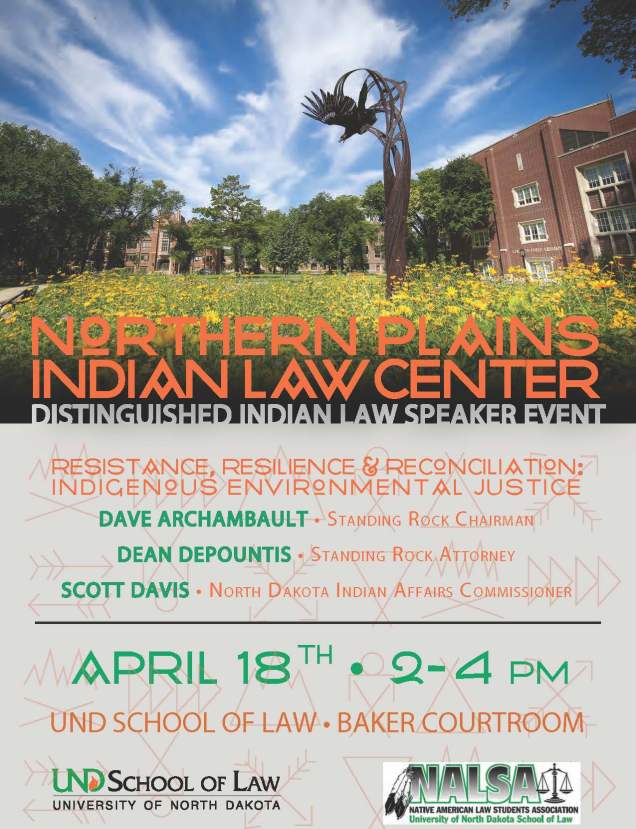
UND Law to Host “Resistance, Resilience & Reconciliation: Indigenous Environmental Justice” April 18, 2017

Here (PDF):

School of Law DAPL Panel