Here.
42.753552
-84.466289
Here.
Here:
Native Wholesale Supply v Wasden Cert Petition
1. Whether under circumstances in which a State is admittedly precluded from regulating an Indian it is also precluded from regulating a corporation wholly owned by an Indian and organized under the laws of a federally recognized tribe.
2. Whether, under a State law that purports to give the Attorney General power to “approve” all cigarettes before they may be imported into Idaho, the State of Idaho can prohibit an Indian-owned business on the Coeur d’Alene reservation from importing into that reservation cigarettes that are sold “FOB Seneca Nation” by a company wholly owned by a member of the Seneca Nation and licensed by the Seneca Nation to carry on such trade.3. Whether the State of Idaho’s cigarette-sale statutes are preempted to the extent that they are enforced in a manner that prohibits Native Wholesale Supply Company (“NWS”) from trading with Warpath Inc. (“Warpath”).
4. Whether the State of Idaho can constitutionally exercise personal jurisdiction over NWS, an Indian-chartered entity located on Seneca Nation of Indians Land, situated within the geographic boundaries of the State of New York, where NWS sells the tobacco products “FOB Seneca Nation” to Warpath, and the products are then transported to Warpath’s place of business on the Coeur d’Alene reservation.
Lower court materials here.
Here:
Wolfchild questions presented:
1. Whether the court of appeals interpretations of statutes specific to the Mdewakanton Band — 1863 Acts, 1888-1890 Acts and 1980 Act: (a) contradict Tohono O’Odham Nation because the court of appeals failed to appreciate that the U.S. Court of Federal Claims (CFC) is to provide a judicial forum for most non-tort requests for significant monetary relief against the United States; (b) contradict Nevada v. Hicks, because the court of appeals opinions, including the Eighth Circuit opinion in Smith v. Babbitt, essentially refer the Mdewakanton Band’s federal claims to tribal courts which lack jurisdiction; (c) contradict Mitchell I, Mitchell II, White Mountain Apache, and Navajo Nation because the court of appeals misinterpreted statutory trust and other legal obligations and failed to properly apply the money-mandating duty requirement; (d) conflict with the First Circuit opinion in Passamaquoddy Tribe because the court of appeals failed to apply the “plain and unambiguous” requirement to the 1980 Act for the purported termination of the Mdewakanton Band and its statutory property rights; and (e) contradict Carcieri because the court of appeals treated the three non-tribal communities as sovereign historical tribes when they are not.
2. Whether the court of appeals’ interpretation of statutes general to American Indians: (a) contradict Oneida I and Oneida II and their progeny because the court of appeals failed to properly interpret the Indian Nonintercourse Act to require Congressional authorization prior to the purported termination of the Mdewakanton Band’s tribal statutory property rights; (b) contradict Carcieri and the 1934 Indian Reorganization Act (IRA) because the court of appeals deemed the purchased IRA lands to be held exclusively in trust for the three post-1934 non-tribal communities; and (c) misinterpreted the six-year statute of limitations and the Indian Trust Accounting Statute (ITAS) to bar the Mdewakanton Band’s monetary claims.
3. Whether summary judgment should have been granted to petitioners on the pre-1980 and post-1980 statutory fund claims and the statutory land claim.
Zephier questions presented:
I. Whether the Federal Circuit’s 2013 holding that a February 16, 1863 Act of Congress, providing that “the Secretary of Interior is hereby authorized to set apart of the public lands . . . eighty acres in severalty” to loyal Mdewakanton Indian individuals, is “too discretionary to support a viable claim,” thereby conflicts with this Court’s and other precedents holding that power given to public officers in permissive form statutory language, but involving individual property rights calling for its exercise, the language used is “in fact peremptory” and money-mandating?
II. Whether the Panel failed to recognize the trust nature of the February 1863 Act in rejecting Petitioners’ “two basic claims” and thus issued a determination that conflicts with a previous authoritative decision in Wolfchild v. United States, 559 F.3d 1228 (Fed. Cir. 2009), which found that the language of the Act of February 16, 1863, Section 9, ch. 37, 12 Stat. 652, “created an inheritable beneficial interest in the recipients of any land conveyed under the statute . . . [and] explicitly created a trust relationship” with the Federal Government?
III. Whether the Secretary of Interior’s 1865 actions “invoking the land-allocating authority of the two 1863 Acts” created an equitable estoppel against the Government, conflicting with the 2013 Panel’s conclusion that “those 1865 actions . . . cannot support a timely claim for relief?”
IV. Whether the Panel erred in failing to find an actionable violation of the 1851 and 1858 treaties between the Government and the loyal Mdewakanton by the Government’s failure to fully implement Section 9 of the Act of February 16, 1863?
Lower court materials here.
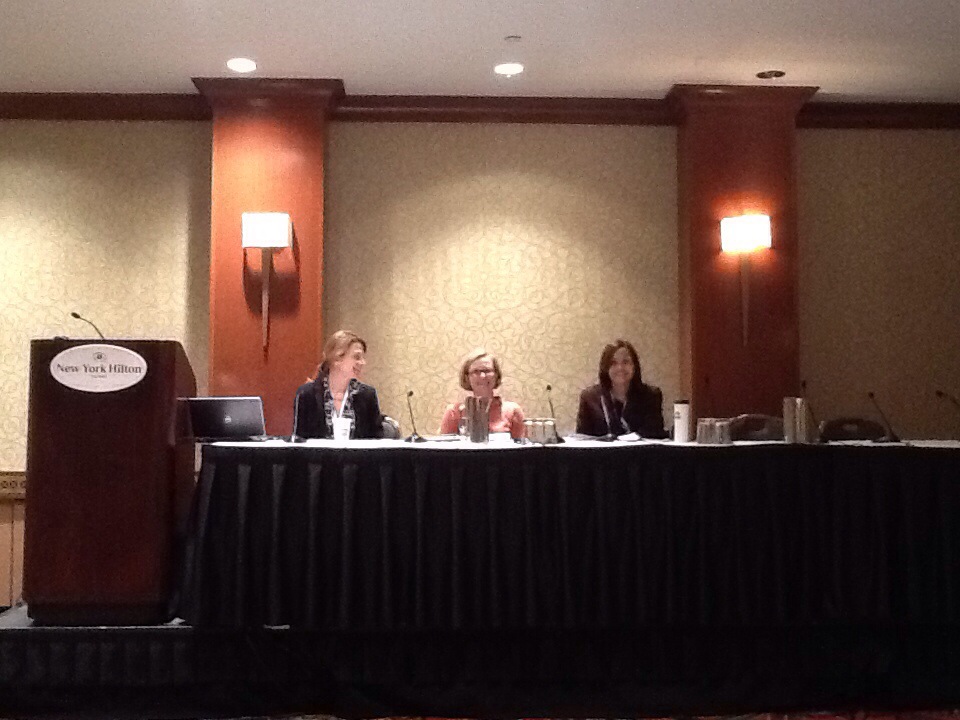
Bethany Berger, our own Kate Fort, and Solangel Maldonado
Here.
Here.
“The Roberts Court has lost faith in the democratic process,” Professor Karlan wrote, noting that the conservative justices, at least in practice, reject the idea that the political branches have a “special institutional competence” in addressing certain questions. In his argument in the voting-rights case, Solicitor General Donald Verrilli tried this line, too, insisting on “the deference that Congress is owed… because, frankly, of the superior institutional competence of Congress to make these kinds of judgments.” This is probably a losing proposition on its face, unless one is talking about Congress’s superior competence at walking in circles with its shoes tied together. But when the legislative branch is not only disrespected but disabled—when the Court waves away the intent of Congress and takes away its tools to redress social and economic inequities—then Congress may well go to hell, and we’re going with it.
The post does not mention federal Indian law, or Adoptive Parents v. Baby Girl, or the oral arguments in the Bay Mills case, the inclusion of which would only make the argument stronger. And is yet another in a long list of reasons why this Court is no friend to Indian tribes.
My read of the transcript is below. Same disclaimers as always — I wasn’t there; cold transcripts are treacherous; and, especially, none of this means anything if it isn’t in the majority opinion.
State’s Main Argument
As has become the norm in Indian law arguments, Justice Sotomayor opened with an initial flurry of questions to State’s counsel, a discussion that went on for some time (page 3 line 25 through page 6 line 20). She wondered why the State was the petitioner here when the district court expressly did not include the State in the denial for an injunction against the Vanderbilt casino (it was a motion by the Little Traverse Bay Bands of Odawa Indians instead), a point made by the National Congress of American Indians. The State’s response was fairly weak — the parties (and it turns out, perhaps, the CA6) merely “assum[ed]” the State and LTBB’s claims were consolidated. Moreover, Justice Sotomayor’s questions delayed the State’s wish to proceed directly to a discussion of tribal immunity by several minutes.
Justice Ginsburg further delayed the State (page 5 line 5 through page 8 line 18) by wanting to know why the State did not choose to invoke the dispute resolution mechanism in the 1993 gaming compact with Bay Mills, especially as Justice Kagan later noted the Court had previously held in C&L Enterprises that an arbitration provision can effectuate a waiver of tribal immunity. From page 8 line 19 to page 9 line 7, the Chief Justice wanted to know why the State raised its own immunity when BMIC sued for a declaratory judgment on the merits of the Vanderbilt casino theory. The State’s blithe(?) response was “all roads lead to tribal immunity.”
Justice Sotomayor finally got the argument into important ground by asking about Ex parte Young, which prompted the State to explain why federalism principles justified the procedural posture of this case (page 9 line 8 through page 12 line 15). First, this initial colloquy:
JUSTICE SOTOMAYOR: All roads lead to one issue, I think. If you had gotten a declaratory judgment, they would have had to stop their gaming activity.
MR. BURSCH: No.
JUSTICE SOTOMAYOR: But you wouldn’t have gotten their property; isn’t that what this suit is about, you trying to take over the –the casino?
MR. BURSCH: No, we don’t want to take over the casino. We want to stop illegal gaming on lands subject to Michigan’s exclusive jurisdiction.
JUSTICE SOTOMAYOR: So why not Ex Parte Young?
The State’s answer is quite silly — and what is getting picked up in the newspapers and perhaps some Justices gaoing all the way back to Kiowa itself — if France or Haiti opened a casino in Michigan then the State would be able to sue those foreign nations to get relief, but for some unexplained reason not Indian tribes (page 10 line 17 through page 17 line 21). I don’t believe the State ever explained why Ex parte Young is insufficient to shut down off-reservation gaming under the tribe’s MILSCA theory. The State wants to win by limiting or modifying Kiowa Tribe, rather than win with Ex parte Young (page 17 lines 15-23):
JUSTICE GINSBURG: But once the Congress didn’t respond, the majority opinion in Kiowa –I don’t know whether it’s “Kiowas” or “Kiowa” –said, you know, this is an unfortunate result, but Congress can do something about it. Well, now Congress hasn’t done anything about it, and you are asking this Court essentially to modify the –that precedent.
MR. BURSCH: I am. I mean, I don’t think you need to modify it.
Justice Alito kicked off another almost morbid series of colloquies that bled into the Tribe’s argument time about whether the State could arrest tribal officials, employees, and casino patrons, and prosecute them on page 18 line 9.
A largely irrelevant point to this case, but perhaps more important to the six tribes (including BMIC) now negotiating with the State over class III gaming, the State made a concession:
JUSTICE ALITO: It seems to me if a tribe wants to open a casino and the State has to –it has to have a compact with the State. Isn’t all the bargaining power on the –on the side of the State? So the State says, fine, if you want to do that, you have to waive sovereign immunity.
MR. BURSCH: Well, we had a compact in place in 1993 that limited their casinos so that this wouldn’t happen.
JUSTICE ALITO: Well, I –but I mean, when will –when will this compact expire?
MR. BURSCH: Right. Let me give you a very practical answer to that question. This compact in 1993 had a 20-year term on it. And so it essentially expired at the end of –of November, just a few days ago, although it has an evergreen clause that allows it to continue while the parties try to negotiate a new compact. And As you would imagine, the very first thing Michigan asked for in its proposed amended compact was to waive tribal sovereign immunity to deal with issues like this. And, unsurprisingly, the tribe said: We’re really not interested in that; we kind of like the way the sovereignty issue is preserved in the existing compact.
***
JUSTICE ALITO: So the compact has expired and there’s –so then how can they operate the casino?
MR. BURSCH: Well, it hasn’t expired. Until the parties –
JUSTICE ALITO: Until they reach a new compact, it continues.
MR. BURSCH: Until they reach a new compact, it continues in effect.
Near the end of the State’s time, Justice Sotomayor redirected the argument at least obliquely to an important issue raised by the National Congress of American Indians — why is the NIGC is sitting this one out? (page 22 line 20 to page 24 line 16). Specifically:
JUSTICE SOTOMAYOR: All right. The issue of what constitutes Indian lands is between the Federal government and the Indians pursuant to the land trust settlement, correct?
MR. BURSCH: I disagree with that because –
JUSTICE SOTOMAYOR: Well, I know you do and I know why you do. But –but what defines the lands is the settlement trust, correct?
MR. BURSCH: Federal court interpretation of the Michigan Indian Land Claims Settlement Act, yes, would determine the status of these lands. The reason why it’s not just between the tribe and the Federal government is because Michigan has a huge interest in having lands that aren’t currently under its exclusive sovereign jurisdiction be determined to be Indian lands –
One wishes Justice Sotomayor had been more direct in her questioning on this point, but the point was made.
Tribe’s Argument Continue reading
Here.
 Turtle Talk
You must be logged in to post a comment.