Here is the order in State of Washington v. Towessnute:
Here are a couple contemporaneous newspaper accounts:
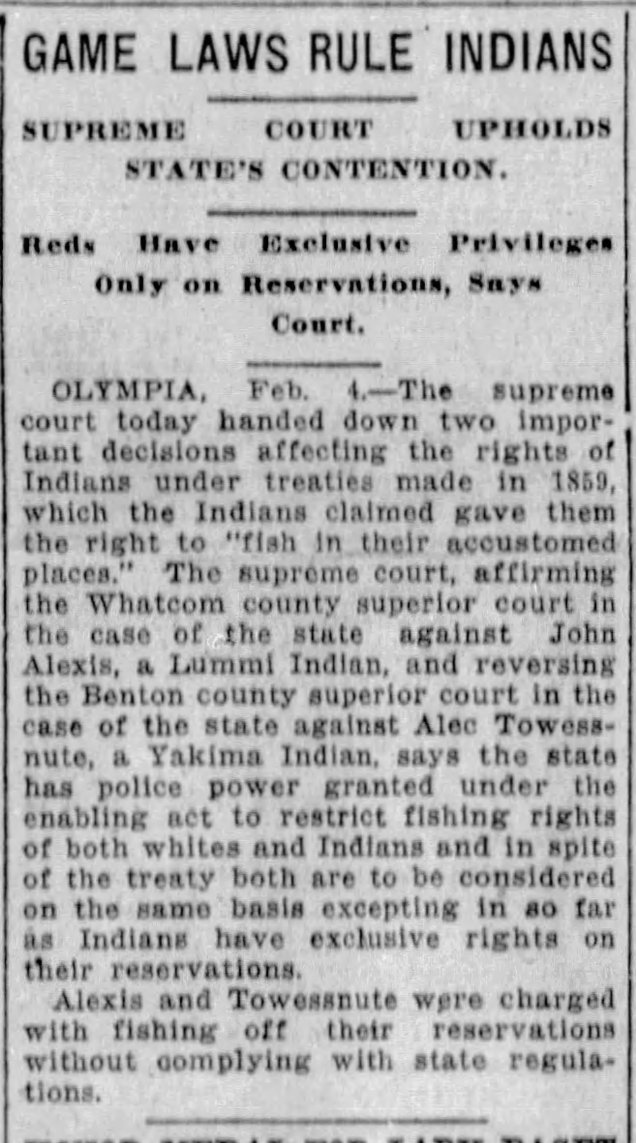
The Spokesman Review, Sat., Feb. 5, 1916
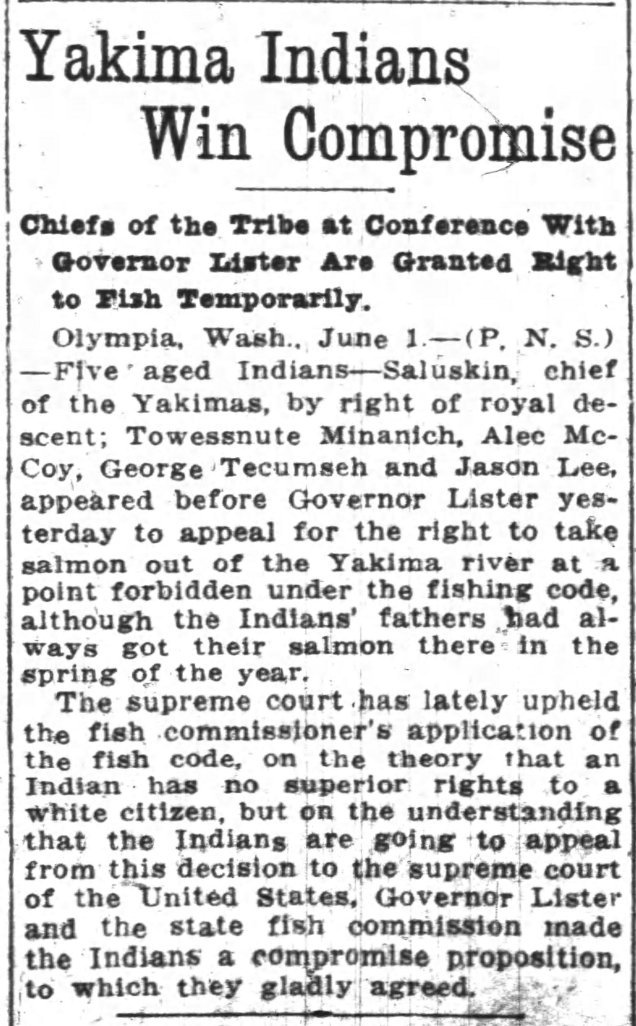
Here is the order in State of Washington v. Towessnute:
Here are a couple contemporaneous newspaper accounts:
The Spokesman Review, Sat., Feb. 5, 1916
ICWA was thereafter applied to the case, but the damage was done — the children were placed in foster care without the normal protections the law would have offered them. Now, the Central Council of Tlingit and Haida Indian Tribes of Alaska are challenging the decision in the Washington State Supreme Court. If the court’s decision is upheld, advocates say the case could significantly weaken the use of ICWA in Washington by raising the bar for what qualifies as a “reason to know” that a child is “Indian” in the eyes of the law.
Kathryn Fort, director of Michigan State’s Indian Law Clinic, who is arguing on behalf of the tribes in the case involving Greer and Graham, says that it shouldn’t be so difficult. The burden of checking in with a tribe is low, she says, but the outcome has immense implications for the family, children and tribe.
Briefing and oral arguments here.
Here is the opinion in Confederated Tribes and Bands of the Yakama Nation v. Yakima County:
Here is the brief in Garfield County v. State of Washington (Wash. S. Ct.):
This is the appeal of the court of appeals opinion posted here.
Oral arguments here
Briefs:
The MSU ICWA Appellate Project co-represented the Tribes in this case, along with the Center for Indigenous Research and Justice.
Here are the materials in Robbins v. Mason County Title Insurance Co.:
Mason County Title Opening Brief [COA]
Mason County Title Petition for Review
Here is the link.
Congrats to Justice Montoya-Lewis!
Justice Montoya-Lewis was appointed to the state bench first in 2014.
Here is the order. The amendment:
(d) Communication Between Superior Court of Any County of this State and Indian Tribal Court.
(1) A superior court of any county of this state may communicate with any Indian tribal court concerning co-occurring proceedings, whether they are active or have been concluded. The parties shall provide to the respective courts the identity, contact information, and a case or docket number of the other court’s proceedings to facilitate this communication.
(2) The superior court may allow the parties to participate in the communication. If the parties are not able or allowed to participate in the communication, they shall be given an opportunity to present facts and legal arguments in writing before a decision is made regarding the communication, or the subject of communication, by the superior court. The Indian tribal court‘s procedures and customs shall determine the parties’ participation in the Indian tribal court proceedings.
(3) The superior court shall make a record of a communication made pursuant to this section. The parties shall be informed promptly of the communication by the superior court and granted access to the record. The Indian tribal court‘s procedures shall determine whether and how a record is made in Indian tribal court proceedings, and whether and how parties may be informed of the communication or granted access to a record of the communication.
(4) Except as otherwise provided in subsection (3) of this section, communication between the superior court and the Indian tribal court regarding scheduling, administrative or emergency purposes, and similar matters may occur without informing the parties. The superior court need not make a record of the communication under this section. The Indian tribal court‘s procedures shall determine whether and how a record is made in Indian tribal court proceedings of such communication.
(5) For the purposes of this section, “record” means information that is inscribed on a tangible medium or that is stored in an electronic or other medium and is retrievable in perceivable form.
(6) The superior court shall follow the procedures set forth in subsection (3) of this section when communicating regarding adult criminal matters, except as otherwise authorized by law. The Indian tribal court‘s procedures shall determine the requirements for communication regarding adult criminal matters in Indian tribal court proceedings. Superior courts and Indian tribal courts may communicate about the orders prohibiting contact as set forth in subsections (1) – (5) above.
 Turtle Talk
You must be logged in to post a comment.