Friday Job Announcements

To post an open Indian law or leadership job to Turtle Talk, send the following information to indigenous@law.msu.edu:

  1. In the email body, a typed brief description of the position which includes
    • position title,
    • location (city, state),
    • main duties,
    • closing date,
    • and any other pertinent details such as links to application;
  2. An attached PDF job announcement.

Three Affiliated Tribes Tribal Administration Headquarters

Staff Attorney, New Town, ND. Provide legal advice and counsel to the Three Affiliated Tribes, The Tribal Business Council and all Tribal Programs, entities and sub-divisions of the Tribes, including but not limited to representation before Tribal, Federal & State Courts and Administrative agencies. Review, drafting, and negotiation of contracts, including PL 93-638 Contracts with Governmental Agencies and other outside Agencies. For more information please see the job description. Application here. Application is open until filled.

UCLA Law

Richard Taylor Law Teaching Fellowship, 2021-2023. Applicants who intend to pursue a career as an assistant professor of law are invited to apply if their research interests concern topics at the intersection of race/racism, sexual orientation, and gender identity. The law teaching fellowship programs of Williams Institute and Critical Race Studies Program at UCLA Law are some of the oldest in the nation. For more information and to apply, please click here.

Quinault Indian Reservation

RFQ. The Quinault Indian Nation in Taholah, Washington is seeking a Chief Judge for the Quinault Tribal Court. Please see the detailed RFQ document for proposal qualifications and requirements. Proposals must be submitted by October 9, 2020. Anticipated start date will be early January, 2021. Proposals and/or questions about the RFQ should be submitted to lbruner@quinault.org.

Office of the Attorney General for the Mississippi Band of Choctaw Indians

Staff Attorney, Choctaw, MS. Under the direction of the Tribe’s Attorney General, the Staff Attorney is responsible for providing general legal services for the tribal government and representing the Tribe in various criminal and civil actions in tribal, state, and federal courts. This position is open until filled. The Tribe’s Employment Application can be found at http://www.choctaw.org/government/services/employment.html

Earthjustice

Staff Attorney, Fossil Fuels in Chicago, IL. See a brief description below. Earthjustice’s Fossil Fuels Program is hiring a Staff Attorney to join us in using the power of the law to protect communities and our environment from an onslaught of new oil and gas development. We use litigation, administrative advocacy, and partnership to advance an end to U.S. oil and gas extraction and production, and stop new infrastructure (e.g. petrochemical facilities, export terminals and pipelines). The Staff Attorney will focus on challenging upstream and new and expanding fossil fuel infrastructure development with an emphasis on the Ohio River Valley in Appalachia.  

See posts from September 4, 2020.
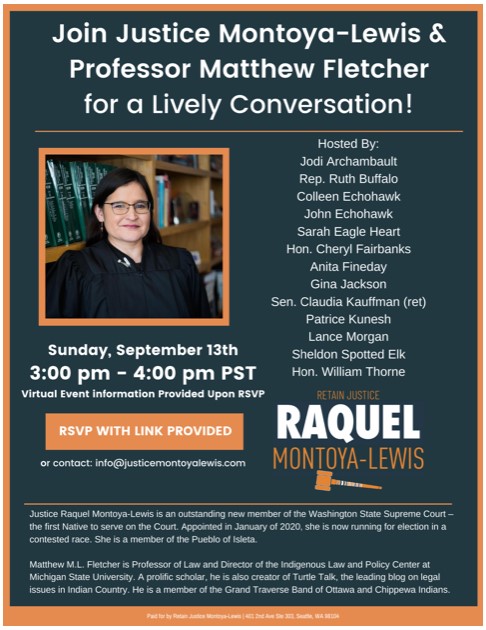
Important Reminder: Please Register for the Conversation between Justice Montoya-Lewis and Fletcher THIS SUNDAY

Register here:

Montoya-Lewis & Fletcher Flyer

Kronk Warner & Tanana on McGirt and Energy Development

Elizabeth Ann Kronk Warner and Heather Tanana have posted “Indian Country Post McGirt: Implications for Traditional Energy Development and Beyond” on SSRN.

The abstract:

The decision in McGirt v. Oklahoma is being heralded as the most important Indian law decision of the last 100 years, as it affirmed the reservation boundaries of the Muscogee (Creek) Reservation – an area long considered by many to be under Oklahoma’s jurisdiction. Yet, following release of the Court’s decision, the outcry from the oil and gas industry was almost instantaneous, as roughly twenty five percent of Oklahoma’s oil and gas well and sixty percent of its oil refineries are impacted by the Court’s decision. Additionally, the territory affected by the Court’s decision also includes pipelines crucial to the successful operation of the nationwide Keystone XL pipeline. While the Court was clear that its holding was limited to criminal jurisdiction under the Major Crimes Act, the decision nonetheless has broader implications for Indian country, including natural resource development and regulatory framework. Because the oil and gas industry will now have to work with tribes and the federal government instead of favorable state officials, industry officials decry the Court’s decision as being detrimental to the industry. But what exactly will be the impact of the Court’s McGirt decision on the oil and gas industry, and the natural resources development in Indian country more broadly? While the full impacts of the Court’s decision are only beginning to unfold, this Article seeks to answer the questions left hanging by the Court’s decision as they relate to traditional energy development. This Article explores the future impacts of the McGirt decision on traditional energy development. The second Part of the article summarizes the legal background that governs oil and gas development in Indian country. Part three provides an in-depth analysis of McGirt—first, describing its predecessor, Sharp v. Murphy, followed by an explanation of McGirt and its holding. The article concludes by discussing future implications of McGirt, including what it means for oil and gas development going forward as well as collateral effects. The article constitutes an important scholarly contribution as it answers important questions left open after the Court’s decision and explains how the Court’s decision has broader implications for Indian country and natural resource development generally.

Shawnee Challenge to CARES Act Distribution Formula Dismissed

Here are the materials in Shawnee Tribe v. Mnuchin (D.D.C.):

45 Motion to Dismiss

46 Opposition

47 Reply

48 DCT Order Dismissing Complaint

Prior post here.

Ann Tweedy on the Impact of the McGirt Decision

Ann Tweedy has posted “Has Federal Indian Law Finally Arrived at ‘The Far End of the Trail of Tears’?”, forthcoming in the Georgia State University Law Review, on SSRN.

Here is the abstract:

This essay examines the United States Supreme Court’s July 9, 2020 decision in McGirt v. Oklahoma, which held that the historic boundaries of the Creek reservation remain intact, and argues that the decision likely signals a sea change in the course of federal Indian law of the magnitude of Obergefell v. Hodges in the LGBT rights arena. The essay shows how the opinion lays a very strong foundation for a much-needed return to traditional federal Indian law principles, respectful treatment of tribal governments as a third sovereign in the American system, and an understanding of fairness from the perspective of tribes and Native individuals. The essay concludes with the hope that Justice Gorsuch’s majority opinion will foster predictability in the wildly unstable area of disestablishment and diminishment jurisprudence, as well as in other facets of federal Indian law.

D.C. Federal Court Instructs Sho-Ban Tribe to Seek Idaho Federal Court Review of Claims the U.S. Violated a Trust Breach Settlement Agreement

Here are the materials in Shoshone-Bannock Tribes of the Fort Hall Reservation v. Bernhardt (D.D.C.):

84 Settlement Agreement

90 Tribe Motion to Clarify

95 Federal Opposition

98 Reply

103-1 Tribe Motion to Enforce Settlement Agreement

104 Federal Opposition

105 Reply

109 DCT Order

And here are related materials in Shoshone-Bannock Tribes of the Fort Hall Reservation v. United States (D. Idaho):

21 Amended Complaint

41 US Motion to Dismiss

59 DCT Order Issuing Stay

Tenth Circuit Decides Hackford v. State of Utah [nonmember Indian traffic ticket]

Here is the unpublished opinion in Hackford v. State of Utah:

Opinion

Briefs:

Hackford Brief

State Brief

Uintah Brief

This Hackford has been before the Tenth Circuit several times before, here, here, and here.

Alaska Native Tribe Sues Interior over Opening Up Coastal Plain to Drilling

Here is the complaint in Native Village of Venetie v. Bernhardt (D. Alaska):

1 Complaint

Nottawaseppi Huron Band of the Potawatomi Sue Vaping Companies

Here is the complaint in Nottawaseppi Huron Band of the Potawatomi v. Juul Labs Inc. (N.D. Cal.):

1 Complaint

Stephanie Barclay & Michalyn Steele on Indian Sacred Sites

Stephanie H. Barclay & Michalyn Steele have posted “Rethinking Protections for Indigenous Sacred Sites,” forthcoming in the Harvard Law Review.

Here is the abstract:

Meaningful access to sacred sites is among the most important principles to the religious exercise of indigenous peoples, yet tribes have been repeatedly thwarted by the federal government in their efforts to vindicate this practice of their religion. The colonial, state, and federal governments of this Nation have been desecrating and destroying Native American sacred sites since before the Republic was formed. Unfortunately, the callous destruction of indigenous sacred sites is not just a troubling relic of the past. Rather, the threat to sacred sites and cultural resources continues today in the form of spoliation from development, as well as in the significant barriers to meaningful access indigenous peoples face.

Scholars concerned about government failure to protect indigenous sacred sites have generally agreed that the problem stems from the unique nature of indigenous spiritual traditions as being too distinct from non-indigenous religious traditions familiar to courts and legislators and therefore eluding protection afforded to other traditions. By contrast, this Article approaches the problem from an entirely different angle: we focus instead on the similarities between government coercion with respect to indigenous religious exercise and other non-indigenous religious practices. We illustrate how the debate about sacred sites unwittingly partakes of longstanding philosophical debates about the nature of coercion itself—a phenomenon that has previously gone unnoticed by scholars. This Article argues that whether or not one formally labels the government’s actions as “coercive,” the important question is whether the government is bringing to bear its sovereign power in a way that inhibits the important ideal of religious voluntarism—the ability of individuals to voluntarily practice their religious exercise consistent with their own free self-development. Indeed, this is precisely the sort of question courts ask when evaluating government burdens on non-indigenous religious exercise. The failure to ask this same question about voluntarism for indigenous religious practices has created a double standard, wherein the law recognizes a much more expansive notion of coercion for contexts impacting non-indigenous religious practices, and a much narrower conception of coercion, in the tradition of Robert Nozick, when it comes to indigenous sacred sites.

This egregious double standard in the law ought to be revisited. Doing so would have two important implications. First, when coercion is viewed clearly, tribal members and indigenous practitioners should be able to prove a prima facie case under statutes like the Religious Freedom Restoration Act (RFRA) much more easily. Second, this Article makes the novel claim that clearer understanding of the coercive control government exercises over sacred sites should animate a strong obligation under the government’s trust responsibility and plenary power doctrine to provide more—rather than less—robust protection of indigenous sacred sites.

Highly recommended!!!