Here is the unpublished opinion in Anchorbilt Inc. v. Arviso Construction Company Inc.:
Here is the unpublished opinion in Anchorbilt Inc. v. Arviso Construction Company Inc.:
Here is the petition in Flying T Ranch Inc. v. Stillaguamish Tribe of Indians:
Question presented:
Under the immovable-property rule, may a party sue an Indian tribe, without the latter’s consent, in a State court to quiet title to real property located in that State but which is not within the boundaries of the tribe’s reservation and is not held in trust by the United States?
Lower court materials here.
Marissa Uri has published “Rule 19 and Tribal Representation in Indian Gaming Litigation” in the Stanford Law Review.
Here is the abstract:
Since 1988, when Congress passed the Indian Gaming Regulatory Act (IGRA) into law, many Indian tribes have established gaming as a vital source of economic and political sovereignty. The process envisioned by IGRA, however, has allowed private actors to challenge tribal gaming operations by suing state and federal entities that negotiate the gaming operations with the tribes, rather than the tribes themselves. These third parties have succeeded in legal challenges enjoining tribal gaming without ever making the operating tribe a party to the suit.
Tribes, protected by the well-established doctrine of tribal sovereign immunity, frequently intervene in these suits under Rule 19, arguing that their inability to be joined necessitates dismissal of the case. An emerging disagreement among federal circuit courts underscores the procedural and practical difficulties that courts face in weighing these interests, particularly in assessing whether existing federal or state defendants can adequately represent absent tribal interests such that the case can proceed “in equity and good conscience.” This Note argues that consistent with the deference under Rule 19 case law accorded to other sovereigns, there should be a presumption of dismissal when tribes cannot be joined in discrete gaming challenges due to tribal sovereign immunity. In doing so, this Note examines Indian gaming challenges as a unique form of Administrative Procedure Act litigation and catalogs where federal, state, and tribal gaming interests diverge, underscoring why this divergence poses significant legal and practical threats to tribal sovereignty in a budding area of contemporary Indian law.
Trudel Pare has published “Ensuring Sovereignty in Healthcare: A Comparison of Tribal Healthcare Compacts and Medicaid” in the Yale Law Journal.
Here is the abstract:
This Note examines federal-state and federal-tribe relationships through a comparison of Medicaid and the Indian Health Service (IHS). Analysis of tribal contracting and compacting documents and Medicaid state plans reflects the history of each program: Medicaid is a product of trusting federal-state collaboration, while the IHS reflects a history of distrust between tribes and executive-branch agencies in particular. This finding suggests that IHS compacting and contracting practices have significant lessons for Medicaid as the latter program negotiates with a hostile federal government.
Here are new materials in Bad River Band of Lake Superior Chippewa Indians v. Enbridge Energy Company (W.D. Wis.):
Crispin T. South has published “Let Them Be Tribal Members: Exempting Nonmember Resident Indians from State Taxes” in the Arizona State Law Journal. Here is the abstract:
Under McClanahan v. Arizona State Tax Commission, States are categorically preempted from taxing the income of an Indian who lives within his own Tribe’s reservation and gains his income from reservation sources. Later cases have distinguished McClanahan, holding that the income of Indians who live and work within a different Tribe’s reservation is generally taxable by the State. State income taxation of these non-member resident Indians poses a number of problems for individuals, Tribal governments, and tribal sovereignty as a whole. This Comment argues that to push back against these problems, Tribes ought to enter into membership reciprocity agreements that allow non-member resident Indians to become Tribal members, thus exempting them from state income taxes under McClanahan’s categorical rule.
Emiliana Almanza Lopez has published “Tribal Sovereignty, Sales Tax, and States Interference: Why Tax Compacts May Be the Best Way Forward” in the Minnesota Journal of Law & Inequality. Here is the abstract:
Tribes as sovereigns have the power of taxation. When states seek to impede this power by imposing their own taxes on non-member transactions on Reservations, Tribes must decide if imposing their own Tribal tax outweighs the risk of increased prices deterring business and business partnerships. This is the issue of double taxation. This Note investigates paths of remedy that address the burden of double taxation specific to sales taxes. Specifically, it looks at tax preemption, litigation, and policy. Preemption is difficult, and the existing case law framework on state tax preemption in Indian Country is complex, fact specific, and generally favors the state. Current federal policies fail to address this issue, and states are unlikely to preempt their own taxes without gaining something in return. Tribe-state tax compacts offer a compromise that releives some of the burden borne by Tribes, but also requires concessions. This Note argues that while imperfect, these tax compacts may be the best remedy to double taxation in Indian Country and offers suggestions for how these binding agreements between sovereigns can be used to enforce state respect for Tribal sovereignty.
A Resource for Indian Country: Coalition for Tribal Sovereignty
What is the Coalition for Tribal Sovereignty?
Launched in early 2025, the Coalition for Tribal Sovereignty (CTS or Coalition) is a nonpartisan collaboration of nearly 40 inter-Tribal, policy-focused, non-profit organizations from across the United States. CTS’s member Tribal organizations regularly engage on coordination at the national and regional levels to support Indian Country with tools to use when interacting with the Trump Administration and others about the Administration’s policy initiatives, with the goal to get those tools into as many Tribal advocates’ hands as possible.
While member organizations continue their own advocacy and education efforts, CTS compliments those efforts by interfacing collectively with federal officials in the Administration and on the Hill regarding actions taken by the Trump Administration. CTS offers a space and platform for Tribal organizations to build consensus on key messaging and legal arguments, allowing CTS to speak with a single powerful and consistent voice. To learn more, visit our website at CoalitionForTribalSovereignty.Org.
What Tools Has CTS Created?
Access the Meeting Materials Toolkit here. The materials can be downloaded as individual documents or in a single toolkit PDF.
The Federal Grand Termination Toolkit is available for download as part of the password protected page on the CTS website. Please email info@CoalitionForTribalSovereignty.org for the access password. Please see the access page here.
These materials are available for download as part of the password protected page on the CTS website. Please email info@CoalitionForTribalSovereignty.org for the access password. Please see the access page here.
Why Now? The Coalition exists for one core purpose: to support Tribal Nations and Tribal organizations as they defend Tribal sovereignty and trust and treaty rights amid rapid and sometimes harmful impact of policy changes. In response to new executive orders, funding shifts, agency actions, and more that often overlook Tribal Nations’ sovereignty, the government‑to‑government relationship, and trust and treaty obligations, Tribal‑serving organizations came together to ensure Indian Country’s rights and status are respected and protected. By uniting local, regional, and national advocates who had previously been working in silos, the Coalition provides coordinated, proactive advocacy so that fast‑moving federal decisions do not erode Tribal Nations’ inherent sovereignty or the trust and treaty rights on which our communities rely.
What is Our Topline Message? CTS educates the Administration on why programs serving Indian Country are not like other federal programs because: (1) they deliver on the United States’ trust and treaty obligations to Tribal Nations, Tribal citizens, and Native communities, for which we prepaid with our lands and resources; and (2) the U.S. Supreme Court has said United States actions that deliver on trust and treaty obligations are not unconstitutionally race-based but are instead political in nature. CTS works to engage with the Administration on why and how it should insulate Indian Country from the disproportionate and potentially unintended negative impacts of its policy actions, while also finding opportunities to work with the Administration to pursue important shared priorities.
How Do I Access CTS Tools? To learn more about CTS and to access our material, please visit CoalitionForTribalSovereignty.Org. To subscribe to our newsletter, visit https://coalitionfortribalsovereignty.org/coalition-action-center/contact-us/. You can reach the CTS team, including to request the website password, by emailing info@coalitionfortribalsovereignty.org.
Here.
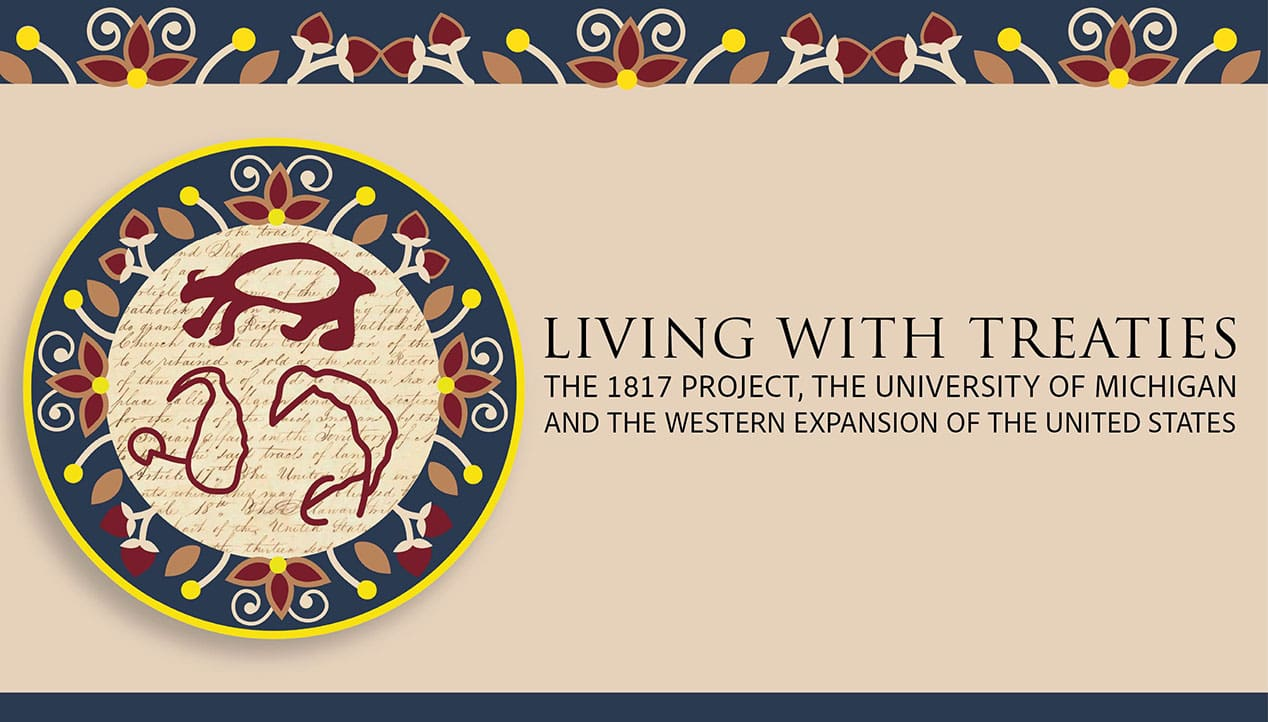
Join us April 9-11, 2026, for Living with Treaties: The 1817 Project, the University of Michigan, and the Western Expansion of the United States. This conference will explore the role of treaties in the development of both the University of Michigan and the state of Michigan, while considering how their effects continue to resonate locally, regionally, and nationally today for an Indigenous present and future.
The conference will bring together members of Anishinaabe Tribal communities; U-M faculty, staff, and students; K-12 educators; scholars; tribal historians; and community activists for roundtable discussions, panels, and workshops that aim to inform and connect with non-specialist audiences.
Conference sessions will focus on key themes that include the role of treaties in the founding and development of the University of Michigan, such as the 1817 Treaty of Fort Meigs; the ongoing impact of 19th-century treaty agreements on tribal communities in the region; and the ways in which these treaties continue to shape contemporary Native activism and legal efforts. Discussions will also explore the broader histories of colonization and Indigenous dispossession across what is now the state of Michigan and the Midwest region of the U.S, with an eye to how local and regional histories provide valuable insights into broader national patterns.
The conference is free and open to all, and will be livestreamed and recorded. Registration is encouraged but not required. We will send out reminder emails and event updates when you register.
The Living with Treaties: The 1817 Project, the University of Michigan, and the Western Expansion of the United States Conference is part of The 1817 Project: Land, Culture, Memory, and Repair, one of the major research initiatives of the University of Michigan’s Inclusive History Project. Led by Eric Hemenway, Bethany Hughes, and Michael Witgen, The 1817 Project is a multi-disciplinary examination of the foundational land transfer by the Ojibwe, Odawa, and Boodewaadamii nations in the 1817 Treaty of Fort Meigs (also known as the Treaty of the Maumee Rapids), which was part of the University of Michigan’s 1817 origins in Detroit and subsequent relocation to Ann Arbor, as well the university’s ongoing connections to Indigenous land and contemporary issues of Native American student experience. Learn more about The 1817 Project.
The Living with Treaties: The 1817 Project, the University of Michigan, and the Western Expansion of the United States Conference is presented by the Inclusive History Project in partnership with the Eisenberg Institute for Historical Studies (EIHS) and with the support of the Bentley Historical Library, Clements Library, the Department of American Culture, the Department of History, the Native American Student Association, the Native American Studies Program, Rackham Graduate School, Penny W. Stamps School of Art & Design, and the University of Michigan Museum of Art (UMMA).
The conference logo was designed by Eva Oldman.
For questions or more information, contact inclusivehistory@umich.edu.
 Turtle Talk
You must be logged in to post a comment.