Here:
Author: Matthew L.M. Fletcher
D.C. Circuit Briefs in Moncrief v. Dept. of Interior/Solonex v. Bernhardt
Sovereignty Symposium XXXII Writing Competition + Scholarships
Here:
Ed Edmondson Scholarship Applications
Susan J. Ferrell Scholarship Contest
Chief Justice John B. Doolin Writing Competition
Sovereignty Symposium XXXII details here.
Federal Court Rejects Last Remaining Claims in Dahlstrom v US [wrongful discharge from Sauk-Siuattle]
Here are the materials in Dahlstrom v. United States (W.D. Wash.):
82 Individual Defs Motion for Summary Judgment
Prior posts here.
Federal Court Makes Indian Country Determination in Criminal Case
Here are the relevant materials in United States v. Coriz (D.N.M.):
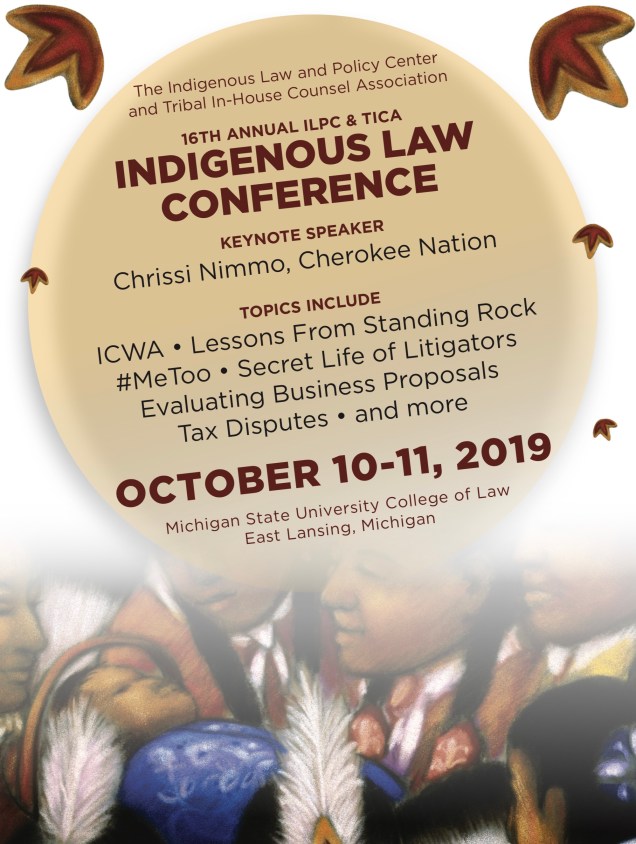
MSU ILPC/TICA Conference Save the Date — Oct. 10-11, 2019
Here:
Bethany C. Sullivan & Jennifer L. Turner on Carcieri
Bethany C. Sullivan and Jennifer L. Turner have published “Enough Is Enough: Ten Years of Carcieri v. Salazar” in the Public Land & Resources Law Review. Here is the abstract:
Ten years ago, the United States Supreme Court issued its watershed decision in Carcieri v. Salazar, landing a gut punch to Indian country. Through that decision, the Supreme Court upended decades of Department of the Interior regulations, policy, and practice related to the eligibility of all federally recognized tribes for the restoration of tribal homelands through the Indian Reorganization Act (IRA) of 1934. The Court held that tribes must demonstrate that they were “under federal jurisdiction” in 1934 to qualify for land into trust under the first definition of “Indian” in the IRA. Carcieri has impacted all tribes by upending the land-into-trust process and requiring tribes (and Interior) to spend scant resources to establish statutory authority for trust land acquisitions, a burdensome task that had previously been straight forward. In addition, Carcieri has complicated, if not prevented altogether, trust acquisition for tribes who face difficulty in making the requisite jurisdictional showing.
This Article provides the first comprehensive analysis of the last ten years of Indian law and policy that have unfurled from the Supreme Court’s decision. It describes how Carcieri has been weaponized by states, local governments, citizens’ groups, individuals, corporations, and even other tribes, to challenge the exercise of tribal sovereignty through the acquisition of tribal lands, and, at times, the very existence of Indian tribes. This Article details the litigation that has since ballooned, illustrating the dangerous scope creep of Carcieri, while categorizing and evaluating the underlying claims. It also looks to the future, and concludes that, while unlikely, a universal, clean congressional fix is the only real solution. The last ten years of litigation, hearings, and never-ending debate demonstrate that Carcieri is not a constructive or appropriate framework for resolving larger policy questions about the land-into-trust process. Finally, the Article ends by providing practice tips for tribes navigating the current Carcieri landscape.
California SCT & COA Materials in Huber Tax Case
Here are the materials in Huber v. People ex rel. Becerra (Cal.):
Huber-Navarro-Petition-for-Review-04-Apr-Apr-2019-STAMPED
And in People ex rel. Becerra v. Huber (Cal. Ct. App.) [we posted materials here]:
Navarro-Appellant’s-Opening-Supplemental-Brief-15-Nov-2018-FILE-STAMPED
Navarro-Appellant’s-Petition-for-Rehearing-09-Oct-2018-FILE-STAMPED
Navarro-Appellant’s-Supplemental-Reply-Brief-06-Dec-2018-FILE-STAMPED
Federal Court Excuses Insurance Company from Tribal Court Jurisdiction
Here are the materials in Employers Mutual Casualty Company v. Branch (D. Ariz.):
Comanche Nation of Oklahoma v. Bernhardt Cert Petition [Chickasaw Gaming]
Here is the petition captioned Comanche Nation of Oklahoma v. Zinke [but presumably will switch to Comanche Nation of Oklahoma v. Bernhardt]:
Companche v Zinke Cert Petition
Question presented:
Whether the “former reservation” exception permitting lands acquired by the United States in trust for an Oklahoma Tribe after the effective date of the Indian Gaming Regulatory Act of 1988 to be devoted to gaming purposes, is applicable to lands not subject to Tribal jurisdiction prior to the acquisition.
Lower court materials here.
 Turtle Talk
You must be logged in to post a comment.